
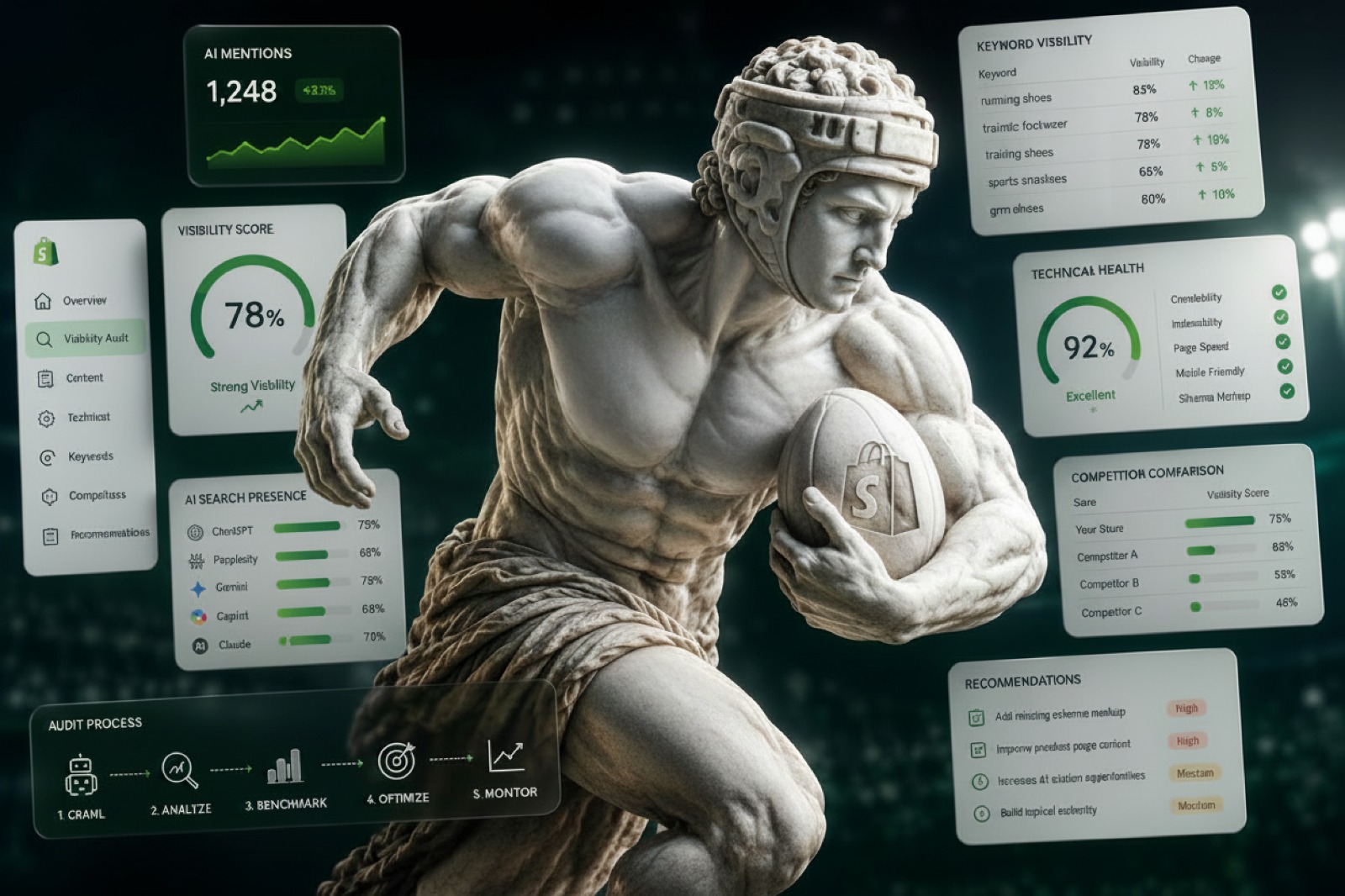
AI Visibility Audit. Your Shopify store can rank on Google and still be absent when shoppers ask ChatGPT, Perplexity, Gemini, or Google AI for product recommendations.
That creates a serious discovery gap. If AI platforms mention competitors but not your store, those brands can enter the customer’s consideration set before the shopper reaches a search results page.
An AI Visibility Audit shows whether AI platforms can find, understand, cite, and recommend your store. It also reveals where competitors are stronger, which sources shape their visibility, and what your team should improve first.
For Shopify brands investing in GEO, the audit turns uncertainty into a clear action plan.
What Is an AI Visibility Audit?
An AI Visibility Audit is a structured review of how a brand appears across AI-powered search and answer platforms.
For a Shopify store, it should answer four questions:
- Does the brand appear for relevant buyer prompts?
- Are its products mentioned or recommended?
- Which pages or third-party sources are cited?
- Where do competitors appear instead?
Traditional SEO tools focus on rankings, impressions, clicks, and traffic. An AI Visibility Audit measures whether the brand becomes part of the generated answer itself.
That makes it an important first step in any GEO for Shopify strategy.
How Traditional SEO and GEO Work Together
SEO and GEO support the same foundation: accessible pages, clear product information, useful content, strong internal linking, and credible authority. GEO builds on strong SEO foundations rather than replacing traditional SEO.
The difference is the outcome being measured. SEO asks whether a page ranks and earns clicks. GEO asks whether a brand is understood, cited, or recommended inside an AI-generated response.
A practical AI SEO for Shopify strategy combines technical SEO, strong product and collection content, structured data, answer-focused pages, external authority, and ongoing visibility tracking. Understanding the GEO ranking factors that influence AI answers helps teams prioritise these areas more effectively.
What Your Shopify AI Visibility Audit Should Cover
| Audit area | What to check |
| Buyer prompts | Category, comparison, problem, alternative, and purchase-intent questions |
| Platform visibility | Brand mentions across major AI platforms |
| Recommendations | Whether the brand is suggested or only referenced |
| Citations | Which pages or third-party sources support the answer |
| Competitors | Which brands appear more often and for which prompts |
| Accuracy | Whether product and brand information is correct |
| Technical readiness | Crawlability, schema, internal links, and duplicate content |
| Content quality | Product details, use cases, comparisons, and FAQs |
| Authority | Reviews, editorial mentions, and community references |
| Measurement | Mention rate, citation rate, recommendation rate, and prompt coverage |
The goal is not to collect endless data. It is to identify the visibility gaps that matter most to revenue and product discovery.
1. Define the Products and Questions You Want to Audit
Do not begin with a branded search such as “What is [brand name]?” That only confirms whether the platform already knows the company.
Start with the commercial areas that matter most:
- Priority products and collections
- High-margin categories
- Customer problems and use cases
- Important comparisons
- Target locations
- Price or delivery concerns
Then create a repeatable set of 20 to 40 prompts.
| Prompt type | Example |
| Category discovery | What are the best Indian coffee brands for home brewing? |
| Problem-solving | Which coffee works for cold brew without tasting bitter? |
| Recommendation | Recommend medium-roast coffee under ₹1,000 |
| Comparison | Brand A vs Brand B for espresso |
| Alternatives | What are the best alternatives to Brand A? |
| Purchase-ready | Where can I buy freshly roasted coffee online in India? |
Use natural customer language. The prompt set should reflect how shoppers research products, not how the brand describes itself internally.
This gives you a realistic view of Shopify AI visibility across discovery, evaluation, and purchase intent.
2. Test the Same Prompts Across AI Platforms
Run the prompt set across the platforms most relevant to your audience, such as ChatGPT, Perplexity, Gemini, Google AI Overviews, Claude, or Microsoft Copilot.
Use a fresh conversation where possible so earlier prompts do not influence the answer.
For each result, record:
- Whether the brand appears
- Which product is mentioned
- Whether it is recommended
- Whether a citation or link is included
- Which competitors appear
- Whether the information is accurate
- The platform and test date
Do not expect identical answers across platforms. Focus on repeated patterns. A single mention may be incidental, but consistent inclusion or exclusion is meaningful.
3. Measure Visibility and Competitor Gaps
Turn the results into a small set of metrics.
Mention rate: The percentage of prompts where the brand appears.
Citation rate: The percentage where the store or a relevant supporting source is cited.
Recommendation rate: The percentage where the brand is actively suggested.
Prompt coverage: The percentage of priority topics where the store has any visibility.
Then compare the store with competitors prompt by prompt.
Look for:
- Questions where both brands appear
- Questions where only competitors appear
- Competitor pages or sources receiving citations
- Product attributes associated with competing brands
- Platforms where the gap is widest
For every missed prompt, ask whether the store has a suitable product, whether the website explains that relevance clearly, and whether credible evidence supports the claim.
A GEO audit tool such as Big Head can help organise prompt results, competitor appearances, and citation gaps once manual tracking becomes difficult.
4. Audit Citations and External Authority
A brand mention is useful, but a supported recommendation is stronger.
When your store appears, identify the source behind the answer. It may be a product page, collection page, buying guide, review platform, publisher article, marketplace listing, founder interview, or community discussion.
Repeat the same review for competitors.
The key question is:
What evidence does the AI platform have for recommending the competitor that it does not have for recommending your store?
Review whether your brand has enough credible and consistent information across the wider web. Focus on reviews, editorial mentions, expert commentary, relevant directories, partner sites, and community discussions.
Weak Shopify AI visibility is often linked to thin or inconsistent external evidence, not only weak on-site content.
This is why Shopify generative engine optimization should include authority-building as well as website improvements.
5. Review Technical Readiness and Shopify Content
Technical SEO is the foundation of AI SEO for Shopify. AI platforms cannot reliably interpret pages they cannot access or understand.
Check the essentials:
- Crawlability, indexation, and canonical URLs
- XML sitemaps and internal linking
- Product schema and duplicate markup
- Accurate price, stock, shipping, and return details
- Broken pages, redirects, and JavaScript-dependent content
Then review the content on priority product and collection pages. Important product details should appear as readable page content rather than only inside images, tabs, or app-generated elements.
Each product page should clearly explain what the product is, who it is for, what problem it solves, how it should be used, what makes it different, and what evidence supports its claims.
Collection pages should provide more than a product grid. Add category context, selection guidance, important differences, use cases, and FAQs where they help the customer.
These generative engine optimization best practices improve both machine understanding and customer decision-making.
6. Turn the Audit Into a Prioritised GEO Plan
An audit should end with actions, not a spreadsheet full of observations.
Group the findings into three areas.
Immediate Fixes
Correct blocked pages, invalid schema, inaccurate product details, broken links, inconsistent brand descriptions, and outdated information.
Content Opportunities
Improve the pages connected to missed prompts. These may include buying guides, product comparisons, alternative pages, collection explanations, use-case content, and FAQs.
Authority Opportunities
Build stronger supporting evidence through credible reviews, publisher mentions, expert commentary, partnerships, directories, and relevant community participation.
Prioritise each task using four factors:
- Commercial value
- Size of the visibility gap
- Strength of competitor coverage
- Effort required
This keeps GEO for Shopify tied to real product discovery opportunities.
When Should You Use a GEO Audit Tool?
A manual audit works well for a small set of prompts. It becomes difficult to manage when the number of products, platforms, competitors, and citations grows.
A GEO audit tool can help teams:
- Discover relevant prompts
- Track brand mentions and recommendations
- Monitor citations
- Compare competitors
- Identify technical or content gaps
- Measure visibility changes over time
The tool should not only provide a score. It should help explain why the store is visible for some prompts and absent from others.
How Big Head Helps Shopify Brands Find Visibility Gaps
Big Head by ShopOS brings prompt tracking, citation analysis, competitor insights, and crawlability checks into one connected workflow.
Big Head is part of ShopOS, an AI agent platform for ecommerce brands. By bringing prompt coverage, citations, competitor insights, and crawlability together in one workflow, it gives Shopify teams a clearer view of what is helping or limiting their AI visibility and which Shopify generative engine optimization actions deserve priority.
How Often Should You Run an AI Visibility Audit?
Run a full audit every quarter and monitor high-value prompts monthly.
Repeat the audit after major product launches, collection updates, website migrations, content releases, or significant changes in brand positioning.
Keep a stable core prompt set so results can be compared over time. Add new prompts only when customer language, product priorities, or market conditions change.
Consistency is one of the most important GEO best practices. Random checks can reveal examples, but they cannot show whether visibility is improving.
Run a free Big Head audit to uncover hidden visibility gaps, understand why competitors appear in AI answers, and identify new opportunities to earn mentions, citations, and product recommendations across AI search.
Final Thoughts
An AI Visibility Audit helps Shopify teams see where their brand is being discovered, where competitors are taking the lead, and which gaps deserve attention first.
The value of the audit is not the score alone. It is the ability to connect missed prompts, weak citations, technical issues, and authority gaps to a practical GEO plan.
Book a demo with ShopOS to see how Big Head can uncover hidden visibility gaps, explain why competitors appear in AI answers, and identify opportunities to earn more mentions, citations, and product recommendations across AI search.
FAQs
What Is an AI Visibility Audit for Shopify?
An AI Visibility Audit assesses whether AI platforms can find, understand, mention, cite, and recommend a Shopify brand for relevant customer questions. It also reviews competitor visibility, technical accessibility, content quality, external authority, and information accuracy.
How Can I Check Whether My Shopify Store Appears in ChatGPT?
Test a consistent set of branded and non-branded buyer prompts in fresh conversations. Record mentions, recommendations, citations, competitors, linked sources, and factual errors. Repeat the process regularly to compare results.
What Does a GEO Audit Tool Measure?
A GEO audit tool can measure prompt-level mentions, citations, recommendations, competitor visibility, source coverage, platform performance, crawlability issues, and changes over time.
Is GEO for Shopify Different From Traditional SEO?
Yes, although they work together. SEO focuses on rankings, impressions, clicks, and organic traffic. GEO for Shopify builds on those foundations and focuses on whether the store is understood, cited, and recommended within AI-generated answers.
Can GEO Best Practices Guarantee AI Citations?
No. GEO best practices improve accessibility, clarity, relevance, and supporting evidence, but AI platforms decide which sources to retrieve and cite.