

- What Is Machine Learning in Ecommerce?
- The Core Framework
- Why Machine Learning in Ecommerce Matters for Modern Brands
- Where Predictive Analytics in Ecommerce Fits In
- What Brand Memory Contains and Why It Matters
- How Machine Learning Supports Ecommerce Workflow Automation
- Practical Ecommerce Examples
- Where ShopOS Fits In
- How Ecommerce Brands Can Prepare for This Shift
- Final Thoughts
- FAQs About Machine Learning in Ecommerce
Machine learning in ecommerce is no longer limited to product recommendations, personalized offers, or search results.
It is becoming part of how ecommerce brands understand customers, improve product content, plan campaigns, and automate daily workflows.
For years, machine learning for ecommerce was mostly seen as a customer-facing technology. It helped brands suggest products, personalize offers, segment customers, and forecast demand.
Those use cases still matter. But the bigger shift is now happening inside brand operations.
Modern ecommerce teams use AI across creative, ads, Shopify, email, SEO, social, growth, and customer experience. The problem is that many AI tools still work separately. One tool writes product copy. Another supports SEO. Another creates ad ideas. Another helps with email.
That can make work faster, but not always better.
The real opportunity is to connect machine learning, predictive analytics, Brand Memory, and workflow automation into one operating layer for ecommerce teams.
This is the larger direction behind ShopOS. Instead of treating AI as a set of disconnected tools, ShopOS works more like an AI platform for ecommerce brands, where different brand workflows can stay connected through shared learning and execution.
What Is Machine Learning in Ecommerce?
Machine learning in ecommerce means using data and pattern recognition to help ecommerce systems improve decisions over time.
Instead of following only fixed rules, machine learning looks at patterns in customer behavior, product data, campaign performance, search activity, purchase history, and operational workflows.
A basic ecommerce rule may show bestsellers to every shopper. A machine learning system can go deeper by understanding what a shopper viewed, what similar customers purchased, which product category they return to, and which offer may be more relevant.
That is why machine learning in ecommerce is used across product recommendations, customer segmentation, personalized offers, predictive analytics in ecommerce, inventory forecasting, campaign optimization, product search improvement, marketing automation, and customer support routing.
But ecommerce brands are now moving beyond isolated use cases.
The next stage is about embedding machine learning into daily workflows so teams can act on insights faster.
The Core Framework
Here is the simplest way to understand how these ideas connect:
Customer Data + Product Data
↓
Machine Learning
↓
Predictive Analytics
↓
Brand Memory
↓
Workflow Automation
↓
Better Ecommerce Execution
Each layer has a role.
Customer and product data show what is happening.
Machine learning finds patterns in that data.
Predictive analytics in ecommerce helps teams understand what may happen next.
Brand Memory adds the brand’s voice, product story, claims, customer objections, campaign learnings, and past decisions.
Workflow automation turns those insights into action.
The outcome is better ecommerce execution. Teams can plan campaigns faster, improve product pages, create more consistent content, update workflows sooner, and make decisions with less manual effort.
This is where ShopOS fits into the bigger picture. It brings these layers together through AI agents for ecommerce, Brand Memory, and ecommerce workflow automation.
Why Machine Learning in Ecommerce Matters for Modern Brands
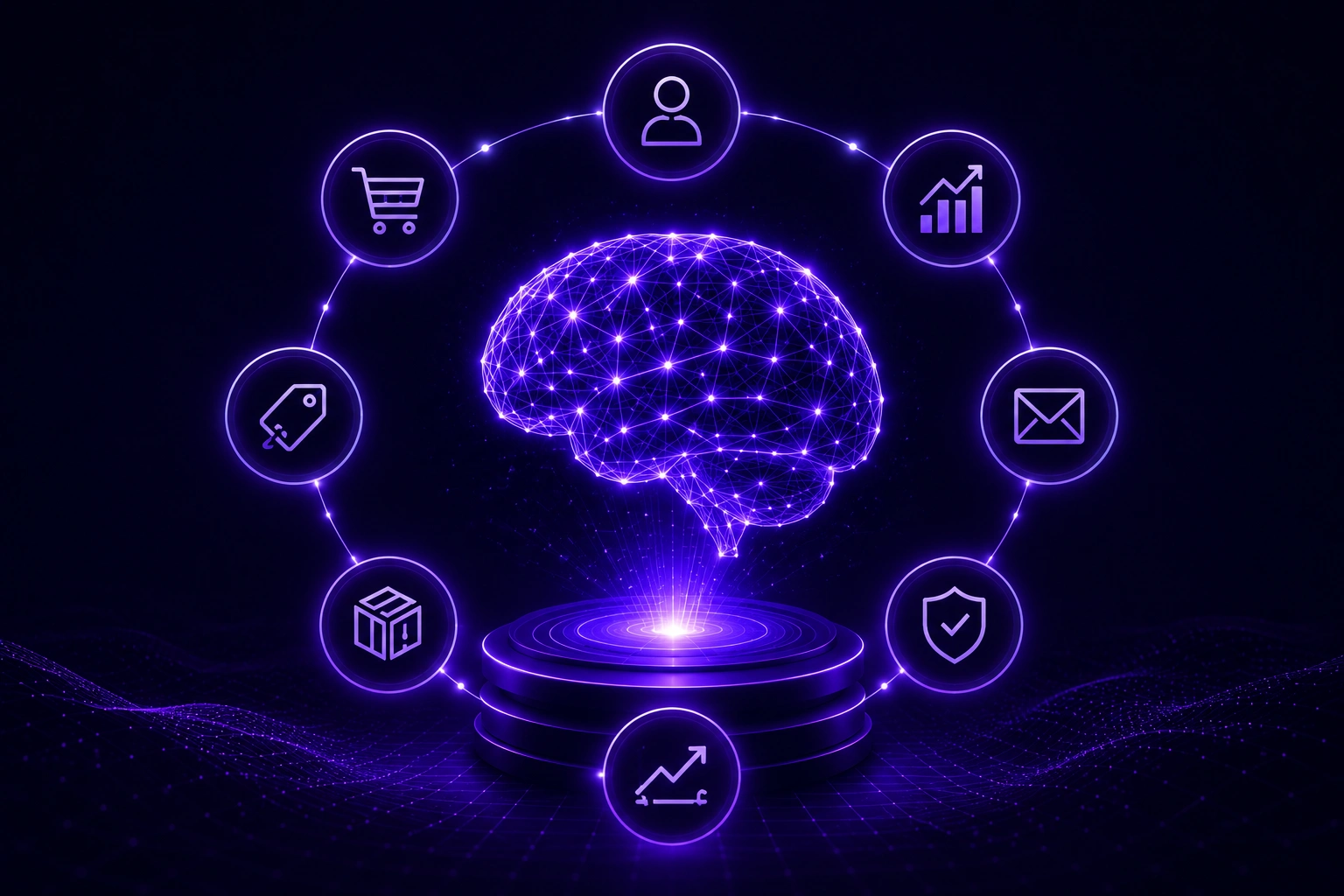
Ecommerce teams manage too many moving parts.
A single product launch may need product page copy, ad creatives, email flows, social posts, SEO content, Shopify updates, FAQs, campaign briefs, and performance reporting.
Without a connected system, every team may create its own version of the same message.
The ad may focus on one benefit.
The product page may highlight another.
The email may use a different angle.
The SEO content may explain the product in another way.
This creates rework, inconsistency, and slower execution.
This is also why the ecommerce tech stack conversation is changing. Brands do not only need more tools; they need tools that work together. The same idea applies when building an AI tools for ecommerce DTC tech stack. The stack is only useful when data, content, customer signals, and workflows can move together.
Machine learning in ecommerce helps brands learn from customer behavior, product performance, and campaign data. But that learning becomes more valuable when it is connected to brand knowledge and daily workflows.
For ecommerce brands, the goal is not only to automate more tasks.
The goal is to make better decisions faster.
Where Predictive Analytics in Ecommerce Fits In
Predictive analytics in ecommerce helps brands use past and current data to estimate what may happen next.
This is important because ecommerce teams often make decisions under pressure.
Which product should be promoted this week?
Which audience should receive the next email?
Which product page needs improvement?
Which campaign angle should be tested next?
Which collection may see seasonal demand?
Predictive analytics can help answer these questions with stronger signals.
For example, a skincare brand may see that hydrating products perform better before winter. Predictive analytics in ecommerce can help the team identify seasonal demand earlier, prepare campaign assets, update product pages, and plan inventory before search interest rises.
An apparel brand may notice that lifestyle-led creative performs better than discount-led messaging for a specific product category. That learning can shape future ad briefs, email campaigns, and social content.
Predictive analytics does not replace strategy. It gives teams better direction before they act.
That direction becomes stronger when it is connected to Brand Memory.
What Brand Memory Contains and Why It Matters

Brand Memory is the stored knowledge that helps AI understand how a brand speaks, sells, explains products, and makes decisions.
A brand’s Brand Memory may include:
- approved claims
- restricted claims
- product positioning
- customer objections
- top-performing campaign angles
- preferred tone of voice
- SEO learnings
- product FAQs
- visual direction
- campaign history
- audience insights
- past creative decisions
- channel-specific rules
This matters because ecommerce content is not only about accuracy. It is also about consistency and brand fit.
For example, a skincare brand may avoid medical claims. A premium fashion brand may avoid discount-heavy language. A food brand may prefer a warm, family-led tone.
If AI does not know these details, teams still spend time rewriting outputs, checking claims, correcting tone, and repeating the same brand rules.
That is why Brand Memory is closely connected to AI-powered brand consistency for ecommerce brands. When the brand’s voice, product story, claims, and campaign learnings are stored in one place, AI can support product pages, ads, emails, SEO content, and social posts with fewer corrections.
If an ecommerce team asks AI to update a product page, the system can use the product story, approved claims, customer objections, SEO learnings, and current campaign angle before suggesting the copy.
This is how machine learning for ecommerce becomes more useful. It does not only read data. It helps teams reuse what the brand has already learned.
How Machine Learning Supports Ecommerce Workflow Automation
Ecommerce workflow automation helps teams reduce manual work across daily brand operations, especially when product content, creative updates, email flows, and campaign assets need to move together.
Traditional automation follows fixed rules. It may send an abandoned cart email after two hours, tag a customer after purchase, publish a product at a scheduled time, or send a review request after delivery.
This type of automation is useful, but limited.
AI workflow automation can support smarter decisions before the task happens.
Instead of only reminding a team to update a product page, an AI workflow can identify that the page is missing key customer questions, has outdated campaign language, and does not explain the main product benefit clearly.
Instead of sending the same email flow to every customer, AI can help identify which customers need education, which need urgency, and which may respond better to bundles.
Instead of only generating ad copy, AI can suggest campaign angles based on product performance, audience behavior, and past creative results.
This is where content and workflow planning start to overlap. For many brands, ecommerce content automation is not only about creating more content. It is about connecting product updates, campaign assets, creative direction, and channel execution in one clearer flow.
That is the difference between basic workflow automation and AI workflow automation.
Basic automation saves time. AI workflow automation helps reduce missed opportunities, improve quality, and keep teams aligned across channels.
Practical Ecommerce Examples
Here are a few ways this can work in real ecommerce teams.
A skincare brand can use predictive analytics in ecommerce to identify rising demand for winter skincare products. The team can prepare product content, offers, FAQs, and campaign assets earlier.
An apparel brand can use past campaign learnings to improve future creative briefs. If lifestyle-led ads perform better for one category, the next campaign can start with that direction.
A Shopify team can use customer questions to improve product FAQs. If buyers repeatedly ask about sizing, ingredients, delivery, usage, or care instructions, that information can improve product pages.
These examples show why machine learning for ecommerce works best when it is connected to workflow automation and Brand Memory.
Where ShopOS Fits In

ShopOS is built around the idea that ecommerce brands need more than disconnected AI tools.
They need a system where AI agents, Brand Memory, and ecommerce workflow automation work together to improve daily execution.
ShopOS brings this into ecommerce operations by helping different brand functions work from the same brand knowledge.
Creative teams need campaign direction and content variations. SEO teams need visibility insights. Shopify teams need product and page updates. Email teams need flows and segmentation. Growth teams need performance learnings.
ShopOS connects these workflows through AI agents built for ecommerce teams.
Monica can support creative workflows by helping brands move from product context to campaign-ready creative direction, product content, and creative variants.
Big Head can support SEO, AEO, and GEO visibility by helping ecommerce brands understand how their product content appears across search engines and AI answer engines.
For teams exploring this search shift, the broader idea of generative engine optimization for ecommerce explains why product pages, FAQs, brand mentions, and structured content now matter beyond traditional SEO.
The value is not only faster output.
The value is reduced rework, stronger brand consistency, faster execution, and better decisions across daily ecommerce operations.
ShopOS is not positioned as another AI tool for one isolated task. It is an AI operating system for ecommerce brands that connects memory, agents, and workflows.
How Ecommerce Brands Can Prepare for This Shift
Before brands use machine learning in ecommerce across workflows, they need to organize the information AI will depend on.
This does not mean building a complicated data system from day one. It means collecting the information that already shapes daily brand decisions.
That includes product data, customer questions, campaign history, product FAQs, approved claims, brand guidelines, SEO learnings, email performance, ad performance, customer segments, and Shopify product information.
The goal is not to make everything perfect before using AI.
The goal is to make the brand easier for AI to understand and support.
Better data improves machine learning. Better Brand Memory improves outputs. Better workflows improve execution.
Together, these help ecommerce brands move from random AI usage to connected AI operations.
Turn Ecommerce Data Into Better Daily Decisions
Machine learning becomes more valuable when customer signals, product knowledge, Brand Memory, and workflows work together.
ShopOS connects AI agents, brand context, and ecommerce workflows so your team can reduce rework, move faster, and make better-informed decisions across channels.
See what connected ecommerce operations can look like for your brand.
Final Thoughts
Machine learning in ecommerce is becoming more important as brands manage more channels, more customer signals, and more content needs.
The early use cases still matter. Recommendations, personalization, segmentation, and forecasting are still valuable.
But the next stage is broader.
Machine learning is now being embedded into Brand Memory and workflow automation so ecommerce teams can work faster, reduce rework, improve consistency, and make better decisions.
Predictive analytics in ecommerce helps teams understand what may happen next. Brand Memory helps AI understand how the brand should act. Ecommerce workflow automation turns that knowledge into daily execution.
This is the system ShopOS is building.
By connecting AI agents, Brand Memory, and AI workflow automation, ShopOS helps ecommerce brands reduce repeated work, keep brand execution consistent, and make faster decisions across creative, SEO, Shopify, email, ads, social, growth, and brand intelligence workflows.
FAQs About Machine Learning in Ecommerce
What is machine learning in ecommerce?
Machine learning in ecommerce means using data and algorithms to help ecommerce systems learn from patterns and improve decisions over time. It can support product recommendations, personalization, predictive analytics, customer segmentation, inventory forecasting, and ecommerce workflow automation.
How is machine learning different from AI in ecommerce?
AI in ecommerce is the broader concept of using intelligent systems to support ecommerce tasks. Machine learning is one part of AI. It focuses on learning from data and improving decisions based on patterns.
What data is required for machine learning in ecommerce?
Machine learning in ecommerce can use customer behavior, product data, purchase history, search queries, cart activity, email engagement, ad performance, inventory data, customer questions, and campaign results.
What is predictive analytics in ecommerce?
Predictive analytics in ecommerce uses past and current data to estimate what may happen next. It can help brands forecast demand, identify customer segments, plan campaigns, improve product pages, and prioritize marketing actions.
How does Brand Memory improve AI outputs?
Brand Memory improves AI outputs by giving AI access to brand voice, product positioning, approved claims, customer objections, campaign learnings, SEO insights, and channel rules. This helps AI create more consistent and useful outputs across ecommerce workflows.
What is the difference between workflow automation and AI workflow automation?
Workflow automation follows fixed rules. AI workflow automation uses data, machine learning, and brand knowledge to suggest smarter next steps. It does not only automate tasks. It helps improve the decision before the task is completed.
Can small ecommerce brands benefit from machine learning?
Yes. Small ecommerce brands can benefit from machine learning by using it for product recommendations, customer segmentation, email planning, product FAQs, campaign analysis, and workflow automation. They do not need massive data systems to start improving daily decisions.
Where does ShopOS fit into machine learning in ecommerce?
ShopOS fits by connecting AI agents, Brand Memory, and ecommerce workflow automation. It helps ecommerce teams use AI across creative, SEO, Shopify, email, ads, social, growth, and brand intelligence workflows while working from shared brand knowledge.