

- Why AI Marketing Content Becomes Generic
- Why Brand Voice Matters When Using AI for Marketing
- Why Context Is the Missing Layer in AI Marketing
- How to Use AI for Marketing Without Losing Brand Voice
- Brand Consistency in Marketing Comes From Workflow, Not Prompts
- AI Marketing for Ecommerce Brands Needs Connected Execution
- Where ShopOS Fits In
- Final Thoughts
- Key Takeaways
- FAQs
AI can help marketing teams move faster.
It can support product pages, ads, emails, social posts, SEO content, launch campaigns, creative briefs, and other daily marketing work. For ecommerce teams, that speed can be valuable.
But speed creates a problem when every output is created separately.
A product page may explain the product one way. An ad may use another angle. An email may push a different benefit. A social post may sound like a different brand. SEO content may use language that does not match the campaign.
That is where many brands struggle with AI.
The real challenge is not creating more AI content. The challenge is keeping brand context connected across every marketing workflow.
That is why the question is not only how to use AI for marketing. The better question is how to use AI for marketing without losing brand voice, product positioning, approved messaging, audience understanding, and campaign learnings.
AI marketing becomes inconsistent when brand context is fragmented across teams, channels, and workflows.
For ecommerce and D2C brands, this matters even more because AI is not being used for one task. It is being used across the full customer journey.
Why AI Marketing Content Becomes Generic

AI marketing content becomes generic when it works without enough brand understanding.
The output may look clean. It may even sound polished. But it often feels like something any brand could say.
That happens because AI may not know what the product is known for, how the brand positions itself, which claims are approved, what the audience cares about, which campaign messages are live, or how each channel should sound.
Without this context, AI fills the gap with safe and common language.
That is why AI-generated content often uses broad benefits, repeated phrases, and generic emotional lines. The problem is not only weak prompting. The problem is disconnected brand knowledge.
When teams ask how to use AI for marketing, this is the first problem they need to solve: AI needs access to the same brand knowledge that guides real marketing decisions.
This becomes a bigger issue for ecommerce teams because content is created across many workflows.
Product teams may work on PDP content. Performance teams may create ads. CRM teams may write emails. SEO teams may publish blogs and category copy. Social teams may create captions and launch posts. Creative teams may prepare visual briefs.
If each team is using AI for marketing separately, the brand message starts to drift. One team may train AI around product benefits, another may focus on discounts, and another may use a tone that does not match the brand.
The result is not just more content. It is inconsistent marketing.
For ecommerce teams already thinking about this problem, the larger issue is similar to what ShopOS explains in its guide on AI-powered brand consistency: consistency starts breaking when brand knowledge stays scattered across people, teams, tools, and channels.
Why Brand Voice Matters When Using AI for Marketing
Brand voice is not just tone.
It is the way a brand explains products, speaks to customers, handles claims, presents benefits, and stays recognizable across channels.
A strong brand voice helps define how the brand should sound, what words it should use, what claims it can make, what phrases it should avoid, and how product value should be explained.
This is why AI brand voice matters.
If AI creates each asset separately, the brand may sound premium in one place, casual in another, aggressive in ads, vague on product pages, and generic in SEO content.
A customer may first see an ad, then visit a product page, then read a blog, then receive an email, then return through a retargeting campaign. If each touchpoint is created independently, the customer experiences multiple versions of the brand.
That weakens trust.
Brand consistency in marketing helps the brand feel familiar across the full journey. It keeps the product story clear and helps teams create faster without rewriting every output from scratch.
For ecommerce brands, consistency is not only a creative preference. It is part of execution.
Why Context Is the Missing Layer in AI Marketing
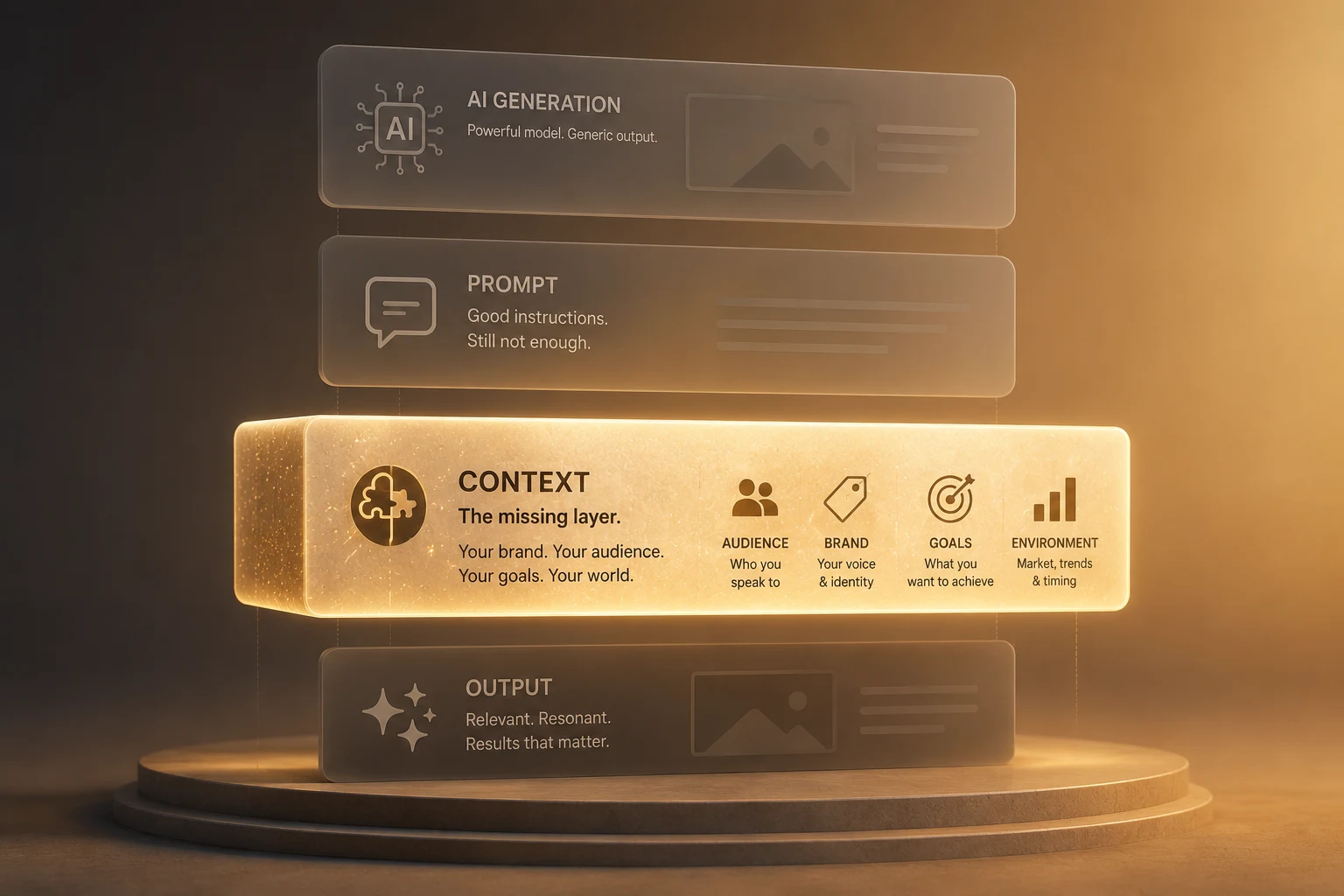
Using AI for marketing works better when AI understands the brand behind the task.
A prompt gives AI one instruction. Context gives AI the larger picture.
That context includes product information, customer insights, approved messaging, brand voice, campaign history, channel rules, and past learnings.
Most ecommerce teams already have this knowledge. The problem is that it is usually scattered across product documents, campaign briefs, Slack conversations, ad reports, old email campaigns, SEO notes, founder inputs, and creative team memory.
This knowledge is valuable, but it often does not become reusable.
When reusable brand knowledge is missing, AI starts each task from scratch. It may create a decent output, but it cannot carry forward the brand’s product story, audience understanding, approved claims, or campaign learnings.
That is why AI marketing needs more than one-time prompts. It needs shared brand knowledge that can be stored, reused, reviewed, and improved across workflows.
For AI for ecommerce marketing teams, how to use AI for marketing becomes less about generating one asset and more about keeping product knowledge, channel rules, campaign direction, and AI brand voice connected across daily execution.
For AI for D2C marketing, this context layer is even more important because the brand often owns the full customer journey, from discovery and product education to conversion, retention, and repeat purchase.
For a deeper explanation of this idea, ShopOS also covers how teams can make AI understand the brand through an AI brand wiki. The principle is simple: AI becomes more useful when brand knowledge is structured, accessible, and reusable.
Good AI marketing context should include:
- Product context: what the product is, who it is for, and what makes it different.
- Audience context: customer needs, objections, buying triggers, and intent.
- Messaging context: approved claims, strongest benefits, proof points, and phrases to avoid.
- Campaign context: launch, sale, education, retargeting, or seasonal direction.
- Channel context: how the message should adapt for ads, emails, PDPs, social, SEO, and creative briefs.
- Learning context: hooks, claims, objections, and messages that worked or were rejected in the past.
This is where context becomes operational. It becomes shared memory that helps teams use AI with more consistency and protect AI brand voice across channels.
How to Use AI for Marketing Without Losing Brand Voice

The best way to use AI is not to treat it as a standalone content generator.
It should be part of a connected workflow.
Here is a practical way to use AI for marketing without losing brand voice.
1. Start with brand voice before content creation
Before creating content with AI, define the brand voice clearly.
The team should document tone, vocabulary, sentence style, product explanation style, words to avoid, and how the brand should adapt across channels.
AI can only follow the brand voice if that voice is clear and available.
2. Give AI reusable product context
AI should not receive only a product name and a basic instruction.
It should understand product positioning, key benefits, use cases, customer objections, approved claims, features, and proof points.
This helps the product story stay consistent across PDPs, ads, emails, social posts, and SEO content.
3. Use approved messaging and claims
AI should not invent product claims freely.
Approved messaging gives AI a safer foundation. It tells AI what the brand can say, what it should avoid, and which proof points matter.
This is especially important for categories like beauty, wellness, food, personal care, fashion, and lifestyle products.
4. Add channel-specific instructions
AI should not write every asset in the same way.
The same product message may need different formats for Meta ads, product pages, email campaigns, SEO blogs, social captions, launch pages, and creative briefs.
Channel-specific instructions help AI adapt the output without breaking the brand voice.
5. Review and refine before publishing
AI content should go through a review process before it goes live.
The team should check whether the content sounds like the brand, uses correct product positioning, follows approved claims, matches the campaign, fits the channel, and feels useful for the customer.
Review and refinement protect brand consistency in marketing.
6. Save learnings for future workflows
After content goes live, the team should capture what worked, what changed, what was rejected, and what should be reused.
This may include winning ad hooks, stronger product angles, customer objections, approved phrases, rejected claims, and channel insights.
When this knowledge is reused, AI becomes better over time.
Brand Consistency in Marketing Comes From Workflow, Not Prompts
A good prompt can create one useful output.
A good workflow can create consistent marketing across every channel.
That difference matters.
This is why how to use AI for marketing cannot be reduced to prompt writing. It has to be treated as a workflow question across brand voice, product context, campaign direction, review, and learning.
The real answer to how to use AI for marketing is not asking every team to write better prompts. It is giving every team access to the same product context, brand voice, approved messaging, and campaign learnings.
If every team member writes a new prompt for every task, the brand depends on individual judgment. One person may give AI strong context. Another may give only a basic instruction. One team may review carefully. Another may publish quickly.
Over time, the brand becomes inconsistent.
A stronger workflow looks like this:
Product context → brand voice → approved messaging → campaign angle → channel-specific output → review → refinement → approval → learning saved back
This workflow makes consistency repeatable.
It also solves the larger ecommerce problem.
Ecommerce teams are not creating one asset. They are creating a full customer journey across product pages, ads, emails, SEO content, social posts, launch campaigns, and creative briefs.
If those workflows are disconnected, the brand voice becomes disconnected.
Each asset may look fine on its own. But together, they do not build one clear brand story.
That is why AI for ecommerce marketing teams needs connected execution. The same shared context should support PDP copy, ad angles, email flows, SEO briefs, and creative directions.
The value is in making sure every output uses the same brand knowledge and improves from the same learnings.
This is also where ecommerce brands can think beyond one-off content tasks and move toward an AI content pipeline, where product data, brand voice, campaign learnings, and performance signals support repeatable execution.
AI Marketing for Ecommerce Brands Needs Connected Execution
AI marketing for ecommerce brands can support product pages, ad hooks, email flows, social captions, SEO briefs, launch campaigns, and creative directions.
But the value does not come from generating each asset in isolation.
For ecommerce brands, how to use AI for marketing should be answered at the workflow level, not only at the content level.
The real value comes when all of these workflows operate from the same product context, brand voice, messaging rules, and campaign direction.
For example, a new product launch may need a PDP description, Meta ad angles, launch emails, influencer briefs, social captions, SEO content, and retargeting messages. If every asset is created separately, the product story can change from channel to channel.
The ad may focus on discounts. The product page may focus on quality. The email may focus on urgency. The SEO blog may explain the product in generic language. The creative brief may use a different campaign angle.
That creates a fragmented customer experience.
AI for D2C marketing should help teams move faster, but it should also help them maintain one clear brand story across the customer journey. For D2C teams, that means the product promise, campaign hook, channel message, and review process need to stay connected.
For AI for ecommerce marketing teams, the same principle applies across every channel. AI can support more execution, but only shared context keeps that execution aligned.
That is the difference between content generation and connected execution.
AI agents become more effective when they operate from shared brand context and memory, instead of working from isolated task instructions.
Where ShopOS Fits In
Once ecommerce teams start using AI across product pages, ads, emails, social content, SEO content, launch campaigns, and creative briefs, brand knowledge cannot stay scattered.
It needs to be stored, reused, reviewed, and improved across workflows.
That is where ShopOS fits in.
ShopOS combines Brand Memory, specialized AI agents, structured workflows, and review systems to help ecommerce teams keep brand context connected across marketing execution.
Instead of starting every task from a blank prompt, teams can work from shared brand knowledge: product context, brand voice, approved messaging, audience insights, campaign direction, and past decisions.
The AI agents then support specific workflows while still working from the same context.
For example, Monica can support creative workflows,
While Big Head can support SEO and AI search visibility workflows.
Spaces helps teams work inside structured ecommerce workflows instead of loose prompts.
Refine helps teams review outputs, improve them, and turn edits into learning signals.
The point is not that each feature creates more content.
The point is that the system helps brand context stay connected while teams create, review, improve, and reuse work across channels.
ShopOS-supported workflow can look like this:
- Product context is added.
- Brand voice and approved claims are available.
- Campaign direction is defined.
- AI agents help create channel-specific outputs.
- The team reviews and refines the work.
- Learnings are saved back into the system for future campaigns.
The result is not just faster content.
The result is more consistent brand execution.
Your AI Should Know Your Brand Before It Creates for It
More content is not the goal. More consistent execution is.
ShopOS gives your ecommerce team shared brand context across product pages, ads, emails, SEO, creative, and campaign workflows, so AI can move faster without making your brand sound different everywhere.
See how connected AI marketing works with ShopOS. Book a Demo
Final Thoughts
AI does not need more prompts. It needs more context.
For ecommerce teams, success with AI comes from keeping product knowledge, brand voice, messaging rules, and campaign learnings connected across workflows.
When that context stays connected, AI becomes a system for consistent execution, not just content generation.
That is the real shift.
The best answer to how to use AI for marketing is not to create more disconnected content.
For brands using AI for marketing at scale, the next step is building a workflow where AI works from the brand’s real context, learns from review, and supports one clear brand story across every customer touchpoint.
AI for D2C marketing also depends on this shift. D2C brands need AI that can connect product education, campaign messaging, customer retention, and performance learnings instead of treating each channel as a separate task.
A useful way to think about how to use AI for marketing is this: AI should not only help teams create faster. It should help them execute from the same brand knowledge, improve through review, and stay consistent as marketing work scales.
That is what makes AI marketing for ecommerce brands stronger: not more isolated outputs, but more connected execution.
Key Takeaways
- AI marketing becomes generic when brand context is fragmented across teams, channels, and workflows.
- Brand voice helps AI outputs stay recognizable across product pages, ads, emails, social content, SEO content, campaigns, and creative briefs.
- Ecommerce teams need reusable brand knowledge, not one-time prompts.
- Strong AI marketing workflows connect product context, approved messaging, channel rules, campaign direction, review, and learnings.
- ShopOS helps ecommerce teams keep brand context connected through Brand Memory, AI agents, Spaces, Refine, review, and workflow orchestration.
FAQs
How can brands use AI for marketing without losing brand voice?
Brands can use AI for marketing without losing brand voice by starting with clear brand voice guidelines, product context, audience insights, approved messaging, and channel-specific instructions. AI output should also be reviewed and refined before publishing.
Why does AI marketing content sound generic?
AI marketing content often sounds generic because AI does not have enough brand context. It may lack product positioning, approved messaging, audience insights, campaign history, channel context, and brand voice.
What is AI brand voice?
AI brand voice means giving AI the right brand context so it can create content that matches the brand’s tone, vocabulary, messaging style, product story, and communication rules across channels.
Why is brand consistency in marketing important?
Brand consistency in marketing helps customers recognize and trust the brand across product pages, ads, emails, social posts, SEO content, launch campaigns, and creative briefs. It keeps the product story clear across the full customer journey.
How can ecommerce teams use AI for marketing?
Ecommerce teams can use AI for product pages, ads, emails, social content, SEO content, launch campaigns, and creative briefs. The key is to keep product context, brand voice, approved messaging, and campaign learnings connected across workflows.
Where does ShopOS help with AI marketing?
ShopOS helps ecommerce teams keep brand context connected across marketing workflows through Brand Memory, AI agents, Spaces, Refine, review, and workflow orchestration. This helps teams use AI while keeping content aligned with the brand voice and product story.