

TL;DR: A generative engine optimization agency should get your brand named inside AI answers and prove it with hard numbers. The good ones show real prompts and honest wins every month. The risky ones sell pretty screenshots. ShopOS runs the same work on software, so content and tracking grow without a bigger team.
Key takeaways
- AI answers are quietly stealing clicks. Google users clicked a normal result on 8% of visits with an AI summary, versus 15% without one (Pew Research Center).
- A good generative engine optimization agency tracks real buyer prompts on ChatGPT, Perplexity, Gemini, and Claude. Vague scores are a warning sign.
- Real progress shows up fast. One apparel brand climbed from zero citations to 17 of 18 tracked prompts within three months (ShopOS case study).
- Software now carries the painful content load. Taste and trusted relationships still need people.
A sneaker brand in Mumbai had done search the right way. It had 40+ press mentions and ranked for 200+ keywords. It felt safe. Then its team tested 20 buyer prompts across four AI engines.
The brand showed up once. Just once.
“We appeared in one. One. That number changes how you think about marketing,” its marketing lead said (sneaker brand case study).
That painful moment is why brands go hunting for a generative engine optimization agency. Strong Google rankings didn’t carry over, and nothing in their reports warned them. It’s a lonely feeling to lose a race you didn’t know had started.
This guide covers what the work really involves and what 90 days should honestly deliver. It also shows how to spot a partner who’s selling fog.
What does a generative engine optimization agency do?
A generative engine optimization agency gets your brand named inside AI answers. It starts with the honest questions buyers ask. It checks which brands ChatGPT, Perplexity, Gemini, and Claude trust and recommend today, then closes the gap with better pages and earned mentions. Good ones prove progress prompt by prompt.
A strong generative engine optimization agency splits the work into four parts:
- Prompt research. Real buyer questions, like “best running shoes for flat feet,” not a stale keyword list.
- Site fixes. Crawler access and clean schema, so engines can actually read your pages.
- Citable content. Pages that answer one hard question well, with specifics an engine can safely quote.
- Earned mentions. Honest reviews and roundups on sites the engines already trust.
None of it is magic, and good partners say so. The KDD 2024 paper that named the field found GEO methods can boost visibility by up to 40% in generative engine responses (GEO: Generative Engine Optimization). The same researchers found results vary a lot by domain. That’s the uncomfortable part most sales pitches skip.
What is a prompt set? A prompt set is the fixed list of buyer questions you test every month. It’s your scoreboard, so it shouldn’t quietly change between reports. If it does, the trend is worthless.
Why are brands scrambling to hire a generative engine optimization agency?
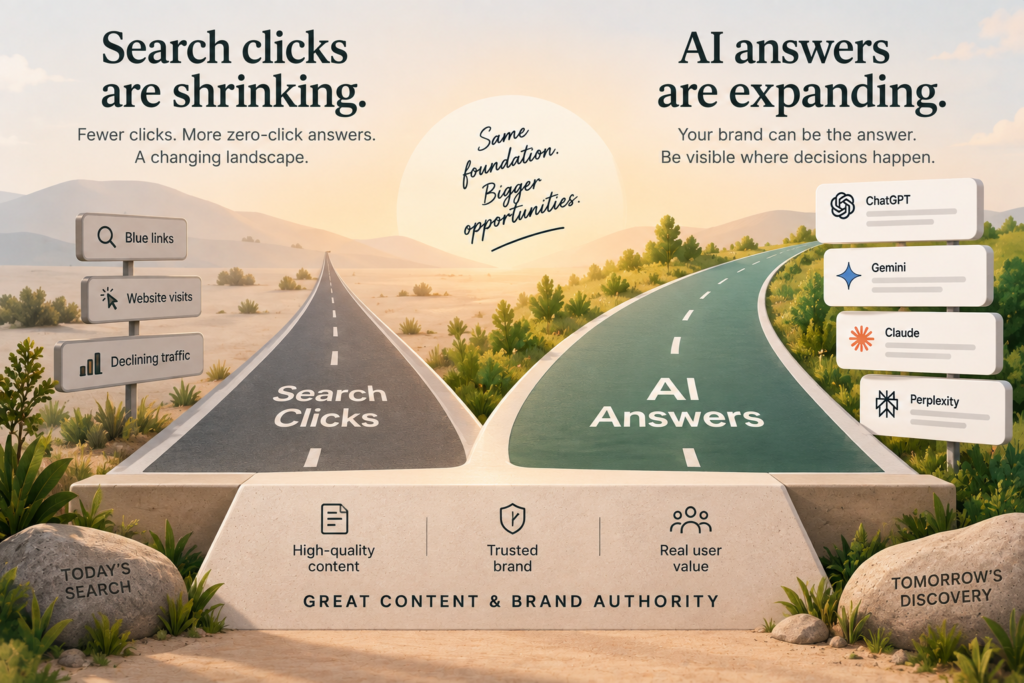
Because clicks are shrinking while AI answers grow. When Google shows an AI summary, people click a normal result far less often. The shoppers who do arrive from AI tend to be ready to buy. That mix scares teams built on rankings, and it richly rewards the brands that move early.
The numbers sting. In a Pew study of 900 US adults, people who saw an AI summary clicked a traditional result on just 8% of visits. Without a summary, they clicked on 15% (Pew Research Center). Hiring a generative engine optimization agency is often a reaction to that quiet drop.
Now the hopeful part. In July 2026, retail visits referred by AI tools rose 62% compared with a year earlier. Those visits converted 60% better than other traffic and brought 53% more revenue per visit (Digital Commerce 360, citing Adobe).
So the traffic is smaller but far richer. Losing it hurts twice. You miss the visit, and you miss a buyer who was ready.
What should a generative engine optimization agency deliver in 90 days?
Visible wins, in writing, against named prompts. A solid, honest plan moves from foundation to displacement to authority. Every month should end with a clear count of prompts won and pages shipped. If month three still shows only fuzzy insights and no wins, trust your gut and push back.
Here’s what that looked like for a men’s ethnic wear brand that started from a painful zero. Its founder was blunt: “We were ranking on Google. We had 140K followers.” The first audit found zero citations (ethnic wear case study).
| Stage | Work shipped | Buyer prompts naming the brand | Day 1 | Audit of 18 buyer prompts | 0 of 18 | Month 1 | 22 articles, schema fixed, sitemap submitted | 7 of 18 | Month 2 | 18 more articles, Reddit and community seeding | 13 of 18 | Month 3 | 19 more articles and guides, 2 niche authority citations | 17 of 18 |
|---|
Look at the sheer volume. That’s 59 pieces in 90 days, plus 40+ Reddit touch points. Most in-house teams can’t hold that brutal pace. It’s also exactly why the scoreboard moved.
Your plan won’t match this one perfectly, and it shouldn’t. Your rivals and starting point are different. But ask any generative engine optimization agency for the same shape: fix, publish, earn, count.
How do you honestly measure a generative engine optimization agency?
Measure prompts, not promises. Ask for a fixed list of real buyer prompts, tested on each engine every month. Track how often each engine names you versus a rival, and note which of your pages it cites. Then tie those wins to AI referral revenue, because screenshots alone prove nothing.
Engines also move at frustratingly different speeds. In that same brand’s results, citations climbed unevenly (full Big Head case study):
- Perplexity jumped from 1 to 14 of 18 prompts.
- Claude climbed from 1 to 11 of 18.
- ChatGPT crawled slowly from 0 to 9 of 18.
- Gemini lagged, from 0 to 8 of 18.
That gap is dangerous. A generative engine optimization agency reporting one blended visibility score can hide a weak ChatGPT result behind a strong Perplexity one. Ask for the split. If they can’t give it, that silence is your answer.
A fair, useful monthly report covers four things: prompt share by engine, rival prompts reclaimed, open prompt gaps, and AI referral conversions. That last one keeps everyone honest.
Should you hire a generative engine optimization agency or trust software?
It depends on what’s truly scarce. If you lack strategy and press relationships, an agency helps. If you lack hands, software usually wins, because GEO eats content by the dozen. A sharp marketer with no spare time does best paired with a platform, and most brands are painfully short on hands.
| Option | Best when | Watch out for |
|---|---|---|
| Agency retainer | You need senior strategy and PR relationships | Slow content pace and reports heavy on screenshots |
| In-house hire | GEO is a long-term priority, and you can train someone | Cost and ramp time. An e-commerce marketing manager averages $114,481 a year in the US (Salary.com) |
| Platform like ShopOS | You need content and tracking at volume | You still need a person to approve and steer |
Here’s the honest take. Big press placements still come from people with real relationships, and software won’t charm a journalist over coffee. But most of the wins in that case study came from steady, specific content. That’s the part a generative engine optimization agency struggles to scale, and it’s exactly where software shines best.
What red flags should you watch for?
Guarantees are the loudest red flag. Nobody controls what ChatGPT says tomorrow, so a promised ranking is a guess dressed up as a plan. Be wary of vague visibility scores with no prompt list. Honest partners admit what they can’t promise and show per-engine results without being asked.
Google is bluntly honest about shortcuts too. Its AI features guidance says plainly that no special AI text files or extra markup are needed to show up in its AI results.
Walk away fast if a generative engine optimization agency shows these warning signs:
- A promise to “rank you #1 in ChatGPT” by a fixed date.
- No written prompt list before work starts.
- Pretty screenshots, but no counts by engine.
- Thin content stuffed with keywords and zero real facts.
One more quiet risk hides in plain sight. Some partners publish dozens of weak pages fast to look busy. Engines may ignore them, and shoppers notice the sloppy work. Volume only wins when every page is genuinely useful.
How does ShopOS run generative engine optimization at scale?
ShopOS built GEO into software instead of a costly headcount plan. Big Head, its GEO and SEO agent, finds the prompts buyers really ask and scores your brand across four AI engines. Then it writes and publishes content to close the gaps. A person approves anything risky, so speed never costs you control.
Setup is refreshingly simple, with five steps: URL scan, selling regions, competitors, topics, and prompt suggestions. From there, the GEO and SEO agent tracks cited or not cited status, prompt by prompt, with a tier. Its product page says 20+ AI-ready pages can be published every week. An earned actions tab handles the harder outreach work.
This is where the technical product earns its keep. The hardest, most expensive part of GEO is production, not ideas. Drafts and tracking pile up fast, and they quietly burn out small teams.
ShopOS turns that grind into a repeatable system, and Brand Memory keeps every page sounding like you. You get the output of a generative engine optimization agency without the painful wait for one.
Pricing is public, which is refreshingly rare in this space. Pro includes 5 tracked prompts at $19 a month, Growth includes 35 at $99, and Business includes 100 at $199 (ShopOS pricing). Two honest limits matter. Every published GEO win so far is an apparel or footwear brand, and content publishing needs a verified custom domain.
Feeling lost in the jargon? Start with how answer engine optimization shapes a single page and how LLM SEO works behind the scenes. Then see what it really takes to show up in ChatGPT and where GEO and SEO budgets differ.
Regulated categories carry extra risk, covered in GEO for supplement brands and GEO for beauty brands. Need help beyond AI search? Read about choosing a trusted ecommerce marketing agency.
Want the truth about where you stand before hiring anyone? Paste your store URL into the free tier and get a first AI visibility audit quickly. If your catalog is large or your category is crowded, Book a call and talk it through: Book a call.
FAQ
How much does a generative engine optimization agency cost?
Many agencies keep prices hidden, and scope swings wildly, so compare honest output, not just the fee. Ask how many prompts get tracked and how many pages ship each month. Then work out the true cost per page. ShopOS publishes GEO tracking on public plans, which makes that math refreshingly simple.
How long does GEO take to show real results?
Expect early movement in month one and a clear trend by month three. In the ethnic wear case study above, the brand jumped from 0 to 7 of 18 prompts after the first month. Crowded categories can feel slower. If nothing moves after 90 days, question the prompt list and the content quality.
Is GEO just SEO with a new name?
Not quite, though they share a strong foundation of crawlable pages and a trusted brand. The big difference is what you measure. SEO tracks positions and visits, and GEO tracks how often AI answers mention your brand. The GEO vs SEO guide shows where each dollar works hardest.
Can a small brand do GEO without an agency?
Yes, if someone truly owns it. Start with 10 to 20 genuine buyer prompts, test them by hand each month, and fix the painful gaps on key pages first. The hard part is keeping pace, since winning often takes dozens of pages. That grind is where software or a partner earns its fee.
Which AI engines should an ecommerce brand track?
Track ChatGPT, Perplexity, Gemini, and Claude at a minimum. Each picks sources differently, and they move at very different speeds. In the case study above, Perplexity responded fastest and Gemini slowest. Watching only one engine gives you false comfort, or a false sense of failure.
Does GEO work well in every product category?
The mechanics travel well: clear pages and trusted mentions. The public proof so far is strongest in apparel and footwear, and that’s worth saying honestly. Regulated categories like supplements and skincare need extra care, because AI engines echo your exact wording to shoppers. Stay cautious about big category promises.
What should I ask a generative engine optimization agency before signing?
Ask for the exact prompt list they’ll track and a sample monthly report. Ask how they split results by engine, and who approves each page. Then ask the uncomfortable question: what happens if nothing moves by month three? A calm, specific answer is a good sign.