
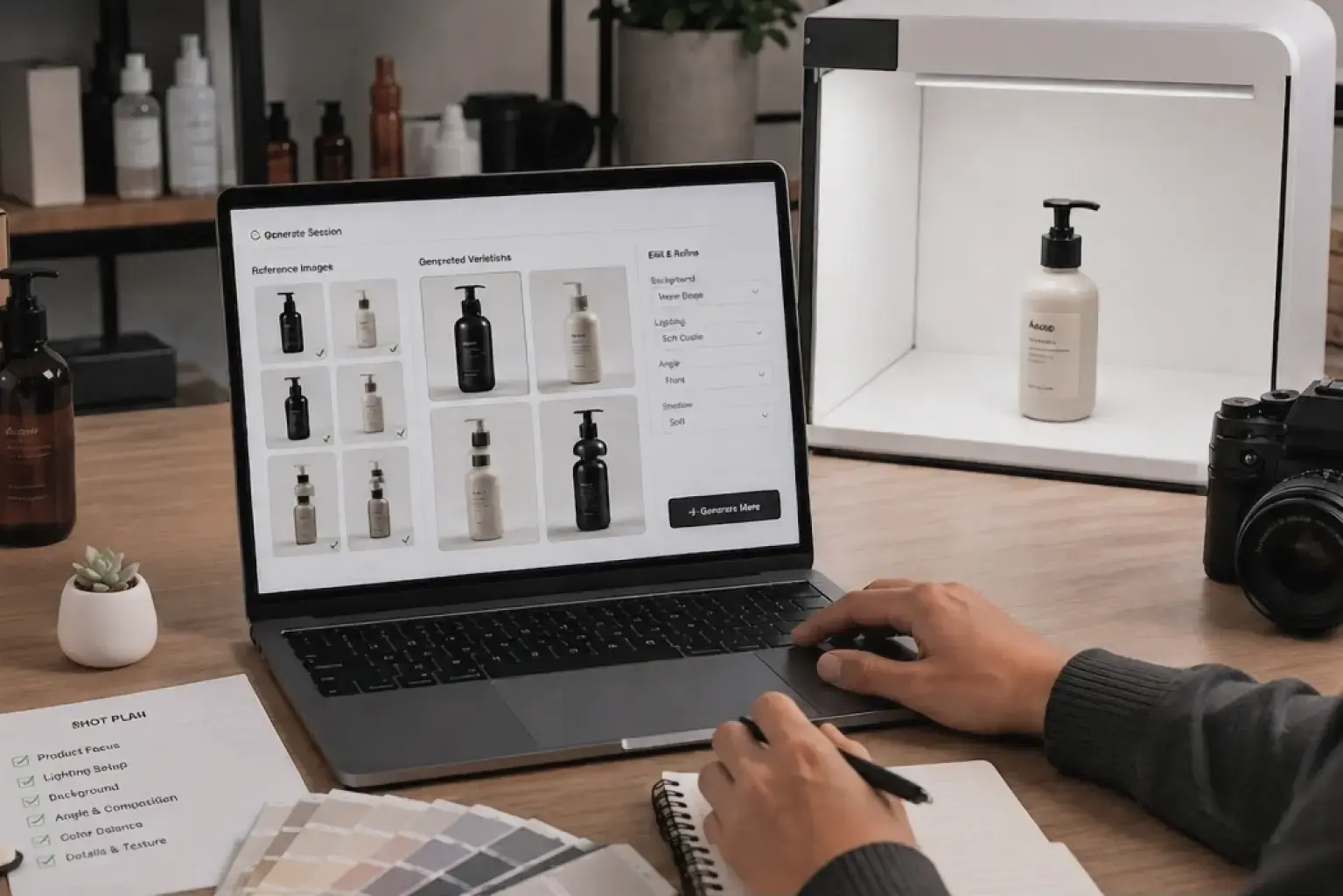
- Why Ecommerce Needs More Than a General AI Picture Generator
- What Makes the Best AI Image Generator for Ecommerce?
- Image Types Ecommerce Teams Should Be Able to Create
- Monica: An Ecommerce-Focused AI Image Generator
- Two Image Workflows: Refine a Direction or Generate Directly
- How to Create Ecommerce Images With Monica
- General AI Image Generator vs Ecommerce-Focused Image Generator
- Where Human Review Still Matters
- How to Choose the Best AI for Image Generation
- Final Takeaway
- Frequently Asked Questions
Traditional product shoots are expensive and slow. Booking photographers, studios, models, props and retouching takes time, while every new channel or campaign creates another round of image requests. When different teams and vendors produce those assets, colours, lighting and visual style can also become inconsistent.
AI can speed up production, but product accuracy is non-negotiable. If a generated image changes a label, garment pattern, logo, texture, colour or proportion, it may look impressive while misrepresenting what the customer will receive. Ecommerce brands need a specialised tool that starts with the real product and protects its defining details.
Choosing the best AI image generator for ecommerce means solving three problems together: reducing production time, preserving product truth and maintaining a consistent brand identity. The best option turns a product input into usable catalogue, lifestyle, advertising and social images without rebuilding the workflow for every asset.
Quick answer: The best AI image generator for ecommerce should accept real product inputs, protect key details, follow brand guidelines, create multiple commercial image types and allow human review. Monica inside ShopOS is built for this workflow.
Turn product inputs into catalogue shots, lifestyle visuals, ads and social content. Sign up free and get 500 credits to start creating.Create on-brand ecommerce images with Monica
Why Ecommerce Needs More Than a General AI Picture Generator
A general image tool can produce an impressive scene, but ecommerce images represent products people may buy. Unclear references and instructions are common reasons why AI product photos get product details wrong. A specialised workflow provides a clearer source of truth and a practical review process.
Commercial images also serve different purposes. A marketplace image needs clarity, while a paid social creative needs a stronger visual hook. The best AI to generate images for ecommerce should support these differences without making the team rebuild product and brand context for every request.
What Makes the Best AI Image Generator for Ecommerce?
The best AI image generator for ecommerce combines image quality with product control, brand consistency and production flexibility.
| Evaluation criterion | What an ecommerce team should look for |
| Product input | Support for a product URL, uploaded image or clear text description |
| Product accuracy | Ability to preserve packaging, colour, shape, material, logos and other defining details |
| Image range | Catalogue, studio, lifestyle, on-model, editorial, ad and social images |
| Brand consistency | Reusable knowledge of colours, visual identity, photography style and approved creative direction |
| Output control | Choice of model, aspect ratio and resolution for different channels |
| Editing | Prompt-based refinement, background replacement and layout improvement |
| Workflow | Support for both direct generation and collaborative iteration |
| Cost clarity | Generation cost shown before the team commits credits |
| Human review | A clear point for checking product truth and brand fit before publishing |
This is the key distinction when a brand searches for the best image generating AI. Image quality matters, but commercial usability matters more.
Image Types Ecommerce Teams Should Be Able to Create
The best AI picture generator for ecommerce should support the full image journey around a product, not just isolated concept art.
- Catalogue and studio images: Clean product shots, detail views and consistent white or custom backgrounds across SKUs.
- Lifestyle and on-model images: Product-in-use scenes that add customer context without a new physical setup for every environment.
- Editorial visuals: Magazine-style layouts and premium campaign scenes that give a launch a stronger point of view.
- Static ads and social content: Paid social creatives, promotional posters, feed posts, carousel images and channel-specific formats.
- Multi-product compositions: Collection, kit, bundle and multi-SKU images that keep each item clear.
- Campaign variations: New layouts, backgrounds, colours, offers and seasonal treatments based on an approved direction.
The best AI photo generator should adapt one product direction across these needs. Faster variation is also one of the practical benefits of AI in ecommerce, because teams gain more creative options without repeating the full production cycle.
Monica: An Ecommerce-Focused AI Image Generator
Monica is ShopOS Creative Director, built to turn a product, brief or rough idea into finished visual content using the brand’s shared context.
This makes Monica relevant to teams looking for the best AI for image generation in ecommerce. It creates catalogue, lifestyle, on-model, editorial, advertising, social and multi-product images.
Its strength is commercial image production for brands that need assets built around a real product and a recognisable visual identity.
Monica image specifications
| Specification | Monica’s capability |
| Input options | Product URL, uploaded product image or text description |
| Image models | Nano Banana Pro, Nano Banana 2, Nano Banana Lite and GPT-image-2 |
| Resolution | 1K, 2K and 4K |
| Aspect ratios | Multiple formats for ecommerce, ads and social platforms |
| Working modes | Supercomputer for collaborative refinement and Creative Studio for direct generation |
| Image editing | Background changes, layout refinement and prompt-based improvements |
| Brand control | ShopOS Brand Memory |
| Cost visibility | Required credits shown on the generation button before use |
These controls help teams choose speed, quality and format according to the job.
Two Image Workflows: Refine a Direction or Generate Directly
Monica provides two natural-language ways to work for different creative situations.
Supercomputer is the collaborative mode. Share a product, reference, mood or initial direction, then refine the result through conversation. Use it while the direction is still developing.
Creative Studio is the direct mode for teams that already know what they want. Previous work remains in Generations, while Templates provide a starting point for repeatable tasks.
This flexibility matters when evaluating the best image AI generator. Some jobs need fast execution from an approved brief. Others need several rounds of visual exploration before the direction is ready.
How to Create Ecommerce Images With Monica
The workflow can begin with a product instead of a long design brief.
1. Add the product input
Add a product URL, upload a clear image or describe the item. A strong reference provides a source of truth for colour, packaging, proportion and materials.
2. Complete Brand Memory
Monica uses ShopOS Brand Memory to understand colours, logo rules, photography style, lighting, model preferences and scenes. This reduces repeated brand instructions.
3. Choose the right working mode and settings
Choose Supercomputer for collaborative refinement or Creative Studio for direct generation. Select the model, resolution and aspect ratio for the intended channel.
4. Describe the commercial goal
A useful prompt explains what the image should achieve, not only what it contains. For example:
Create a premium lifestyle image for this skincare bottle on a clean bathroom counter, using soft morning light, keeping the label and packaging unchanged, formatted for an Instagram feed post.
This covers the product, setting, tone, accuracy requirement and destination.
5. Review, refine and approve
Check product details, brand fit, composition and channel requirements. Refine issues through a follow-up prompt. A practical AI creative workflow keeps people responsible for direction and approval while AI handles repeatable production.
General AI Image Generator vs Ecommerce-Focused Image Generator
The best AI picture generator depends on the job and how the final image will be used.
Use a general AI image generator for moodboards, fictional illustrations, concept exploration and background inspiration where no real SKU must be shown accurately.
Use an ecommerce-focused image generator for product pages, marketplace listings, ads, social campaigns and catalogues. These jobs require product-detail protection, reusable brand context and multiple commercial formats.
| Area | General AI image generator | Ecommerce-focused image generator |
| Starting point | Usually a text prompt | Product URL, image or description |
| Main objective | Attractive image | Usable product asset |
| Brand context | Often repeated manually | Stored and reused across generations |
| Output range | Broad visual creation | Catalogue, lifestyle, ads and social images |
| Iteration | Prompt-by-prompt | Direct or collaborative |
| Production scaling | Individual outputs | Variations and channel formats |
| Final check | Visual preference | Product accuracy and brand fit |
The Monica ShopOS AI Creative Director vs Higgsfield comparison explains these differences in more depth.
Where Human Review Still Matters
No AI output should go live only because it looks realistic. Verify labels, logos, text, colours, patterns, dimensions, product counts and any visual claim implied by the scene.
Human judgment is also necessary for taste. Brand Memory supports consistency, but a person still decides whether an image is distinctive and ready for the campaign. Even the best AI photo generator needs this review. The best AI to generate images speeds up iteration without removing the brand’s responsibility.
How to Choose the Best AI for Image Generation
Test a platform with one real product and campaign requirement, not only a fictional prompt:
- Upload a product with labels, patterns or reflective packaging.
- Request a clean catalogue image and a lifestyle version.
- Generate the same direction in two different aspect ratios.
- Change the background or layout without altering the product.
- Compare the results with the brand’s visual guidelines.
The right platform should pass this test consistently. It reveals whether a platform is an impressive best image generating AI candidate or a repeatable ecommerce tool.
Final Takeaway
The best AI image generator for ecommerce connects product truth, brand identity and production flexibility. Its images must be accurate and ready for catalogue, advertising and social workflows.
Monica brings these requirements into one system. Teams can start with a URL, image or description, choose a collaborative or direct workflow, set the model and resolution, then refine with brand context already available.
For ecommerce teams, that is what separates a general image tool from the best image AI generator for daily commercial work.
Want to see Monica in action before you get started? Book a demo with our team
Frequently Asked Questions
What is the best AI image generator for ecommerce?
The best AI image generator for ecommerce accepts real product inputs, preserves details, follows brand guidelines, creates multiple commercial image types and supports human refinement. Monica is designed for this workflow.
Can an AI image generator replace product photography?
It can reduce shoots for catalogue variations, lifestyle scenes, ads and seasonal adaptations. Accurate source images and human review are still necessary. Some hero campaigns may still need traditional photography.
What is the best AI to generate images from a product photo?
It should keep the product recognisable while changing the setting or campaign treatment. Editing, aspect-ratio and resolution controls make results usable across channels.
Can Monica maintain the same brand style across images?
Yes. Monica uses ShopOS Brand Memory to apply colours, photography style, lighting, model preferences, backgrounds and logo rules. Review images before publication.
Is the best image generating AI always the most realistic one?
No. For ecommerce, the best image generating AI must also maintain product accuracy, follow the brand, support commercial formats and make revisions efficient. A realistic but inaccurate image should not be used.