

- What Are the Main Benefits of AI in Ecommerce?
- Why Most Ecommerce AI Stacks Fail Today
- Brand Memory Makes AI Useful Across Every Function
- Traditional Team vs AI Tool vs ShopOS Agent
- The Future of AI in E Commerce Is Agent-Led
- A Practical Product Launch Workflow in ShopOS
- How ShopOS Connects the Benefits
- Where Should Ecommerce Brands Start?
- Final Takeaway
- FAQs
AI is no longer just a small productivity tool for ecommerce teams. It is becoming part of how modern brands create campaigns, update product pages, plan emails, improve search visibility, and learn from performance.
But the real benefits of AI in ecommerce do not come from using more disconnected tools. They come from giving each brand function the right AI support while keeping brand voice, product context, customer insights, and campaign learnings connected.
That is the idea behind ShopOS.
Instead of treating AI as one tool for one task, ShopOS brings AI agents for ecommerce into the daily workflow of creative, ads, Shopify, email, SEO, growth, social, and brand intelligence teams. Each agent works from shared Brand Memory, so the brand can move faster without losing consistency.
For teams exploring AI for ecommerce brands or AI for DTC brands, this creates a more practical way to use AI across the full ecommerce system.
What Are the Main Benefits of AI in Ecommerce?
The main benefits of AI in ecommerce include faster creative production, better campaign testing, stronger product pages, improved email workflows, smarter search visibility, clearer growth insights, and more consistent brand execution.
For ShopOS, these benefits become stronger when every ecommerce function has its own AI agent and every agent works from shared Brand Memory.
Why Most Ecommerce AI Stacks Fail Today
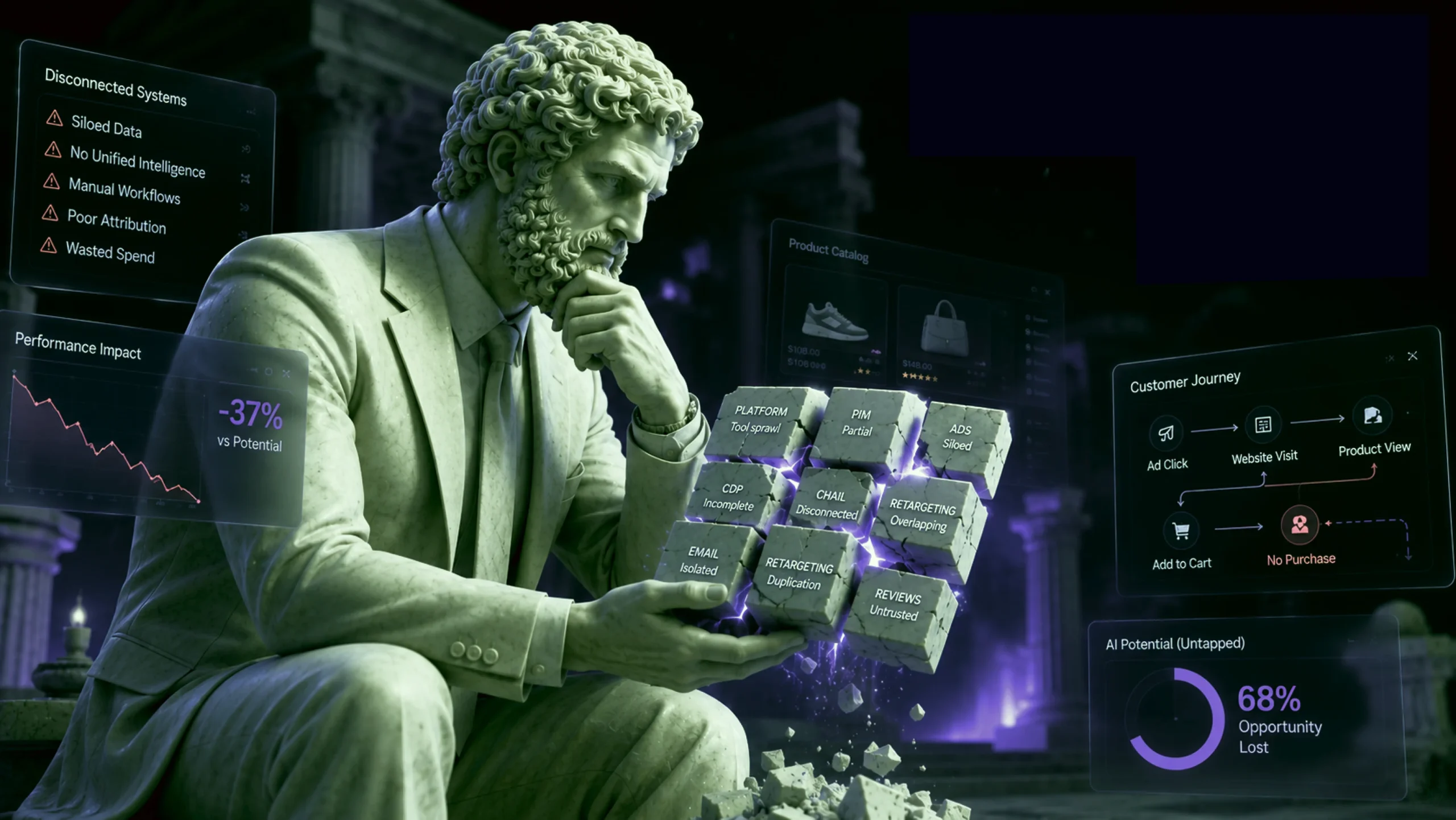
Most ecommerce teams already use AI. One tool writes copy. Another creates ad ideas. Another supports SEO, email, or images.
The problem is disconnection.
When tools do not share context, the team still has to explain the brand voice, product story, customer objections, campaign goals, and past learnings again and again. This creates more output, but also more review and cleanup.
That is where ecommerce automation with AI often fails. Automation helps only when the system understands the brand and the workflow.
This is why the benefits of AI in ecommerce depend less on how many tools a brand uses and more on how well those tools share context, coordinate work, and learn from past decisions.
ShopOS solves this with AI agents for ecommerce supported by shared Brand Memory.
Brand Memory Makes AI Useful Across Every Function
Brand Memory sits at the center of the ShopOS workflow.
With Brand Memory, ShopOS agents use shared context about voice, products, audience, visual rules, approved messaging, and campaign learning.
Monica can shape a campaign. Richard can update a Shopify page. Dinesh can write lifecycle emails. Big Head can structure search content. Jian-Yang can capture brand learning.
Each agent works differently, but they all start from the same memory. This is how the benefits of AI in ecommerce move from speed to consistency.
Traditional Team vs AI Tool vs ShopOS Agent
| Ecommerce Function | Traditional Team | Generic AI Tool | ShopOS Agent |
| Creative | Waits on briefs and approvals | Creates one-off visuals or copy | Monica gives creative direction, visuals, videos, and variants |
| Ads | Reviews performance manually | Suggests generic ad copy | Gavin connects campaign signals with creative testing |
| Shopify | Updates PDPs manually | Writes basic descriptions | Richard supports PDPs, catalogs, collections, and launch updates |
| Email & CRM | Builds flows from scratch | Drafts standalone emails | Dinesh creates lifecycle flows tied to product and campaign context |
| SEO, AEO, GEO | Optimizes pages separately | Generates keywords or FAQs | Big Head improves search visibility and answer-ready content |
| Brand Intelligence | Relies on scattered notes | Gives broad suggestions | Jian-Yang organizes insights, positioning, and campaign learning |
A generic AI tool creates an output. A ShopOS agent supports a function.
The Future of AI in E Commerce Is Agent-Led
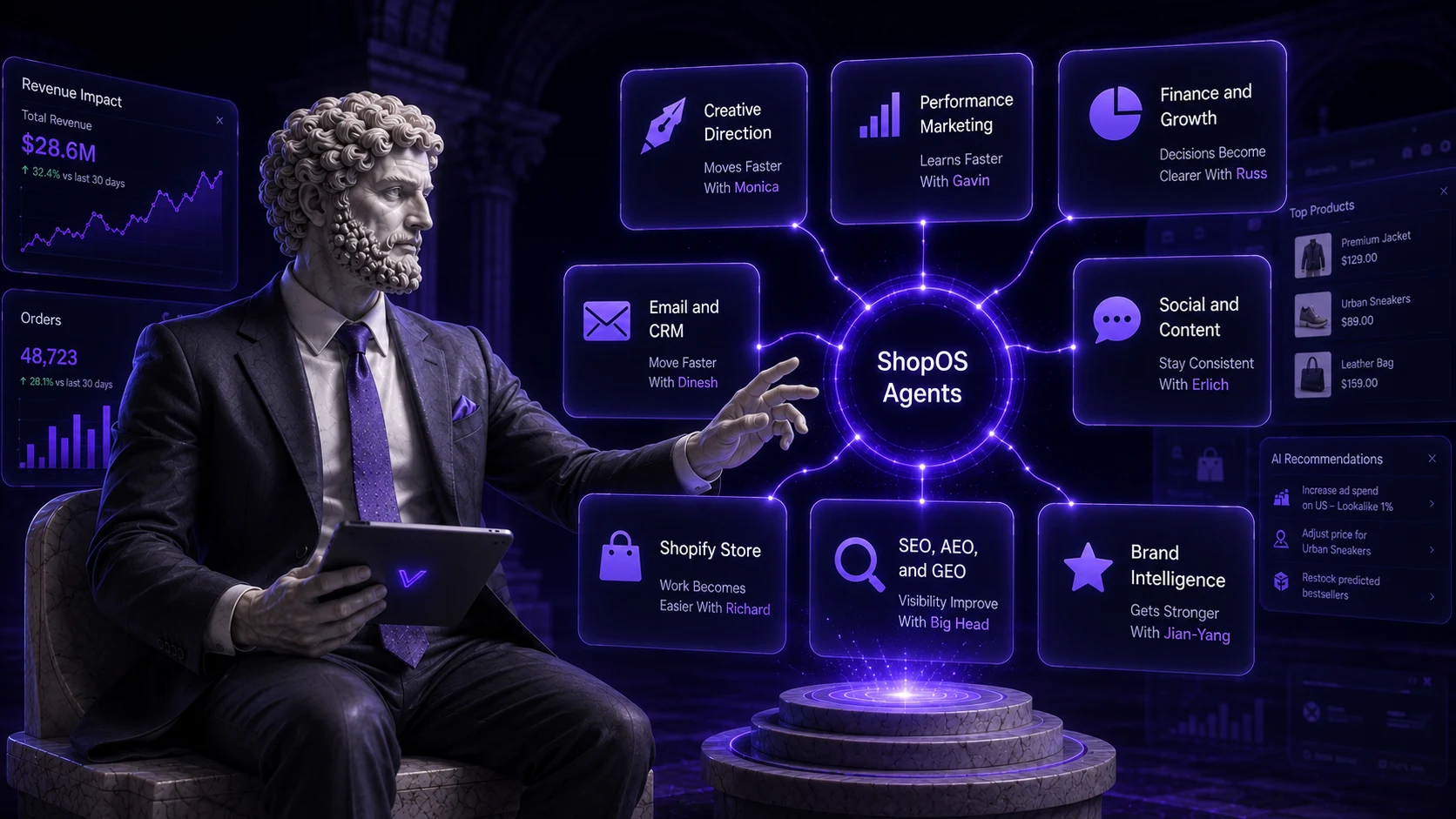
The Future of AI in e commerce is not about replacing ecommerce teams. It is about giving each function an AI teammate.
Creative, ads, email, Shopify, SEO, finance, social, and brand strategy all need different support. That is why AI agents for ecommerce matter, especially for lean teams exploring AI for DTC brands.
1. Creative Direction Moves Faster With Monica
One of the clearest benefits of AI in ecommerce is faster creative direction.
Monica, ShopOS’s AI Creative Director, helps teams turn product context into campaign-ready creative, including product storytelling, catalogue shots, ad ideas, videos, lifestyle visuals, and variants.
For AI for ecommerce brands, the value is not just more assets. It is faster creative direction that still fits the product, channel, and brand.
2. Performance Marketing Learns Faster With Gavin
Gavin, ShopOS’s Performance Marketing agent, helps teams understand campaign signals and plan better tests.
Instead of only creating more ads, teams can identify which hook, product, audience, offer, or creative angle deserves the next test. This makes ecommerce automation with AI more useful because execution connects with learning.
3. Finance and Growth Decisions Become Clearer With Russ
Russ, ShopOS’s Finance & Growth agent, connects marketing activity with revenue, product performance, margin pressure, and growth signals.
This helps teams look beyond sales. A product may convert well but reduce margin. A campaign may drive orders but increase returns. Russ brings better business context into ecommerce decisions.
4. Email and CRM Move Faster With Dinesh
Dinesh, ShopOS’s Email & CRM agent, supports lifecycle campaigns, product launch emails, segmentation ideas, repeat purchase nudges, and win-back flows.
This is a practical use of ecommerce automation with AI because email is recurring, but every message still needs product context and brand voice.
5. Social and Content Stay Consistent With Erlich
Erlich, ShopOS’s Social & Content agent, helps teams plan captions, content calendars, launch posts, founder-led content, and product storytelling.
This supports AI for DTC brands that need more content without sounding generic. When Erlich works with Brand Memory, content stays aligned with the brand’s tone, approved phrases, and campaign message.
For a related read, see ShopOS’s blog on AI-powered brand consistency.
6. Shopify Store Work Becomes Easier With Richard
Richard, ShopOS’s Shopify Store Manager agent, supports PDP content, catalog workflows, collection updates, product publishing, and launch preparation.
This is one of the strongest benefits of AI in ecommerce because store work is detailed and repetitive. Product descriptions, FAQs, metadata, internal links, and collection copy all need regular updates.
For related context, read ShopOS’s guide to ecommerce content automation.
7. SEO, AEO, and GEO Visibility Improve With Big Head
Search is changing. Shoppers now ask Google AI Overviews, ChatGPT, Perplexity, and Gemini for product recommendations, comparisons, and buying advice.
Big Head, ShopOS’s GEO & SEO agent, helps brands improve SEO, AEO, GEO, FAQs, metadata, answer-ready sections, and AI search visibility.
This connects with the Future of AI in e commerce because product discovery is moving beyond traditional search. For more depth, read ShopOS’s guide on generative engine optimization for ecommerce.
8. Brand Intelligence Gets Stronger With Jian-Yang
Jian-Yang, ShopOS’s Brand Intelligence agent, helps organize audience insights, category context, product positioning, competitor signals, and campaign learning.
This matters because ecommerce teams often lose useful context after every launch. A winning hook gets forgotten. A rejected angle returns. Jian-Yang turns scattered knowledge into reusable brand intelligence.
A Practical Product Launch Workflow in ShopOS
A product launch shows how the ShopOS system works together.
| Launch Step | ShopOS Agent | What Happens |
| Campaign direction | Monica | Defines the product story, creative angle, visuals, videos, and ad variants |
| Ad testing | Gavin | Identifies hooks, offers, audiences, and creative tests |
| Shopify page | Richard | Updates PDP copy, FAQs, metadata, product education, and collection content |
| Email and CRM | Dinesh | Builds launch emails, abandoned cart messages, and repeat purchase flows |
| Search visibility | Big Head | Improves SEO, AEO, GEO, FAQs, and answer-ready product content |
| Brand learning | Jian-Yang | Captures what worked, what failed, and what should guide the next launch |
This is the real value of AI agents for ecommerce. Work does not stay trapped in separate tools. It moves through connected agents with shared context.
How ShopOS Connects the Benefits

Cowork supports collaboration. Refine adds human review. Loops capture performance learning. Files keep assets accessible. Together, these turn AI for ecommerce brands from disconnected output into a repeatable workflow.
When every function works from the same memory and workflow, the benefits of AI in ecommerce become easier to measure across creative speed, campaign learning, Shopify updates, email performance, and search visibility.
For a deeper look, read How ShopOS Is Becoming the AI Platform for Ecommerce Brands Through AI Squads.
See How ShopOS AI Agents Work Across Your Ecommerce Team
If your ecommerce team is using too many disconnected AI tools, ShopOS helps bring creative, ads, Shopify, email, search visibility, and brand intelligence into one connected workflow.
See how ShopOS helps ecommerce teams work faster through shared Brand Memory, human review, and connected execution across key business functions.
Ready to simplify your ecommerce workflows? Book a Demo with ShopOS and see how it works.
Where Should Ecommerce Brands Start?
Start with the function creating the most pressure: Monica for creative, Gavin for ads, Richard for Shopify, Dinesh for email, Big Head for search visibility, and Brand Memory with Jian-Yang when brand context is scattered.
For teams exploring AI for DTC brands, this makes adoption easier. Start with one function, prove value, and connect more workflows over time.
Final Takeaway
The benefits of AI in ecommerce are no longer limited to faster copy, more images, or basic automation.
The stronger opportunity is building a connected AI team across creative, ads, email, Shopify, SEO, growth, social, and brand intelligence.
That is the ShopOS approach.
ShopOS helps brands move from disconnected tools to connected agents, shared Brand Memory, human review, and repeatable workflows. For teams exploring AI agents for ecommerce, AI for ecommerce brands, ecommerce automation with AI, or AI for DTC brands, the next step is not adding more tools.
It is giving every ecommerce function the right AI agent.
FAQs
What are the main benefits of AI in ecommerce?
The main benefits of AI in ecommerce include faster creative production, better campaign testing, stronger product pages, improved email workflows, clearer growth insights, better search visibility, and more consistent brand execution.
How do AI agents for ecommerce help brands?
AI agents for ecommerce support specific functions such as creative direction, performance marketing, Shopify store management, email, SEO, social content, finance, and brand intelligence.
Why do ecommerce AI stacks fail?
Many ecommerce AI stacks fail because tools work separately. They do not share context, coordinate workflows, remember brand decisions, or connect campaign learnings across creative, ads, email, Shopify, and search.
What is ecommerce automation with AI?
Ecommerce automation with AI means using AI to reduce repeated manual work across product pages, ads, emails, social content, catalog updates, reporting, and search optimization.
Why is AI for ecommerce brands different from generic AI tools?
AI for ecommerce brands needs ecommerce context, product details, customer objections, brand voice, campaign learnings, and channel-specific workflows. Generic tools usually create standalone outputs.
Why is AI for DTC brands useful?
AI for DTC brands is useful because DTC teams manage product launches, paid ads, email, Shopify updates, social content, and search visibility with lean teams and fast timelines.
What is the Future of AI in e-commerce?
The Future of AI in e-commerce is agent-led. Brands will use connected AI agents that support different functions, remember brand context, learn from performance, and coordinate ecommerce workflows.