
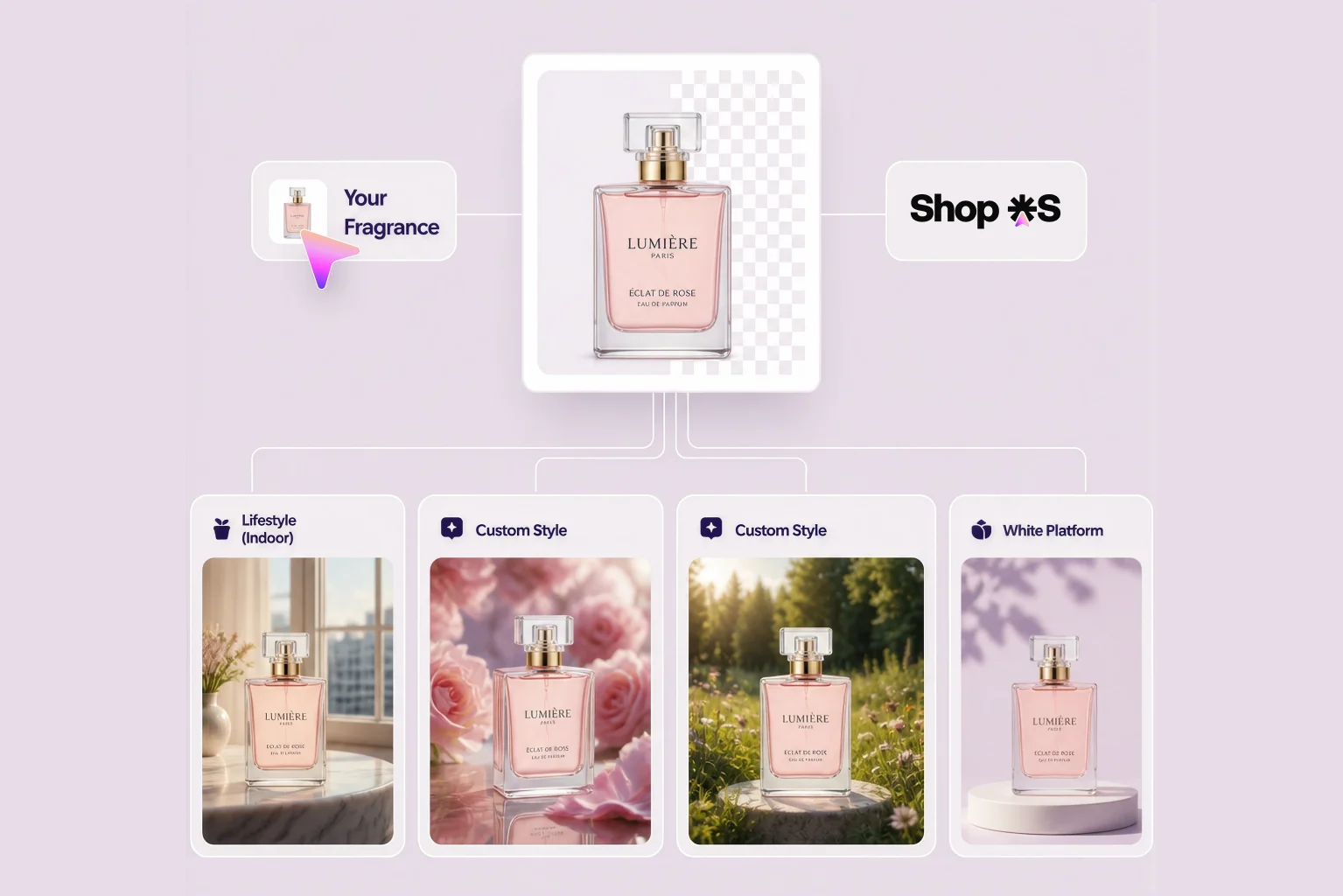
One ecommerce product now needs to work across a product page, marketplace listing, paid advertisement, email campaign and social feed. Each channel calls for a different composition, aspect ratio and creative context. Producing every asset through separate shoots can slow teams down and create gaps between catalog and campaign creative. AI product photography gives ecommerce teams another production path: start with a reliable product asset, apply brand context and create channel-specific visual variations. The value is getting more useful content from information the brand already owns, while people retain final creative and accuracy decisions.
Quick Answer
AI product photography uses an existing product asset, written direction and brand information to create new ecommerce visuals. Brands can develop catalog images, lifestyle settings, model-led fashion content and campaign creatives from the same source, then review each output for product accuracy before publishing.
Turn real product assets into on-brand catalog images, lifestyle scenes, model photography and campaign creatives with ShopOS.Create Your Next Product Campaign With Monica
What Is AI Product Photography?
AI product photography uses artificial intelligence to create or adapt ecommerce visuals from real product assets, written direction and brand context. It can extend an approved source image into new compositions, environments and formats while keeping the product central.
Traditional professional product photography captures a product through a planned physical shoot. The AI-led approach adapts approved assets for additional placements. A team may start with a clean packshot, specify the channel and provide visual direction.
AI photography software should support this commercial workflow rather than treat the product as a loose visual reference. The product’s shape, color, material, proportions, packaging and recognizable details still matter. This separates an ecommerce production system from a broad image generator that may prioritize visual novelty over faithful representation.
The goal is not to remove creative judgment. It is to reduce the repeated production work involved in adapting a product for different customer touchpoints.
From One Product Asset to Campaign-Ready Visuals
Each ecommerce placement serves a different purpose. A useful workflow should create distinct asset types, not the same image in a new size.
Catalog Photography
Catalog photography gives shoppers a direct and consistent view of the item they are considering. Brands can create hero compositions, product-only images, detail close-ups, texture views, feature callouts and multi-SKU arrangements. The emphasis should remain on clarity, comparison and consistency across the range.
AI-supported catalog photography can fill channel-specific gaps, such as a square marketplace image, wider product-page banner or bundle composition built from existing SKU assets. Each output still needs checking against the real item.
Lifestyle Product Photography
Lifestyle product photography places the item in a setting that explains where, when or how it may be used. A cookware brand might show a product in a working kitchen, while a beauty brand may place packaging in a bathroom or travel setting. The scene adds context that a plain product image cannot provide.
Brands can use lifestyle product photography to develop seasonal settings, audience-specific environments and multiple campaign moods. The product should remain the anchor of the composition rather than becoming a minor prop inside an elaborate scene.
Check our guide to lifestyle product photography pricing to see how AI-powered production costs compare with traditional product photography workflows.
Fashion Product Photography With Models
Fashion product photography helps apparel and accessory brands show styling, scale and context. Teams can create on-model views for product pages, collection launches, social posts and paid campaigns. Different poses and environments can give the same item a wider range of usable content.
Read our article on Generative AI in Fashion see how AI helps in fashion
Product photography with models requires particular care because shoppers read the image for information about fit and drape. Fashion product photography should therefore be reviewed against the real garment, especially around sleeve length, hems, fastenings, prints, accessories and body proportions.
Creative Product Photography for Campaigns
Creative product photography is built to attract attention beyond the product page. It can include static advertisements, launch teasers, carousel stories, email banners, social posts and seasonal campaign variations. These assets have more room for art direction, props and visual storytelling than standard listing images.
Effective creative product photography still keeps the item recognizable. Campaign styling should support the product message, offer and audience instead of hiding the details customers need to make a purchase decision.
What Good AI Photography Software Must Get Right
The right AI photography software should be evaluated on production reliability, not only on the appeal of one generated image.
- Product fidelity: Does the output preserve the item’s shape, color, materials and distinguishing features?
- Brand context: Can the system use established visual identity and positioning without requiring the team to restate everything for every asset?
- Repeatable production: Can a team create related outputs across products, formats and campaigns without losing consistency?
- Refinement: Can users request precise changes to a promising output rather than restart the entire process?
- Output control: Does the software support the resolutions, aspect ratios and formats required by ecommerce channels?
- Review: Is there a clear point for human approval before assets are exported or published?
General AI Image Generator vs Ecommerce AI Photography Software
| Criteria | General AI image generator | Ecommerce AI photography software |
| Starting point | A text prompt or optional reference | A real product asset and product information |
| Product treatment | May reinterpret visual details | Should prioritize recognizable product details |
| Brand context | Often repeated in each prompt | Retained brand information guides production |
| Workflow | Usually creates individual images | Supports related assets across products and channels |
| Refinement | Regeneration or separate editing | Focused iteration on an existing direction |
| Review | Depends on the individual user | Built around ecommerce approval and publishing needs |
The difference is practical. Ecommerce teams need a controlled route from an approved product asset to a family of usable visuals, not a collection of unrelated experiments.
How Monica Works With Real Product Assets
Monica is the Creative Director inside ShopOS. It supports AI product photography by working from real product information and the brand’s shared Brand Memory.
Brand Memory carries information about the brand’s tone, positioning and visual identity into the creative process, reducing the need to rebuild that context for every request.
Monica covers two connected areas. For catalog content, teams can work on hero shots, detail views, lifestyle product photography, on-model images, size and fit guidance and multi-product compositions. For marketing content, they can develop social posts, carousels, launch teasers, advertisements and other creative product photography.
There are two natural-language ways to work. Supercomputer is the collaborative mode. A team can share a product, reference or rough direction, review the result and continue refining it through conversation. It suits work where the creative direction is still taking shape.
Read more about AI Creative agent for ecommerce
Creative Studio is the direct mode. It is intended for requests where the team already knows the required asset and wants to generate it without a longer exploratory exchange. Both modes accept plain-language direction and support image, video and editing outputs. Monica uses the available product information and Brand Memory in each request instead of relying only on a standalone prompt.
How Ecommerce Teams Can Use Monica for AI Product Photography
1. Prepare the Source Asset
Choose a clear, high-resolution product image. Record the details that must remain unchanged, including color, materials, proportions, packaging and logos. An approved image from professional product photography can provide a strong starting point.
2. List the Required Outputs
Define what the campaign needs before generating anything. Separate product-page images, model views, paid ads, email banners and social formats so each asset has a clear purpose.
3. Confirm the Brand Context
Review Brand Memory and update any missing information about visual identity, positioning or tone. This gives the request a stable brand foundation.
4. Choose the Working Mode
Use Supercomputer when the team wants to explore references and refine a direction. Use Creative Studio when the composition, channel and output are already defined.
5. Generate and Refine
Review the first output against the brief. Ask for focused changes to the setting, model, framing, lighting or format while retaining the parts that already work.
6. Complete Product QA
Compare the final asset with the real product and the approved source. Export only after the relevant creative, ecommerce and brand stakeholders have reviewed it.
What Teams Must Review Before Publishing
AI product phot remains a production partner, so every final asset needs human approval. Check product shape, proportions, color, materials, shadows and reflections. Confirm that packaging copy, labels, logos and claims match the approved product information.
For fashion product photography, inspect fabric texture, patterns, seams, fastenings, drape and fit. For product photography with models, also review hands, poses, body proportions and the way the person interacts with the item. The image should never communicate a feature or fit that the real product cannot deliver.
Business Outcome: More Useful Visuals From Every Product Asset
AI product photography creates value when it helps a team produce more relevant, channel-specific content from assets it already owns. One approved product image can support catalog photography, campaign variations, social formats and selected model-led scenes without starting every request from zero.
That reduces production coordination, shortens the distance between product launch and campaign delivery and gives lean teams more room to test useful creative directions. Physical shoots and professional product photography still have an important role when precise real-world representation or original art direction is required. The advantage is having a broader production mix, with each method used where it adds the most value.
Create Your Next Product Campaign With Monica
Turn real product assets into on-brand catalog images, lifestyle scenes, model photography, and campaign creatives with ShopOS.
Ready to see what Monica can create for your brand?
Book a personalized demo and explore how ShopOS can fit into your creative workflow.
Frequently Asked Questions
What Type of Source Image Works Best for AI Product Photography?
Start with a sharp, well-lit image in which the complete product is visible and not blocked by props. Use the highest practical resolution and confirm that color, packaging and surface details match the physical item. Cleaner inputs give the team a more reliable reference for generation and review.
When Should a Brand Use a Physical Photoshoot Instead?
Choose a physical shoot when customers need precise evidence of fit, scale, texture, movement or real-world performance. It is also valuable for major brand campaigns that depend on original locations, art direction or recognizable talent. AI can then help adapt approved shoot assets into additional formats.
How Can Teams Maintain Consistency Across Generated Visuals?
Set the visual direction before production, keep product references consistent and use the same approved brand context across related requests. Review outputs as a campaign set rather than approving each image separately. This makes changes in lighting, product scale, color and styling easier to identify.
What Should Teams Check in Product Photography With Models?
Compare the garment or product with its approved reference. Inspect fit, drape, texture, pattern placement, closures and scale. Then check the model’s hands, posture, proportions and physical interaction with the product. Reject any output that could create a misleading customer expectation.
Can One Product Asset Support Product Pages, Ads and Social Media?
Yes, when the source asset contains enough accurate product information. The team should still create a separate brief for each channel because product pages prioritize clarity, while advertisements and social posts may need stronger context, messaging and visual storytelling.