
- What Is Brand Taste?
- AI Has Lowered the Barrier to Content Creation
- Why More Content Is Creating More Sameness
- What Does AI Slop Mean for Ecommerce Brands?
- Original Content Begins With Consumer Insight
- Treat Content Like a Product
- Taste Is Also the Ability to Say No
- Repeatable Content Formats Can Become Brand IP
- A Visual Style Is Not a Brand Point of View
- What AI Cannot Fully Supply
- Where Monica Fits
- Conclusion
- Turn Brand Taste Into a Consistent Creative System
- Frequently Asked Questions
AI-generated content has made publishing easier. A team can now draft scripts, create visuals, build carousels, and develop campaign concepts faster.
But easier creation has not made it easier to stand out.
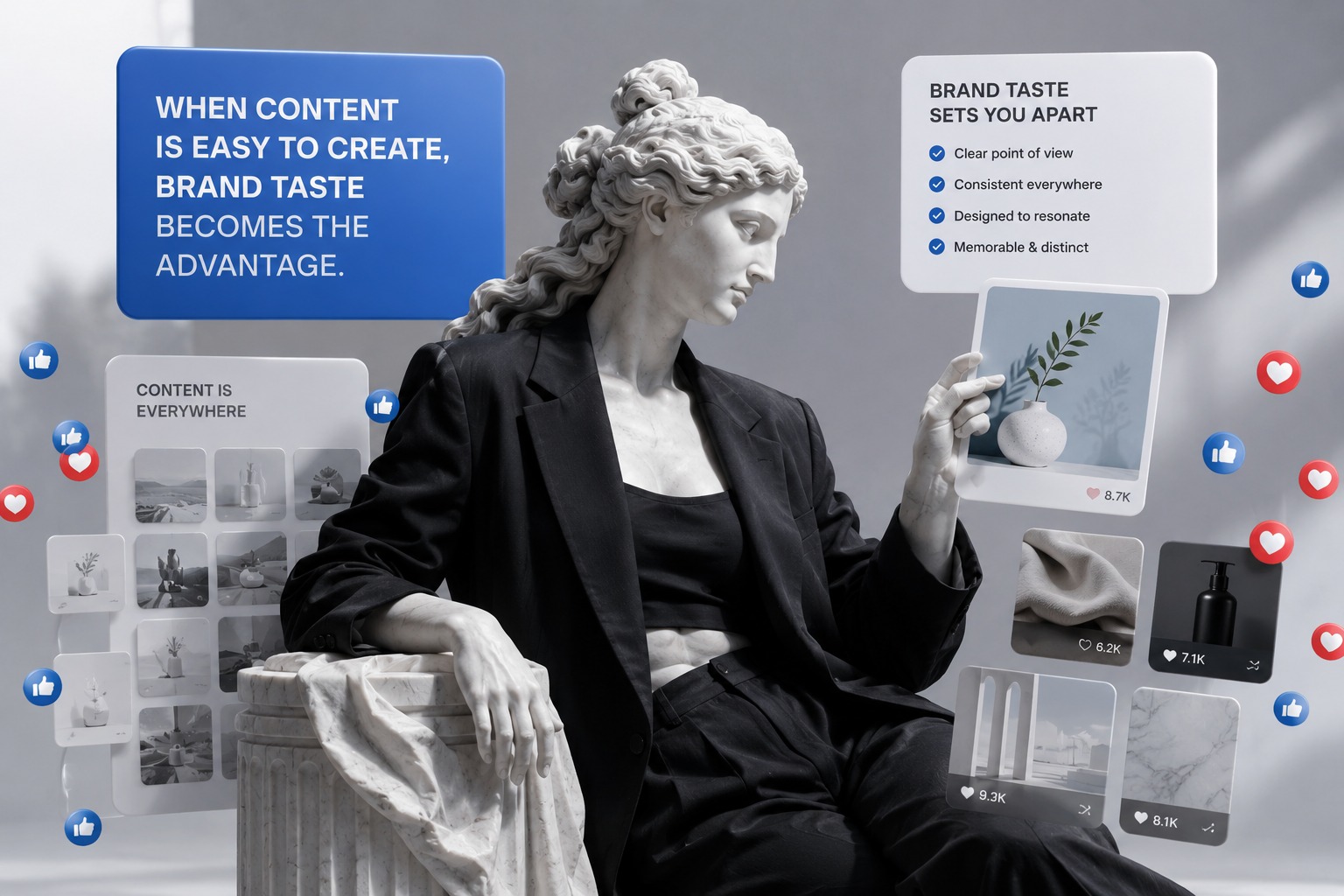
When the same tools, prompts, hooks, references, and templates are available to everyone, content begins to look and sound the same. The advantage is no longer generation. It is knowing what deserves to be created, what should be rejected, and what only your brand can say.
That is where brand taste becomes valuable.
What Is Brand Taste?
Brand taste is the ability to choose ideas, formats, visuals, and language that fit the brand and matter to the audience.
A team with strong taste can identify useful insights, reject generic output, and build content people associate with one brand.
An effective AI content strategy needs a clear point of view and an editorial standard.
AI Has Lowered the Barrier to Content Creation
Generative AI in content marketing lets brands explore ideas, generate alternatives, and move from a rough thought to a usable draft quickly.
When production becomes widely available, speed becomes less defensible. A brand may publish more and still become less memorable.
The question is no longer, “Can we create this?” It is, “Why should this exist, and why should it come from us?”
AI content marketing works best when generation follows a strong idea. Without that foundation, speed only helps brands produce generic content faster.
Why More Content Is Creating More Sameness
Most AI-generated content becomes repetitive for three reasons.
First, the brief is broad. A prompt such as “create a stylish post for a fashion brand” gives the system no audience tension, cultural context, or brand belief.
Second, the inputs are borrowed. Teams use the same trend lists, competitor references, and popular hooks.
Third, there is no meaningful curation. The first acceptable output gets published because it looks polished and arrives quickly.
The result is different logos with similar language, visuals, pacing, and claims.
Human creativity and AI work better when the human provides the reason and the machine helps explore the expression.
What Does AI Slop Mean for Ecommerce Brands?
AI slop is low-context, repetitive, or disposable AI-generated content created because generation is easy.
For ecommerce brands, it may look polished but say little. Common signs include generic hooks, borrowed aesthetics, irrelevant trends, and vague copy. It may gain attention, but attention without recognition does not build durable brand value.
A useful test is simple: if a competitor could publish the same idea with only minor changes, the content is not distinctive enough.
A stronger AI content strategy asks whether an idea adds something useful to the category before asking how quickly it can be produced.
Original Content Begins With Consumer Insight
Original content usually starts with a real tension, habit, frustration, aspiration, or decision the audience already experiences.
Holy Drip, a men’s fashion editorial, offers a clear example. Its content is not built around the broad statement that men like fashion. It starts with a sharper observation: many men want to dress well but feel overwhelmed by daily pairing decisions.
That insight creates content around shirts, trousers, shoes, body types, occasions, and cultures.
During the ShopOS panel, Holy Drip explained that its mission is to reduce decision overload and bring curation back into men’s fashion. The team turns that problem into practical, repeatable ideas.
This is the difference between a topic and an insight.
“Men’s fashion” is a topic.
“Men want to dress well but struggle to combine what they already own” is an insight.
Generative AI in content marketing can expand an insight into many executions. It should not be expected to discover the brand’s most valuable truth without meaningful human input.
Treat Content Like a Product
Holy Drip also described content as a product rather than media inventory.
A product feature must solve a problem. Content should do the same. Before approving an idea, ask:
- What audience problem does this solve?
- What decision does it make easier?
- What new perspective does it offer?
- Why should the audience return for another version?
The panel explained that each content format can be treated like a feature. Its value comes from the audience need it addresses, not simply the number of views it receives.
This changes how teams approach AI content marketing. Instead of filling a calendar, they identify which useful formats deserve to become recurring properties.
A comparison can reduce uncertainty. A demonstration can prove a benefit. A styling series can simplify choice. Volume should come from a strong format, not replace one.
Taste Is Also the Ability to Say No
Taste is not only knowing what looks good. It is also the ability to reject.
The Holy Drip team explained that it became faster by getting better at filtering. It learned what to cut, which outputs lacked finesse, and what did not fit its point of view. Saying no became part of maintaining originality while using AI.
More options do not guarantee better decisions. A clear review process should reject content that is:
- Visually impressive but strategically empty
- On trend but off brand
- Too similar to competitors
- Built around a claim the brand cannot own
- Unhelpful to the intended audience
Good curation protects brand authenticity and prevents teams from confusing abundance with quality.
Repeatable Content Formats Can Become Brand IP
A strong format is more defensible than a single successful post.
When a brand solves a recognizable problem in a recognizable way, the format starts building memory. This could be a comparison, styling series, demonstration, editorial breakdown, or character-led story.
The goal is not repetition. It is a consistent container for new ideas.
A competitor can copy one post quickly. It is harder to reproduce a format supported by category knowledge, audience understanding, and judgment.
AI-generated content can extend a format, but the format itself should come from the brand’s point of view.
A Visual Style Is Not a Brand Point of View
AI has made aesthetic imitation easier. Lighting, composition, colour palettes, illustration styles, and editing rhythms can all be copied.
But a visual style is only the surface.
A brand point of view answers deeper questions:
- What does the brand notice that others ignore?
- What does it believe about the category?
- Which audience problem does it understand differently?
- What will it consistently simplify, challenge, or celebrate?
Two brands can use the same AI tool and create different work if their beliefs differ. They can also use different visual systems and still sound identical when their ideas come from generic prompts.
AI content marketing becomes valuable only when the brand has something specific to say.
What AI Cannot Fully Supply
Large language models can summarize patterns, generate alternatives, and refine an idea. They do not have a brand’s lived history.
They cannot replace customer conversations, cultural observation, category experience, product knowledge, founder conviction, or personal taste.
The panel made this distinction clearly. Original direction comes from experience, while AI can support iteration, checking, and feedback. Without added context, similar prompts produce similar ideas.
Human creativity and AI should therefore carry different responsibilities. Humans bring meaning, judgment, context, and conviction. AI helps organize, explore, and express those inputs.
For generative AI in content marketing to support originality, the brand must first supply the insight and the standard against which every output will be judged.
Where Monica Fits
Monica, ShopOS’s AI Creative Director, should not replace the brand’s original insight or point of view. Its role begins after the team knows what the campaign should communicate.
Monica helps turn a defined direction into connected campaign assets. Through Brand Memory, teams can carry brand context into future outputs instead of starting from a blank prompt.
This matters because AI-generated content becomes more consistent when every output is guided by the same brand rules, product context, and creative direction.
The brand owns the taste. Monica helps carry that direction consistently.
Conclusion
The rise of AI-generated content does not make originality less important. It makes originality easier to recognize.
When execution becomes widely available, the advantage moves upstream. It sits in the consumer insight, the editorial choice, the repeatable format, and the brand point of view behind the output.
Brands do not need to reject generative tools. They need to stop treating generation as the complete AI content strategy.
The brands that stand out will not be the ones that publish the most AI-generated content. They will be the ones that know what deserves to be published, what should be rejected, and what only their brand can say.
Turn Brand Taste Into a Consistent Creative System
Strong ideas should not get lost in disconnected prompts, inconsistent outputs, or repeated revision cycles.
See how Monica helps ecommerce teams turn one clear creative direction into connected, on-brand campaign assets while keeping human judgment at the centre.
Sign-up to see Monica in action.
Frequently Asked Questions
What makes AI-generated content original?
It becomes more original when it starts with a consumer insight, first-hand observation, or brand belief. Better prompts can improve execution, but they cannot replace the underlying idea.
How can brands avoid AI slop?
Brands can avoid AI slop by grounding ideas in audience problems, using clear briefs, rejecting generic outputs, and building repeatable formats instead of disconnected posts.
What is the role of human creativity and AI in content marketing?
Humans should define the insight, context, point of view, and quality standard. AI should support exploration and expression without replacing judgment.
Why is content curation important?
Content curation helps brands select useful, differentiated ideas and remove output that adds volume without strengthening recognition.