

- Why Do Most Ecommerce AI Strategies Fail?
- AI-Assisted Is Not AI-First
- What We Learned From 75 DTC Founders
- Why the Brand’s AI Problem Is Different
- The Three Things AI Agents for Ecommerce Brands Must Solve
- Ecommerce Content Automation Needs More Than Generation
- AI Workflow Automation for Ecommerce Starts With One Loop
- More AI Tools Do Not Mean Better Brand Outcomes
- The Real Bottlenecks Are Briefing, Approval, and Distribution
- Brand Memory Is the Harness That Makes AI Useful
- The Night Shift: What AI Agents Do When Your Team Is Offline
- Meet the ShopOS AI Agents Behind the Brand Loop
- Why Brands Need an AI Operating System for Ecommerce Brands
- What This Actually Costs Compared to Traditional Content Operations
- The Honest Part: What Still Needs Work
- The New Brand Org
- What to Do First
- Where This Ends Up
- Summary
- FAQs
AI Agents for Ecommerce Brands. Ninety-nine percent of the content on some of our best-performing brands is now generated by AI.
Last Tuesday, a brand we work with shipped 50 product descriptions, A/B tested two hero images by noon, killed the weaker performer by 3 PM, and pushed a new lifestyle shot live by 5 PM. Three months ago, that same cycle would have taken six weeks, two agencies, a photographer, a designer, a content lead, and three rounds of revision.
They did not get there by asking ChatGPT to write captions.
They changed how the brand operates.
They changed how they brief, generate, test, approve, publish, and improve content. Most importantly, they stopped adding AI to old workflows and started rebuilding the workflow around AI.
That is where most ecommerce brands are stuck right now.
They have ChatGPT for captions, an image tool for product visuals, another app for copy, and maybe a reporting tool for performance. But the same people still brief manually, approve manually, upload manually, test manually, and report manually.
That creates faster output.
It rarely creates a better operating system.
This is why AI agents for ecommerce brands matter. The real opportunity is not more content. It is a connected system where brand memory, product data, creative workflows, store updates, email, SEO, and performance learning work together.
ShopOS is built for that shift. It helps DTC brands move from scattered AI usage to an AI operating system for ecommerce brands.
Why Do Most Ecommerce AI Strategies Fail?
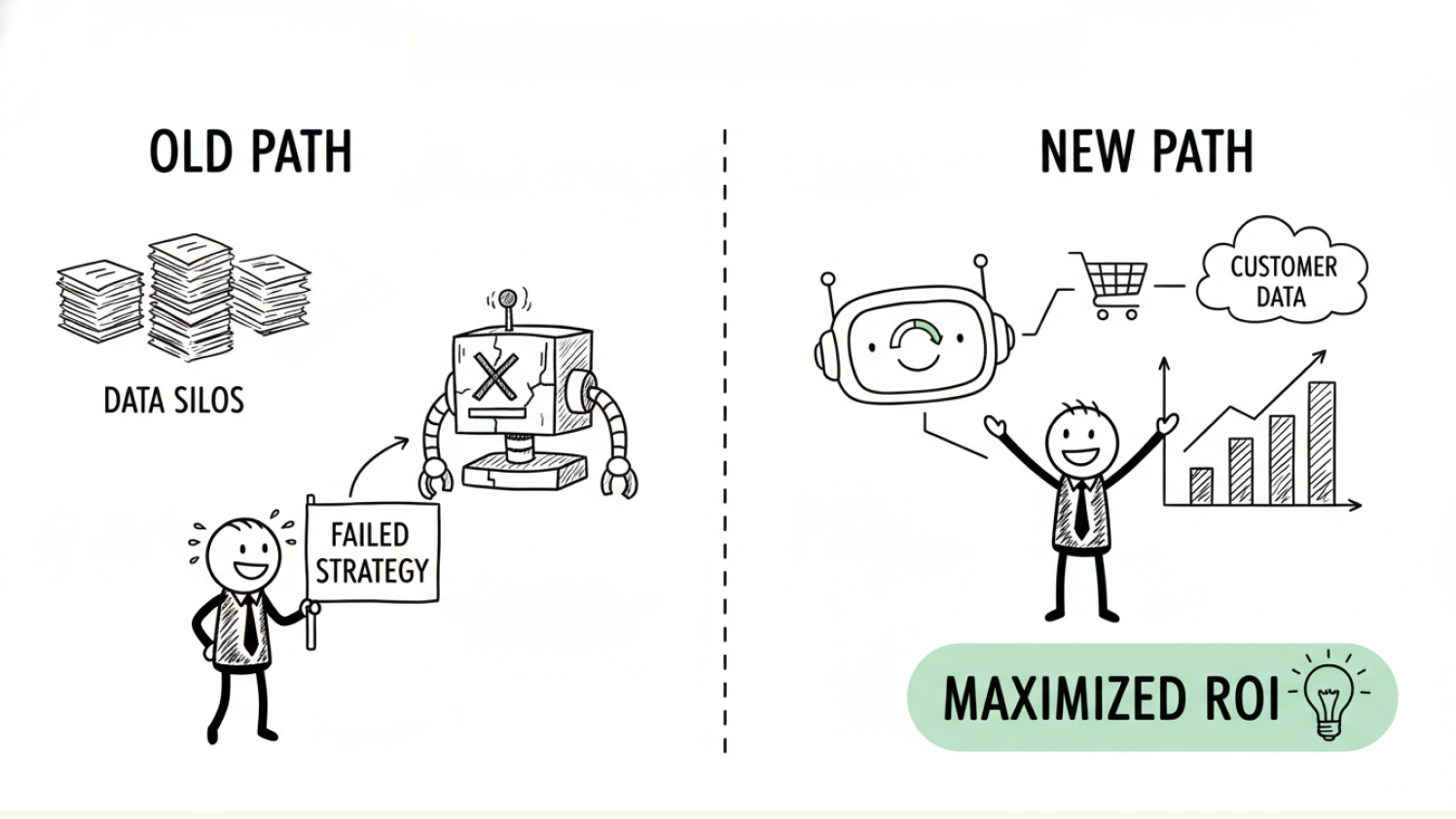
Most ecommerce AI strategies fail because brands use AI tools inside outdated workflows. They generate faster copy, faster visuals, and faster ideas, but the work still depends on manual briefing, approval, uploading, testing, and reporting.
This is where ShopOS AI agents for ecommerce brands become useful. They connect brand memory, product data, content generation, Shopify execution, CRM, SEO, and performance learning into one repeatable operating loop.
Instead of asking AI to help with one task, an AI-first ecommerce strategy asks a bigger question:
How should the whole brand operation change when AI can generate, evaluate, publish, measure, and improve at scale?
That is the difference between using AI and operating with AI.
AI-Assisted Is Not AI-First
AI-assisted work looks productive on the surface.
Someone opens an AI tool, asks it to write a product description, edits it for twenty minutes, pastes it into Shopify, and repeats the process for another hundred SKUs.
It saves time, but only at the drafting stage. Someone still has to review each output, edit it, approve it, upload it, and repeat the cycle for every SKU. So the team works faster, but the structure of the work remains the same.
AI-first means something different.
It means the brand stops asking, “How can AI help my team finish the same work faster?” and starts asking, “How should our workflow change when AI can produce, analyze, test, and improve at scale?”
That shift changes the role of the designer, content lead, store manager, CRM owner, and founder. The team spends less time producing repetitive assets and more time making decisions about taste, direction, brand positioning, and growth.
This is where AI agents for ecommerce brands become valuable. They are not another writing tool or image generator. They are role-based systems that support repeatable ecommerce work across creative, content, storefront, CRM, SEO, performance, and growth.
| AI-Assisted Ecommerce | AI-First Ecommerce |
| Uses AI for isolated tasks | Rebuilds workflows around AI |
| Generates captions, images, or product descriptions | Connects generation, approval, publishing, and measurement |
| Depends on manual uploading and tracking | Uses AI workflow automation for ecommerce |
| Saves time on production | Changes how the brand operates |
| Works tool by tool | Works through agents, Brand Memory, Loops, and Connectors |
| Output-focused | Outcome-focused |
What We Learned From 75 DTC Founders
A few weeks ago, we ran a live session with DTC founders and ecommerce operators.
More than 100 people signed up. Around 75 stayed through the full session. Nearly half of the attendees came from outside India.
The questions were not basic. They were practical.
What about data privacy? How much does it cost? Will this replace my agency? How does this connect with Shopify? How fast can this become usable inside my team?
That told us something important.
Most ecommerce founders already understand that AI matters. The real confusion is around operationalizing it.
So we showed a simple workflow using one Shopify store, Shopify’s AI Toolkit, Claude Code, and ShopOS.
The flow was straightforward: connect the store, upload a product image into ShopOS, pick a lifestyle setting, generate a new visual, review it, and push the selected image into the correct product page position.
The total flow took around 12 minutes for one product.
The powerful part was not that AI created an image. Many tools can do that now. The powerful part was that the image moved closer to execution. It was connected to the store workflow.
A standalone AI tool gives you an asset.
An AI operating system for ecommerce brands helps turn that asset into a live commercial action.
Why the Brand’s AI Problem Is Different
A brand’s work is not clean like a codebase.
A product catalog may have inconsistent descriptions. A Shopify theme may carry years of patched-together edits. An Instagram grid may have a vibe everyone recognizes but nobody has documented. A best-selling product may work because of small details hidden inside customer behavior, not because of obvious product features.
AI cannot guess all of that.
When a brand asks a generic AI tool to write a product description, the output often sounds polished but forgettable. It does not know the brand voice, customer, approved claims, best-performing visual style, or past campaign learnings.
The AI is not failing.
The brand has not built the harness.
That harness is Brand Memory.
Brand Memory gives ecommerce AI agents the context they need to do useful work. It stores voice, visual direction, product truths, customer personas, approved examples, rejected examples, competitor context, seasonal priorities, campaign history, and performance learnings.
Without that layer, AI outputs generic content.
With that layer, AI-powered brand management becomes possible.
The Three Things AI Agents for Ecommerce Brands Must Solve
Most DTC teams do not have a creativity problem.
They have a production, consistency, and execution problem.
The team has ideas. The bottleneck appears when every product, campaign, channel, and customer segment needs fresh work at the same time.
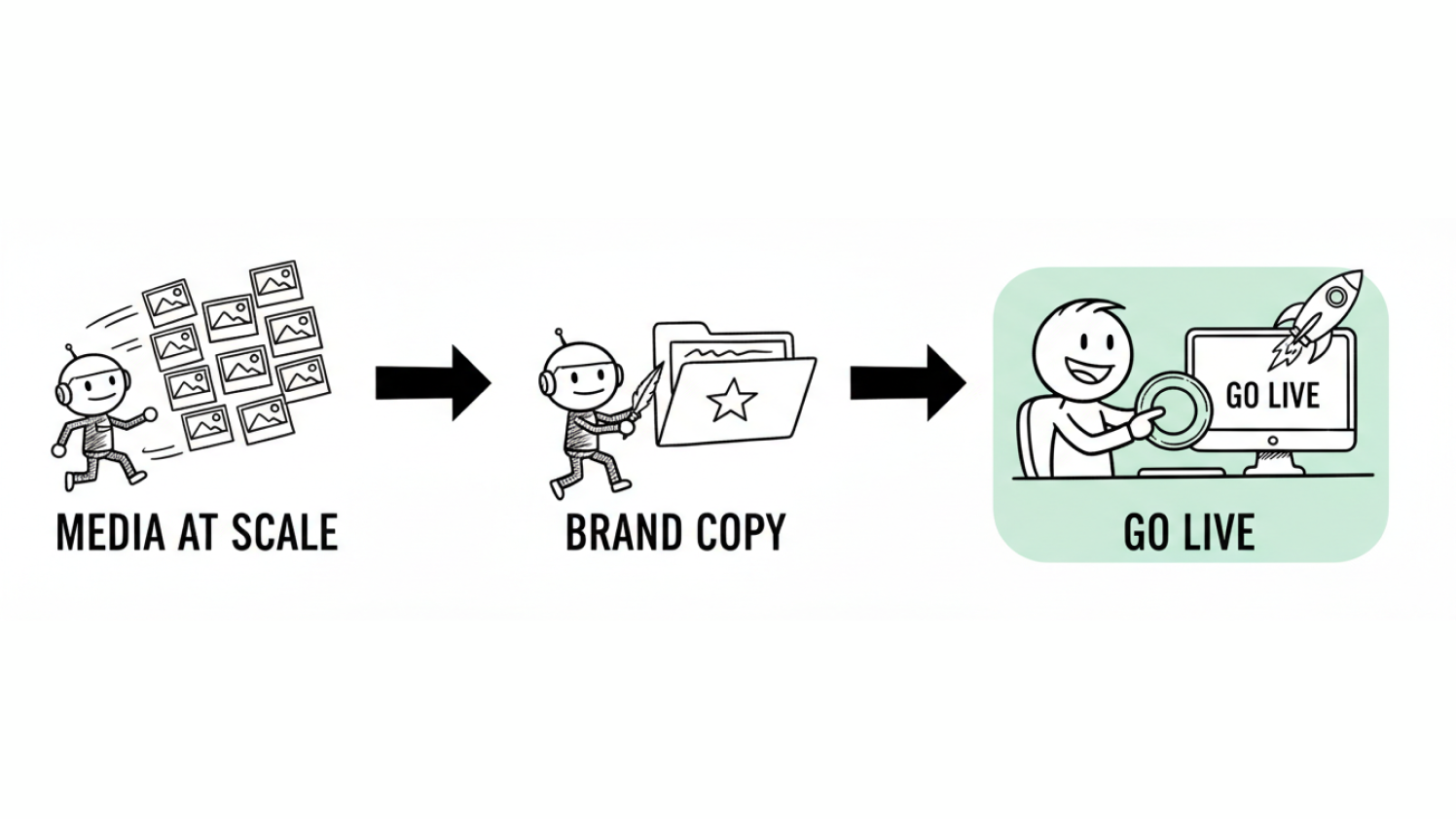
AI agents for ecommerce brands need to solve three connected needs.
1. Media at Scale
A growing ecommerce brand does not need one product image. It needs product images for every SKU, background, campaign, season, platform, and audience segment.
Traditional shoots are expensive. For a brand with hundreds of products and multiple seasonal campaigns, the budget becomes painful very quickly.
A standalone AI image generator can create a lifestyle shot.
An AI agent platform for ecommerce brands can identify image gaps, generate variants, connect visuals to the right SKU, stage updates, help the team review them, and push the winning creative live.
2. Copy That Sounds Like the Brand
Generic SEO filler does not build a brand.
Product descriptions, ads, emails, social captions, collection pages, landing pages, abandoned cart flows, and metadata need to carry the same tone, promise, and customer understanding.
AI for DTC brands becomes powerful when the system already knows how the brand speaks, what the customer cares about, which phrases feel natural, and which claims should be avoided.
That is why Brand Memory sits at the center of ShopOS.
3. Content That Goes Live
A beautiful image sitting in a folder has zero commercial value.
A strong product description in a Google Doc does nothing until it reaches the product page.
The last mile matters.
Store updates, email flows, ad variants, PDP improvements, SEO changes, metadata fixes, image placement, and creative testing need to become part of the same operating loop.
That is where Ecommerce Content Automation needs to move beyond generation. The real value is not just creating output. The real value is creating movement.
Ecommerce Content Automation Needs More Than Generation
Ecommerce Content Automation often gets reduced to writing product descriptions or creating social captions.
That is too small.
Real Ecommerce Content Automation connects what the brand knows, what the product needs, what the channel requires, and what performance data reveals.
A new product launch may need PDP copy, launch emails, paid ad variants, lifestyle imagery, social posts, metadata, collection page copy, retargeting angles, and follow-up flows.
When every task moves through a separate tool and separate owner, the process becomes slow again.
AI agents for ecommerce brands should help teams move through the full workflow. They should create first drafts, apply brand rules, identify missing assets, surface approval needs, support store updates, analyze performance, and recommend the next action.
Generation creates output.
Automation creates movement.
AI Workflow Automation for Ecommerce Starts With One Loop
The strongest brands are not trying to automate everything at once.
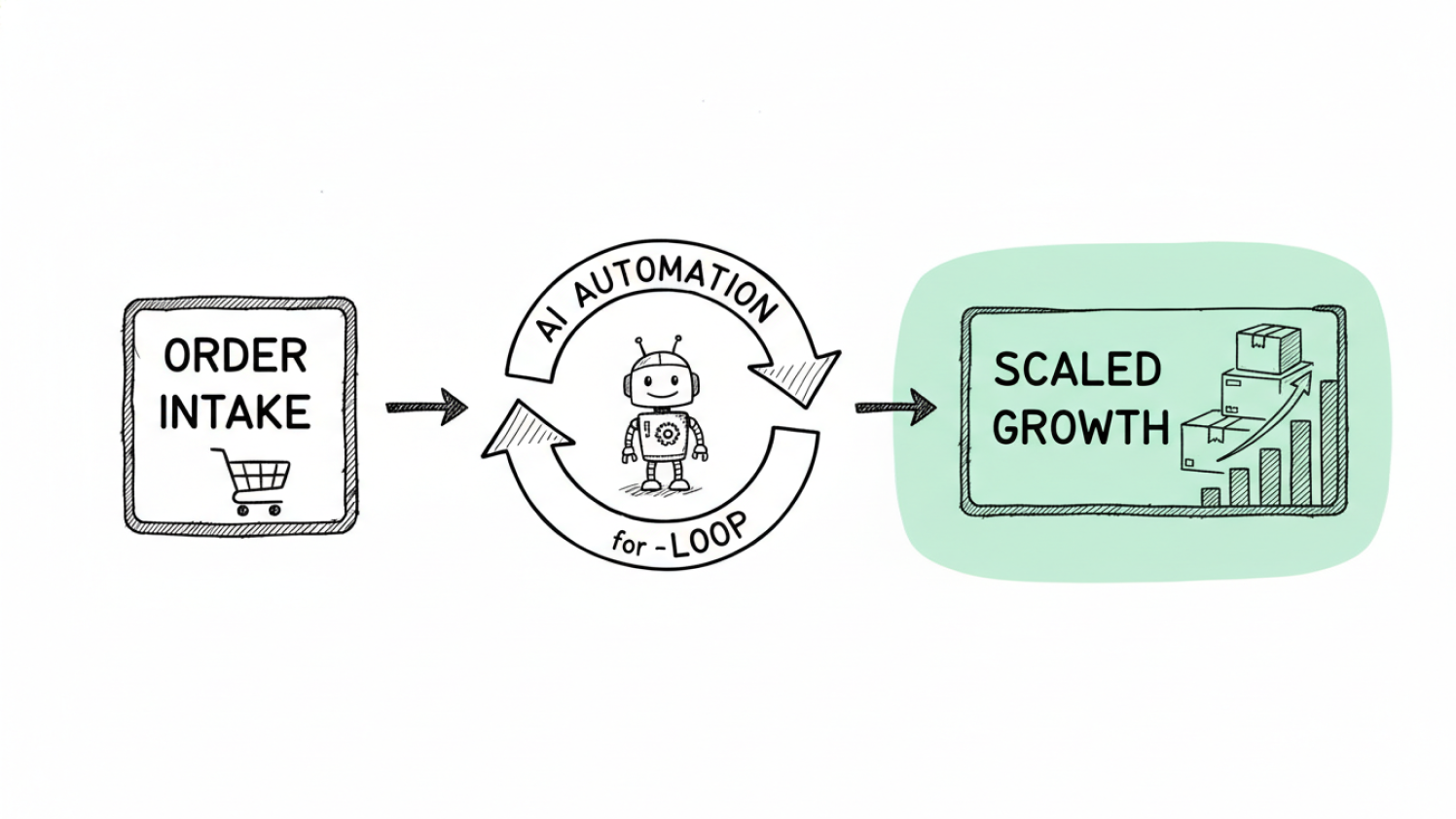
They start with one repeatable loop and make it work.
Generate → Evaluate → Push live → Measure → Generate again
That simple cycle is the heart of AI workflow automation for ecommerce.
A brand can use it for product descriptions, PDP improvements, email flows, ad creative, SEO updates, collection pages, product imagery, abandoned cart journeys, campaign refreshes, and store audits.
The mistake is trying to rebuild the entire brand operation in one move.
A smarter path starts with the highest-friction workflow. For many ecommerce teams, that is product content. For others, it may be product visuals, creative testing, email, catalog cleanup, or SEO.
Pick one loop. Tighten it. Build trust in the output. Improve the memory. Then add the next loop.
This is how AI agents for ecommerce brands become practical.
The team does not need a giant AI transformation project. It needs one working workflow that proves the model.
More AI Tools Do Not Mean Better Brand Outcomes
Many ecommerce brands are collecting AI tools faster than they are fixing their workflows.
One tool for product copy. One tool for images. One tool for research. One tool for SEO. One tool for reporting. One tool for ads.
On paper, that looks advanced.
In practice, it often creates more scattered work.
The team still copies, pastes, reviews, uploads, checks, formats, and measures everything manually.
So the brand has more tools, but the workflow still feels heavy.
That is the trap.
A brand using ChatGPT, Midjourney, Runway, Perplexity, Claude, and five Shopify apps without restructuring its operating process is not AI-first.
It is AI-distracted.
The brands getting real value from AI are doing something different. They are building one repeatable operating loop and improving it every week.
A product description generator is useful. But a product content loop that finds weak PDP copy, rewrites it in the brand voice, stages it for review, pushes approved changes live, and learns from conversion data is far more valuable.
An AI image generator is useful. But a product visual loop that flags missing assets, creates variants, connects them to SKUs, supports approval, and tracks performance is far more powerful.
This is why AI agents for ecommerce brands should be judged by how much movement they create, not just how much content they generate.
The Real Bottlenecks Are Briefing, Approval, and Distribution
Content generation is no longer the hardest part.
The bottlenecks have moved.
The Briefing Bottleneck
Most brands still brief work using PDFs, mood boards, loose guidelines, scattered examples, and founder notes.
Humans can interpret that mess. AI needs structured context.
Until brand voice, visual direction, product rules, customer insight, competitor references, and examples become machine-readable, the agent is working with partial information.
The Approval Bottleneck
If AI creates one hundred pieces of content and the founder has to manually review all one hundred, the system has not truly scaled.
Human judgment still matters, but it needs to be applied where it creates the most value.
Low-risk updates, routine fixes, and pattern-based improvements can move through lighter review. High-impact creative and brand-sensitive changes should still reach the right person.
The Distribution Bottleneck
Content in a folder does not drive sales.
Product copy has to reach the PDP. Images have to be placed in the right order. Emails have to be set up. Ads have to be tested. SEO updates have to be implemented.
AI workflow automation for ecommerce matters only when generated work can reach the customer.
A brand that fixes generation but ignores approval and distribution has only moved the constraint.
Brand Memory Is the Harness That Makes AI Useful
The most important feature in an AI operating system for ecommerce brands is not a prompt box.
It is Brand Memory.
Brand Memory gives AI the context it needs to work like part of the team. It can include brand voice, customer personas, product truths, visual references, approved language, rejected examples, competitor context, seasonal priorities, campaign performance learnings, and store patterns.
Without Brand Memory, AI behaves like a talented freelancer on the first day of work. It can produce something polished, but it may miss the brand’s real edge.
With Brand Memory, ecommerce AI agents can create work that feels closer to the brand from the start.
That is how AI-powered brand management becomes operational, rather than theoretical.
The Night Shift: What AI Agents Do When Your Team Is Offline
Your store does not stop working when your team logs off.
At 2 AM, inventory may drop below threshold. At 3 AM, customers may abandon carts. At 4 AM, product images may be ready for review. At 5 AM, a competitor may change pricing. At 6 AM, the founder may need to know what changed overnight.
Before AI, most of that waits until morning.
With AI agents running, the system can keep moving.
An inventory alert can fire. An abandoned cart sequence can be personalized by cart value, product category, and browsing behavior. Product images can be generated and staged. Competitor pricing can be reviewed and flagged. A morning report can summarize what happened, what changed, and what needs human attention.
The founder is not managing ten disconnected tools.
The founder becomes an air traffic controller.
The agents handle the volume, routing, pattern recognition, and first-pass execution. Humans make the calls that require judgment.
That is the future of AI for DTC brands.
Meet the ShopOS AI Agents Behind the Brand Loop

ShopOS is built around a simple idea.
Ecommerce teams do not need a pile of disconnected AI tools. They need a connected AI Platform for Ecommerce Brands that brings Brand Memory, agents, workflows, spaces, connectors, and performance learning into one system.
The agents inside ShopOS support different parts of the ecommerce operation while working with shared brand context.
Monica, Creative Director
Monica supports creative direction and visual production. She helps ecommerce teams move from product assets to campaign-ready visuals, lifestyle concepts, ad creatives, PDP imagery, and seasonal variations.
Richard, Shopify Store Manager
Richard supports store execution. He helps with product updates, PDP improvements, catalog fixes, image placement, missing content, and Shopify-ready tasks.
Gavin, Performance Marketing
Gavin supports performance decisions. He helps read campaign signals, creative performance, conversion behavior, and test results.
Dinesh, Email and CRM
Dinesh supports email and CRM workflows. He helps with lifecycle emails, abandoned cart flows, promotional campaigns, customer segments, subject lines, retention messages, and CRM-ready communication.
Erlich, Social and Content
Erlich supports social and content workflows. He helps turn Brand Memory into platform-specific posts, campaign narratives, captions, launch messaging, and social-first angles.
Big Head, GEO and SEO
Big Head supports search visibility, AI search readiness, technical content opportunities, PDP optimization, metadata, content gaps, and generative engine optimization.
Jian-Yang, Brand Intelligence
Jian-Yang supports brand intelligence. He helps organize customer insight, competitor context, market signals, brand voice, product truths, and past learnings into useful direction for the rest of the system.
Russ, Finance and Growth
Russ supports finance and growth thinking. He helps connect AI workflows to cost, margin, production economics, agency spend, growth efficiency, and investment decisions.
Together, these agents make ShopOS more than an AI writing tool or image generator.
They make it an AI agent platform for ecommerce brands that connects creative, content, CRM, SEO, Shopify operations, performance, and growth.
Why Brands Need an AI Operating System for Ecommerce Brands
A brand using five disconnected AI tools may still operate slowly.
The team may generate faster, but it still has to copy, paste, review, upload, format, test, measure, and repeat everything manually.
That creates a busy workflow, not a better one.
An AI operating system for ecommerce brands gives the team a connected way to work.
Brand Memory keeps the context consistent. Agents handle specific roles. Spaces organize work by campaign, launch, catalog, or workflow. Loops make repeated operations easier to run. Connectors help the system interact with Shopify, Meta, CRM platforms, and performance data sources.
That connected structure turns AI from a side tool into operating infrastructure.
This is the difference between using AI and operating with AI.
What This Actually Costs Compared to Traditional Content Operations
Traditional content production is expensive because it depends on people, agencies, shoots, revisions, and manual coordination.
AI does not remove every cost.
It changes the cost structure.
Instead of paying for every single asset to be manually produced, the brand invests in the system that creates, reviews, improves, and distributes those assets repeatedly.
There are still costs involved: AI tools, image generation, platform usage, setup time, integrations, review workflows, and team training.
But once the loop works, the economics change.
One workflow can support hundreds of product descriptions. One visual system can generate multiple product image variants. One SEO agent can keep identifying metadata, PDP, and content gaps. One email workflow can produce campaign variations without starting from scratch every time.
The comparison is not simply AI cost versus agency cost.
The better comparison is this:
How much does it cost your team to keep doing the same work manually every week?
That includes founder review time, designer time, copywriter time, store manager time, agency coordination, delayed launches, stale PDPs, weak product visuals, slow testing, and missed revenue opportunities.
That is why ShopOS is not positioned as another AI tool.
It is built to help ecommerce teams change the economics of brand execution.
The Honest Part: What Still Needs Work
The future is exciting, but the current reality deserves honesty.
Many AI workflows are still too technical. Some setups require tools, permissions, integrations, command-line steps, and workflow knowledge that most brand owners do not want to deal with.
AI also needs strong Brand Memory. Without that foundation, output may be polished but generic.
Approval systems still need work. If a team increases content output by 10x but still reviews every asset manually, the bottleneck comes back.
Rollback is another real issue. When AI changes several product descriptions or store assets, teams need a clean way to compare versions, reverse mistakes, and manage quality.
This is exactly why ShopOS exists.
The goal is to make the AI-first ecommerce workflow simple enough for operators, not just technical teams.
The New Brand Org
The strongest DTC teams will not look like traditional content teams.
They will have fewer people doing repetitive production and more people directing systems.
The Brand Architect builds the harness. They define Brand Memory, workflow rules, agent instructions, approval steps, and what can go live automatically versus what needs a human review.
The Brand Operator reviews what the agents surface, makes judgment calls, and handles the parts that require human context.
The ability to evaluate brand content will become more valuable than the ability to produce it manually.
Humans remain central. They simply stop carrying every repetitive task manually.
What to Do First
A brand does not need to automate everything on day one.
Start with Brand Memory.
Document the brand voice, customer, product context, visual rules, approved examples, rejected examples, content that performed well, language to use, language to avoid, and campaign patterns.
Then choose one loop.
For many ecommerce brands, the first useful loop is product content. Audit the catalog. Find missing descriptions, weak PDP copy, inconsistent tone, thin metadata, and outdated product images.
Let the system generate improvements. Review the output like a brand director, not a spell-checker. Fix the memory and workflow when the output misses the mark.
Then move to the next loop.
That may be product visuals, email, abandoned cart, social content, SEO, or performance creative.
The brands that win with AI will not be the ones with the longest tool stack. They will be the ones that build repeatable systems around context, agents, workflows, and measurement.
Where This Ends Up
Stores are becoming infinitely programmable.
That means they are also becoming infinitely personalizable.
The same product page does not need to look the same for every customer. Different lifestyle shot. Different product copy. Different sizing recommendation. Different social proof. Different email follow-up. Different retention trigger.
Ecommerce has promised personalization for years and delivered segmentation.
AI agents change that.
When Brand Memory, product data, customer signals, creative generation, store execution, and performance learning sit inside one operating loop, personalization stops being a campaign tactic.
It becomes infrastructure.
- The toolkit is just the starting point.
- The harness is what makes it useful.
- The agents are what make it scalable.
- The humans are what make it a brand.
Summary
Most brands do not have an AI strategy problem because they lack tools.
They have a workflow problem.
They use AI for scattered tasks while the rest of the operation still runs through manual briefing, approval, uploading, testing, and reporting.
AI agents for ecommerce brands change that model.
They help teams move toward a system where Brand Memory, ecommerce AI agents, connected workflows, and human judgment work together.
ShopOS fits this shift as an AI Platform for Ecommerce Brands built around Brand Memory, Spaces, Loops, Connectors, and specialized agents.
It helps DTC teams move beyond one-off prompts and toward an AI operating system for ecommerce brands.
The future of ecommerce AI will not be won by brands using the most tools.
It will be won by brands that build the strongest loops.
Build the harness first.
You Don’t Need Another AI Tool
You need a system that can remember the brand, do the work, push it live, measure what happened, and make the next cycle smarter.
That is the shift ShopOS is built for.
See How ShopOS Turns AI Into an Operating System: Book a Demo
FAQs
What are AI agents for ecommerce brands?
AI agents for ecommerce brands are role-based AI systems that support specific ecommerce tasks such as product content, creative production, Shopify updates, email, SEO, social content, performance analysis, and brand intelligence. They work best when connected to Brand Memory, product data, workflows, and human approval.
Why do ecommerce brands need an AI-first ecommerce strategy?
Ecommerce brands need an AI-first ecommerce strategy because scattered AI tools usually improve speed without changing the real workflow. An AI-first approach rebuilds how the team briefs, creates, reviews, publishes, measures, and improves content. This helps brands scale output while keeping stronger control over voice, visuals, and execution.
How does Brand Memory help ecommerce AI agents?
Brand Memory gives ecommerce AI agents the context they need to create useful work. It stores brand voice, customer insights, product details, visual direction, approved examples, rejected examples, competitor context, and performance learnings. This helps agents produce work that feels closer to the brand and reduces repeated manual correction.
What is an AI operating system for ecommerce brands?
An AI operating system for ecommerce brands is a connected platform that brings together Brand Memory, AI agents, workflows, content generation, store execution, performance learning, and team collaboration. Instead of using separate AI tools for separate tasks, the brand runs repeatable loops across creative, content, CRM, SEO, store management, and growth.
How can AI workflow automation for ecommerce improve content execution?
AI workflow automation for ecommerce improves content execution by moving work through a repeatable cycle: generate, evaluate, publish, measure, and improve. This can support product descriptions, product visuals, PDP updates, email flows, SEO fixes, campaign assets, and ad creative.
What makes ShopOS different from standalone AI tools?
ShopOS is built as an AI agent platform for ecommerce brands. Standalone tools may generate copy, images, or ideas, but ShopOS connects Brand Memory, Spaces, Loops, Connectors, and specialized agents across the ecommerce workflow.
ShopOS is an AI-native commerce platform for DTC brands, built to turn brand memory, AI agents, content creation, Shopify execution, CRM, SEO, and performance learning into one connected operating system.