
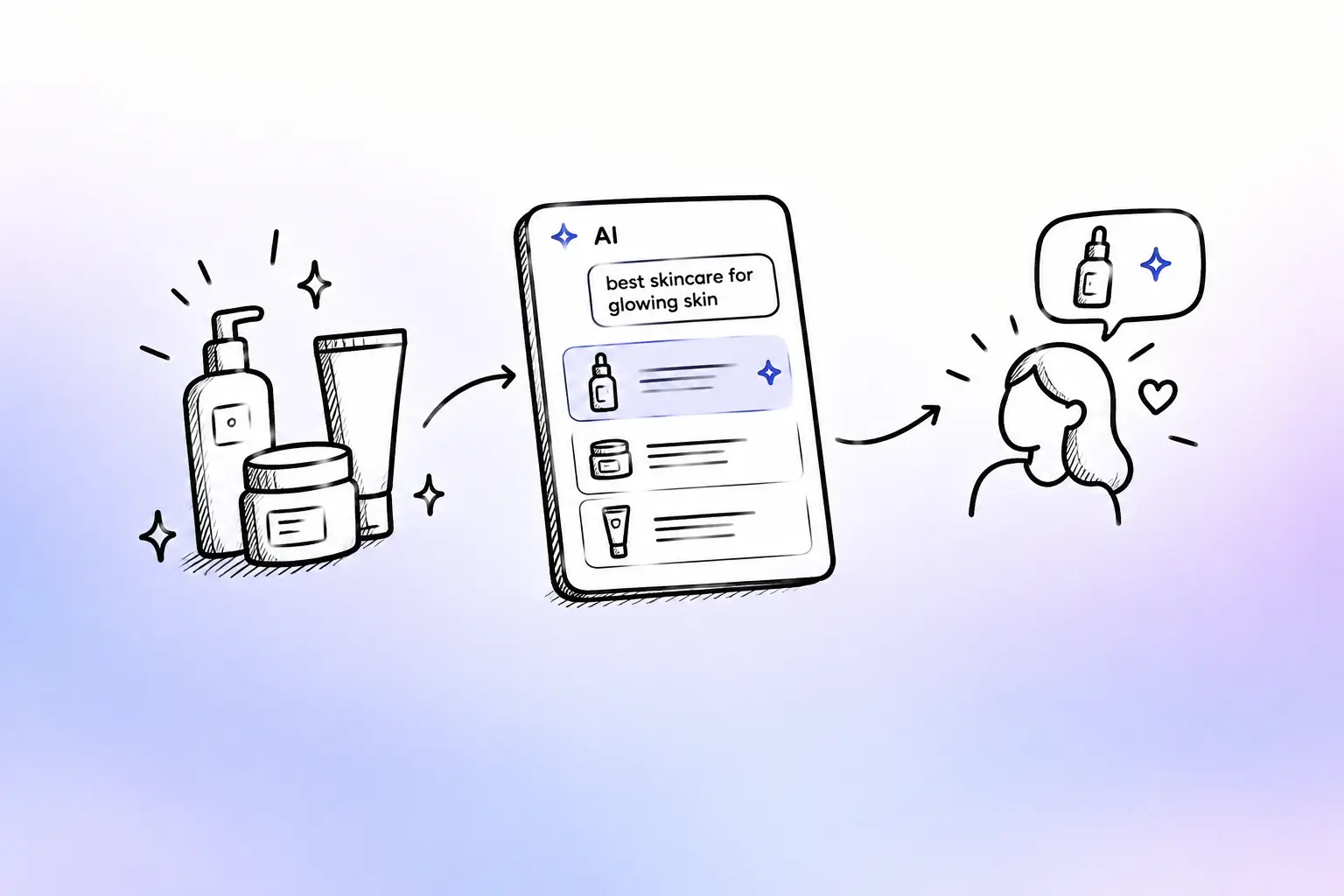
TL;DR: GEO for beauty brands rewards honesty over glamour. AI engines recommend products they can explain clearly, so full ingredient lists and credible expert input matter more than dreamy copy. Careless claims are risky, since AI repeats them. Build transparent product pages, keep claims cosmetic, and track what AI tells anxious shoppers about you.
Key takeaways
- Beauty shoppers already trust AI, and that should wake you up. 32% of US women surveyed have used AI for skincare or body-care advice, and 50% would trust it for product recommendations (Haut.AI survey).
- Honest ingredient transparency seems to matter most. One analysis of 127 beauty brands found it correlated with AI visibility at 0.78 (Yotpo).
- Some bold beauty claims can legally turn a cosmetic into a drug, and AI can spread those risky claims fast.
- Makeup and fragrance brands face a tougher climb than skincare, so they need sharper, more specific pages.
Picture a shopper with red, sensitive skin. She’s tired of products that sting and burn. One frustrating evening, she asks an AI engine for a gentle, fragrance-free moisturizer that won’t cause breakouts.
The answer confidently names three brands. Each one honestly lists its full ingredients and explains who the product suits.
Your brand makes a lovely moisturizer too. But your page talks about “glow” and “radiance” and never lists what’s inside. You’re not mentioned. That silent, painful miss is the gap GEO for beauty brands exists to close.
Why does GEO for beauty brands matter now?
Because beauty feels personal and confusing, and worried shoppers now bring their questions to AI. They ask which serum suits their skin or which foundation matches their tone. GEO for beauty brands decides whether AI trusts you enough to recommend you in those intimate, emotional moments.
The numbers show real, surprising trust. In a Haut.AI survey of 1,238 US women, run from April 16 to May 8, 2026, 32% said they’d already used AI for skincare or body-care advice. Half, 50%, said they’d trust AI for product recommendations (Haut.AI survey).
Keep one honest caveat in mind. Haut.AI sells AI skincare tools, so it has a stake in the topic. Even so, a third of women already using AI for beauty advice is hard to ignore.
When half your shoppers would trust an AI’s pick, being absent from that answer is a painful, invisible loss that no dashboard warns you about.
What makes AI recommend one beauty brand over another?
AI engines favor beauty brands they can explain with confidence. That usually means clear ingredient information and credible expert validation. Pretty photos and vague luxury language help far less. For GEO for beauty brands, the winning page reads like a trusted, honest advisor, not a glossy magazine ad.
Yotpo analyzed 127 beauty brands using its own scoring framework, with striking results. It found ingredient transparency correlated with AI visibility at 0.78, and expert validation at 0.71. Visual user-generated content correlated at only 0.34 (Yotpo).
That’s a vendor study with its own method, so stay careful and don’t treat it as gospel. But the direction matches common sense. An engine can’t quote a photo. It can happily quote a clear ingredient explanation.
The surprising, slightly painful lesson? Your gorgeous before-and-after gallery may matter less for AI than a plain, honest ingredient page.
What is an INCI name? INCI stands for International Nomenclature of Cosmetic Ingredients. It’s the standardized naming system used on ingredient labels, so shoppers and AI can recognize ingredients consistently and trust what they read.
Which beauty claims can backfire in AI answers?
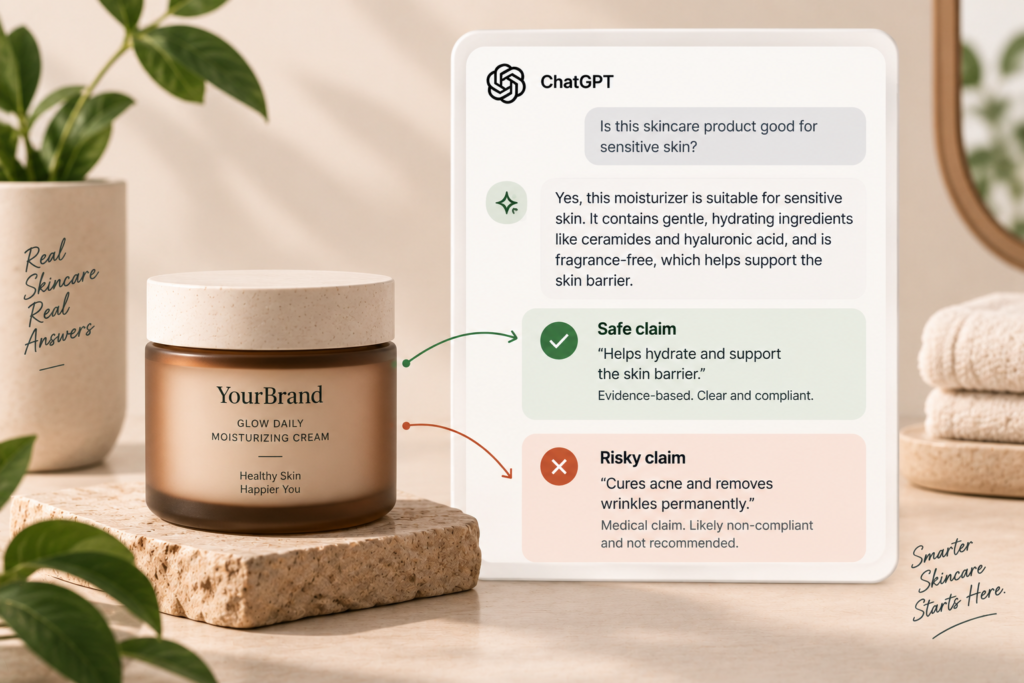
Claims that promise to change how the body works can badly backfire, because they may turn a cosmetic into a drug in the eyes of US regulators. AI engines repeat your wording to shoppers, so risky claims spread quickly. GEO for beauty brands should stick to honest cosmetic benefits and let your regulatory reviewer approve anything borderline.
The FDA is refreshingly clear that intended use decides the category. It says, “Whether a product is a cosmetic or a drug under the law is determined by a product’s intended use.” That intended use can be shown through claims “on the Internet, or in other promotional materials” (FDA).
So your website copy truly counts. The FDA lists claims that can make a product a drug, such as promises to “restore hair growth, reduce cellulite, treat varicose veins,” or “regenerate cells.”
Here’s the uncomfortable part. Many beauty brands use bold language like that without thinking twice. Once an AI repeats it to shoppers, that careless line carries far more weight and risk. This isn’t legal advice, so check claims with an expert before you publish.
How does GEO for beauty brands work on product pages?
GEO for beauty brands works best when every product page answers the questions a nervous shopper would ask. List full ingredients in plain text, not just in an image. Honestly explain which skin types the product suits, and which it doesn’t. Keep shade and routine facts identical across your site and retailers.
A strong, trusted, citation-ready beauty page includes:
- Full ingredient list. INCI (International Nomenclature of Cosmetic Ingredients) names in text, plus clear, honest notes on key ingredients.
- Skin type and concern fit. Who it’s great for, and who should honestly skip it.
- Shade and finish details. Undertones and finish described clearly in words.
- Routine guidance. When to use it and what pairs well, in simple, reassuring steps.
Consistency across retailers matters more than most brands realize. If a major retailer lists different ingredients or claims than your site, AI gets confused and may repeat the wrong, embarrassing version.
This work gets heavy and exhausting fast for brands with dozens of shades and SKUs. That’s where a technical product genuinely helps. ShopOS scales content production across a large catalog, with Brand Memory holding your voice and claim rules so every page stays consistent.
For the simple page-writing basics, see ShopOS’s helpful guide to answer engine optimization for stores.
Why do makeup and fragrance brands struggle more?
Makeup and fragrance are frustratingly harder for AI to describe than skincare. Skincare has ingredients and concerns engines can explain clearly, while a red lipstick or a floral scent is tough to put into comparable words. So GEO for beauty brands in those categories needs extra, careful effort to describe products precisely.
Yotpo’s category averages show a brutal gap. Skincare brands averaged a strong 76.2 on its scale, makeup averaged 52.8, and fragrance averaged a weak 41.3 (Yotpo).
That can feel crushing for a fragrance founder. It isn’t a dead end, though. It’s a clear, useful signal to write more specific pages.
Here’s how makeup and fragrance brands can fight back:
- Describe with specifics. Name notes and wear time in plain, honest words.
- Answer comparison questions. “Similar to” and “best for” pages give AI something useful to trust.
- Organize by use case. Group products by real need, like “long-wear for hot, sweaty weather.”
- Earn expert voices. Honest reviews from credible makeup artists build real trust.
How do you track GEO for beauty brands?
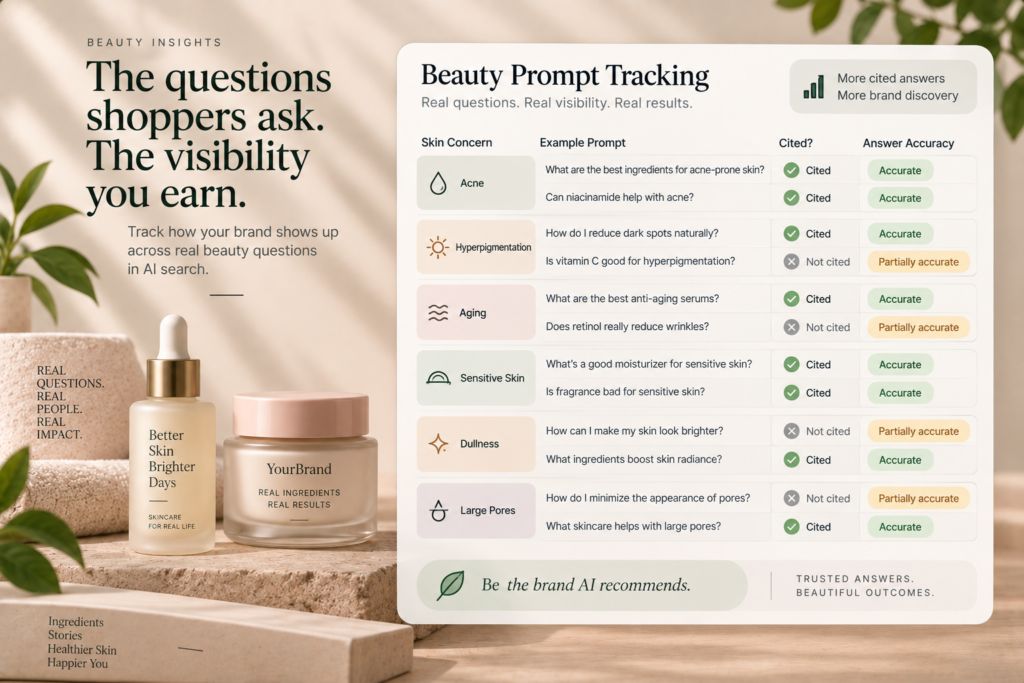
Track whether AI recommends you for real beauty concerns, and whether it describes your products accurately. Build prompts around skin concerns and comparisons, then test them monthly across engines. For GEO for beauty brands, accuracy checks matter as much as visibility, because a wrong ingredient or claim can hurt shoppers and your reputation.
A strong beauty prompt set might include:
- “Best fragrance-free moisturizer for sensitive skin.”
- “Brand A vs Brand B for painfully dry, flaky skin.”
- “Is this serum safe to use with retinol?”
- “Which foundation suits warm undertones?”
If an engine gets a fact wrong, don’t panic. Trace the source, which is often a stale retailer listing or a forgotten old page. Update your own pages first, then nudge retail partners to match.
ShopOS is sector agnostic, and Big Head, its trusted GEO and SEO agent, handles this tracking across ChatGPT, Perplexity, Gemini, and Claude. It then drafts pages for the prompts you’re losing, and approval gates let your team or regulatory reviewer sign off first. One honest limit: there’s no published ShopOS beauty case study yet, so treat category results as unproven.
Still unsure where the bigger strategy fits? See how to judge a generative engine optimization partner before committing budget. Supplement brands face even stricter claim rules, covered in GEO for supplement brands.
Ready to face what GEO for beauty brands would honestly reveal about your products? Drop your store URL into the free tier to see how AI engines describe your products today. Juggling many shades and SKUs? Book a call: Book a call.
FAQ
Do beautiful product photos help beauty brands get recommended by AI?
They help shoppers fall in love, but they help AI far less. Engines mostly read text, so even a stunning photo can’t explain an ingredient or a skin-type fit, which surprises many brands. Keep your beautiful visuals, but pair them with clear, honest written details. That combination serves both the human and the AI.
Should beauty brands list full ingredients on their websites?
Yes, in plain text, not just inside a label image. Full ingredient lists help anxious shoppers with allergies feel safe. They also give AI engines specific, trusted facts to quote. Add short, honest notes on what key ingredients do, without drifting into drug-like claims.
Can influencer content help GEO for beauty brands?
It can, especially when creators give specific, honest reviews that explain why a product works for them. AI learns from real conversations. But avoid fake, scripted claims that promise drug-like results. Genuine, detailed reviews build trust, while exaggerated promises can create legal and reputational risk.
Is GEO for beauty brands different for skincare versus makeup?
The method is the same, but the effort differs, and that feels unfair to some brands. Skincare is easier for AI to explain through ingredients and concerns. Makeup and fragrance need harder descriptive work, like finish and wear time. Those categories must work harder to give AI clear, comparable facts.
How long does GEO take for a beauty brand?
Most beauty brands can hope to see early shifts after a few weeks of steady publishing, and a clearer picture around month three. Brands with large catalogs may need longer to update every product page, and that’s perfectly fine. Start with best-sellers first. Quick, satisfying wins there build momentum and show which pages are worth expanding.
What’s the smartest first step for GEO for beauty brands?
Audit your ten best-selling product pages with fresh, honest eyes. Add full ingredient lists in text, clear skin-type guidance, and honest “not for” notes. Remove any risky claims that sound drug-like. Then test ten real beauty prompts to see what AI says about you today, and fix the most painful gaps first.