
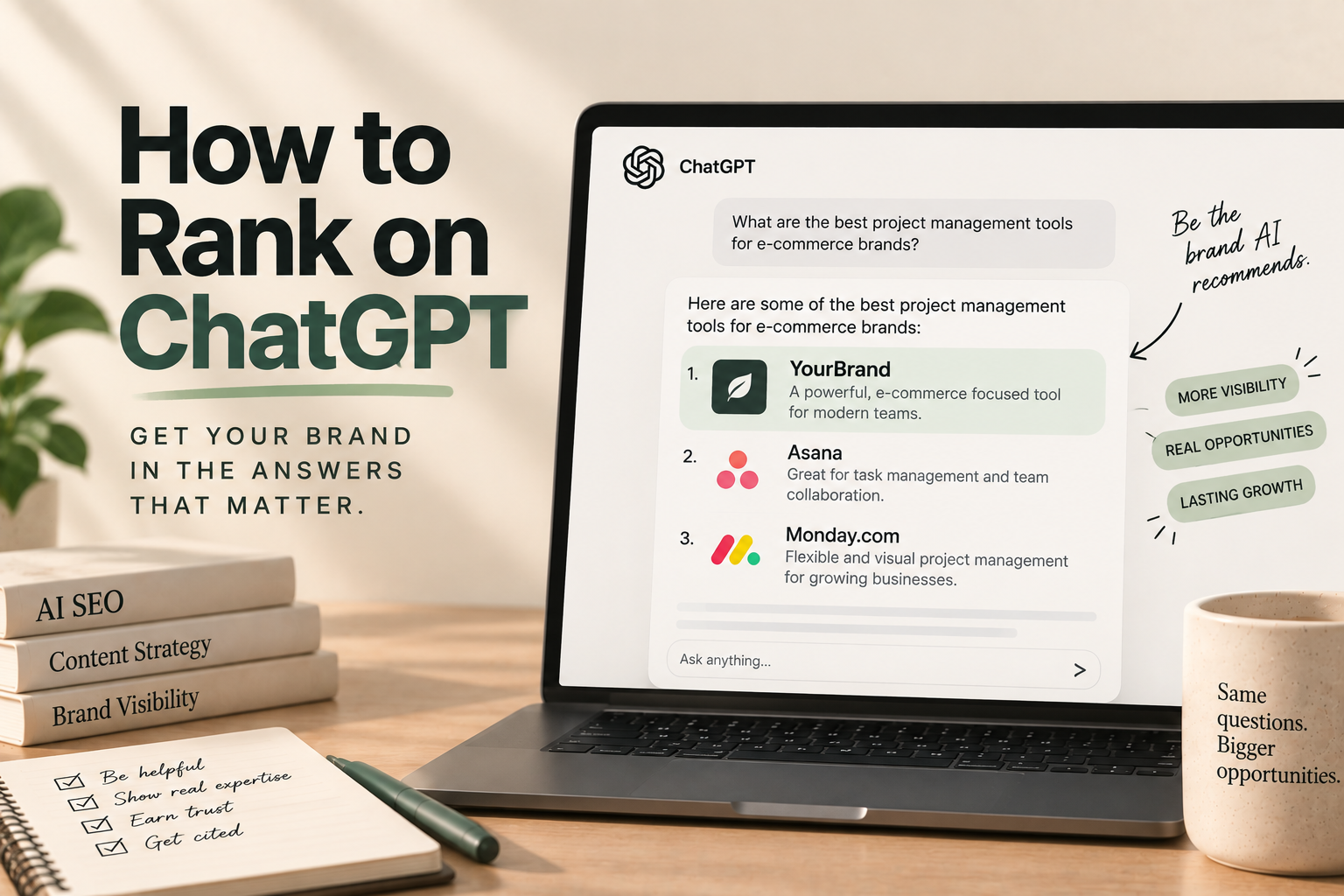
TL;DR: Learning how to rank on ChatGPT starts with a hard truth: there’s no fixed rank to win. Answers shift with wording and live search. What you can win is a steady share of answers for real buyer prompts. That takes accessible pages, clear product facts, and genuine mentions, plus patience, because ChatGPT is often the slowest engine to move.
Key takeaways
- Knowing how to rank on ChatGPT matters more every month. It reached 900 million weekly active users in February 2026 (TechCrunch), so being absent is a costly blind spot.
- There’s no position one to win. Honest tracking counts how often you’re named across repeated runs of the same prompt.
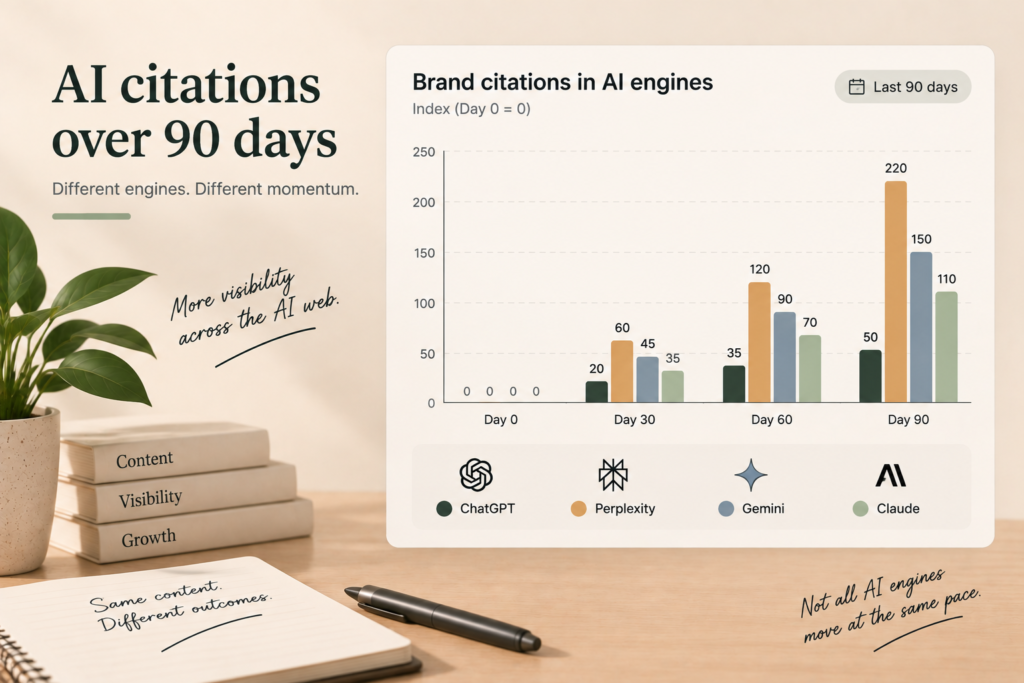
- In two published ShopOS case studies, ChatGPT was frustratingly the slowest of four engines to cite the brand.
- Clear product data, honest comparison pages, and genuine third-party mentions do the hard, heavy lifting.
Here’s a story plenty of marketers know too well. A manager asks ChatGPT for the best brands in their category. Their brand is named, and they feel a rush of pride. They screenshot it and happily share it with the team.
The next morning, a colleague asks the same question. The brand is gone. Just gone.
Panic sets in. Did something break? Probably not. That frustrating flicker is simply how ChatGPT works, and it’s the first hard truth about how to rank on ChatGPT without losing your mind.
Can you actually rank on ChatGPT?
Not in the way you rank on Google. ChatGPT writes a fresh answer every time, shaped by the exact wording and sometimes a live web search. So there’s no safe, stable position to hold. What you can earn is a reliable share of answers, where your brand shows up again and again for real buyer questions.
Learning how to rank on ChatGPT feels confusing at first, so this shift in thinking is a genuine relief once it lands. You stop chasing one lucky screenshot. You start measuring something honest and useful.
The prize is huge, and it’s worth the hard effort. ChatGPT has reached 900 million weekly active users, OpenAI announced in February 2026 (TechCrunch). Every one of them is a potential, curious shopper.
So when people ask how to rank on ChatGPT, the smarter question is simple. How often does ChatGPT recommend you when a real buyer is ready?
What is share of answers? Share of answers is the percentage of repeated test runs where an AI names your brand for a given prompt. It smooths out random flicker and shows the true trend.
Why is learning how to rank on ChatGPT so slow?
Because ChatGPT seems to lean more on accumulated trust than on your newest page. In both published ShopOS GEO case studies, it moved slowest of the four engines tracked. Perplexity and Claude responded faster to fresh content, while ChatGPT demanded more time and more patience than most eager teams expect.
The numbers are humbling, and a little painful. A men’s ethnic wear brand went from 0 to 9 of 18 buyer prompts on ChatGPT in 90 days, while Perplexity reached 14 of 18 (ShopOS case study). A Mumbai sneaker brand saw the same pattern. ChatGPT went from 0 to 9 of 20, while Perplexity hit 16 of 20 (sneaker case study).
Two case studies aren’t a law of nature, so stay careful and humble with big conclusions. But the pattern is worth respecting. If ChatGPT lags behind other engines at first, that’s normal, not failure.
It also means you shouldn’t judge your whole plan for how to rank on ChatGPT by month one alone. That’s how good work gets canceled too early, right before it pays off.
What does ChatGPT look at before recommending a brand?
ChatGPT draws on what it learned in training, plus pages it finds through live search. For shopping questions, structured product data is becoming a direct input too. It favors facts it sees repeated across trusted sources, so a brand with consistent, clear details feels like a safe answer to give.
Three inputs matter most for stores, and understanding them is the core of how to rank on ChatGPT.
Search access. ChatGPT’s search features rely on OpenAI’s search crawler. If that crawler is blocked, your pages can’t be shown in ChatGPT search answers, which is a painful, silent loss. The LLM SEO guide explains how to check your crawler settings safely.
Product feeds. OpenAI’s commerce docs say feeds carry “identifiers, descriptions, pricing, inventory, media, and fulfillment options” so ChatGPT can surface products accurately (OpenAI Developers). In March 2026, OpenAI said it was “prioritizing making ChatGPT search and product discovery great” (Digital Commerce 360).
Repetition across the web. Wil Reynolds of Seer Interactive tested this in his own category. He noticed certain agencies “keep popping up, over and over, and over” in ChatGPT results (Seer Interactive). Being mentioned often, in many trusted places, clearly helps.
How to rank on ChatGPT: a practical plan
The most reliable way to learn how to rank on ChatGPT is a simple monthly loop. Check access, pick real prompts, fix your facts, publish helpful pages, earn mentions, then retest. None of it is flashy, but all of it compounds. Brands that keep the loop running steadily win more answers over time.
Here’s the plan, step by step, with no magic tricks or false promises.
1. Confirm ChatGPT can reach you. Check robots.txt for blocked AI search crawlers. It takes five easy minutes and prevents a painful, invisible mistake.
2. Collect 20 real buyer prompts. Pull them from honest reviews and frustrated support tickets. Use shoppers’ real words, like “best waterproof hiking boots under $150,” not your confusing internal jargon.
3. Test each prompt several times. Run each one three times in fresh chats. Record whether you’re named, which rivals win, and which sources appear.
4. Fix product facts everywhere. Prices and sizes should match on your site, marketplaces, and feeds. Mixed signals make ChatGPT hesitant and wary.
5. Publish pages that answer buying questions. Honest comparison pages and “best for” guides work well. Admit where a rival is better for some shoppers, because that fairness builds real trust.
6. Earn mentions where buyers talk. Genuine reviews and forum threads count. Both ShopOS case studies paired content with real community seeding.
7. Retest monthly and adjust. Keep the same prompt list so trends stay honest and you can trust what you see.
If you sell on Shopify, ShopOS has a detailed Shopify guide to getting cited by ChatGPT that covers store settings.
How long does it take to rank on ChatGPT?
Expect a slow, nervy first month and meaningful progress by month three, if you keep publishing and earning mentions. Quick wins can appear when ChatGPT searches the live web. Deeper trust builds slower. In published ShopOS case studies, ChatGPT reached roughly half of tracked buyer prompts after 90 days of steady work.
That can feel discouraging if you expected overnight results. It shouldn’t. Winning half of your buyer prompts, from zero, is a huge shift in who gets recommended. Anyone promising a one-week shortcut for how to rank on ChatGPT is guessing.
Honest timelines are part of how to rank on ChatGPT, too. Plan for three phases:
- Month 1. Fix access and facts, publish your first helpful answer pages, and set an honest baseline.
- Month 2. Fight for prompts where rivals win, with fair comparisons and community mentions.
- Month 3. Build trusted authority through third-party citations, then double down on what worked.
Tracking this by hand gets exhausting and messy fast. Twenty prompts, three runs each, four engines, every month, is 240 checks. That’s where software earns its keep.
That exhausting loop is exactly what Big Head, the ShopOS GEO and SEO agent, runs at scale. It tracks cited or not cited status for each prompt across ChatGPT and three other engines. When it spots a gap, it drafts and publishes a fix, and nothing goes live until you say yes.
What mistakes keep brands out of ChatGPT answers?
The most common mistakes are blocking AI search crawlers, hiding facts inside images, and trusting one lucky screenshot as proof. Vague product copy hurts too, because ChatGPT can’t recommend what it can’t describe. Fake reviews and spammy forum posts are worse, since they can damage trust permanently. Most of these are easy, cheap fixes.
These traps wreck most attempts at learning how to rank on ChatGPT:
- Blocked crawlers. A blanket “block all bots” rule quietly erases you from answers.
- Image-only details. Size charts and ingredient lists trapped inside graphics, invisible to AI.
- One-run testing. A single good answer creates false confidence.
- Self-praise only. If only your own site says you’re great, ChatGPT has little reason to believe it.
Want the bigger picture beyond ChatGPT? The ShopOS guide to hiring a GEO agency covers what full GEO work looks like, and the ChatGPT visibility tracker guide covers what to monitor.
Still unsure how to rank on ChatGPT in your category, or nervous about what it says today? The free tier checks your store against real buyer prompts, ChatGPT included, from a single URL. Selling thousands of SKUs? Then Book a call with the team: Book a call.
FAQ
Can I pay to rank higher in ChatGPT answers?
No, and be wary of anyone who promises that, because no organic answer placement is for sale. The honest way in is being a trustworthy, easy-to-describe option across the web. Product feeds help ChatGPT show accurate details for shopping questions, but they don’t guarantee a recommendation. Treat any guaranteed top spot as a red flag.
Why does ChatGPT recommend my competitor instead of me?
It stings, but usually your competitor is mentioned more often, in more places, with clearer facts. Check which sources ChatGPT cites when it names them. Those pages reveal exactly where you’re missing. Then earn a presence there honestly, and make your own pages easier to trust and quote.
Does ranking on Google help you rank on ChatGPT?
It helps, but sadly it’s not enough on its own. Both published ShopOS case studies involved brands with solid search visibility and weak AI citations. Strong pages give ChatGPT something useful to find. Mentions and consistent facts across other sites give it the confidence to recommend you.
How many prompts should I track for ChatGPT?
Tracking is the backbone of how to rank on ChatGPT. Start with 20 real buyer prompts, and run each one a few times per check. That gives a fair picture without burning hours. Add prompts as you learn which questions drive sales, but keep the core list stable so your trend stays honest.
Is ChatGPT search different from regular ChatGPT answers?
Yes. When ChatGPT searches the web, it can use fresh pages and show sources. Without search, it relies on what it learned in training. Your pages can influence search answers quickly, but training memory changes slowly, so steady, trusted mentions matter for the long run.
What’s the fastest way to learn how to rank on ChatGPT?
Start with quick, easy fixes to access and facts. Make sure AI search crawlers aren’t blocked, and move key product details out of images into plain text. Then publish one honest comparison page for your most common, most urgent buyer question. It’s simple work, and it often delivers the fastest, most satisfying results.