
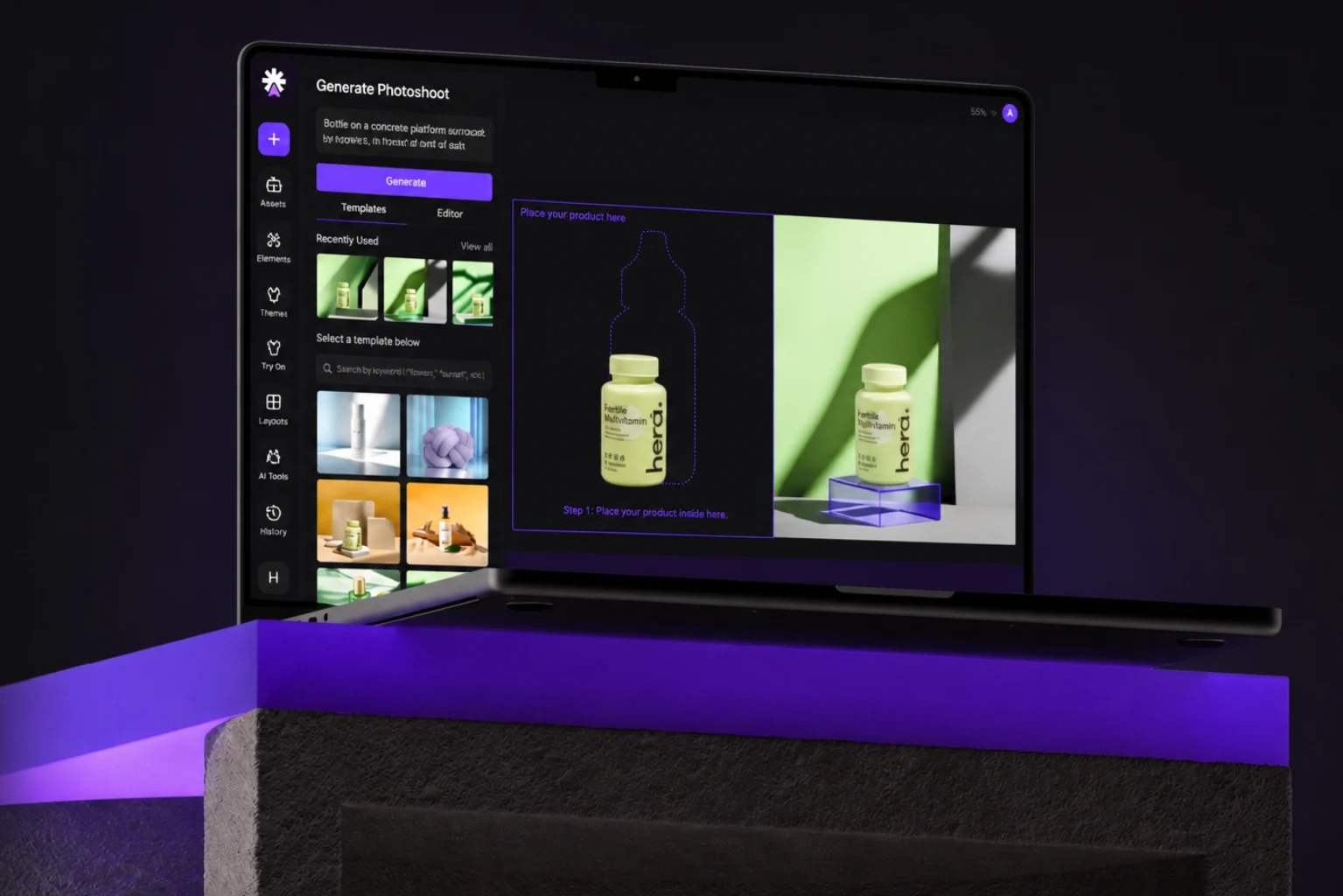
The first product shoot is rarely the end of the photography budget. Once accurate product images exist, ecommerce teams still need new locations, lifestyle settings, seasonal concepts, ad formats and marketplace variations. Each request can bring back the photographer, studio, stylist, editor or agency.
AI reduces these recurring costs by changing what happens after the initial shoot. Brands can capture the physical product accurately once, then use AI for new environments, campaign treatments, edits and channel formats. This means fewer lifestyle productions, fewer reshoots and less repetitive post-production.
ShopOS Monica supports this model by using real product information and Brand Memory to create accurate, on-brand visual assets. The goal is not to replace the original shoot. It is to reduce the recurring production work required to keep campaigns moving.
Quick Answer
AI helps brands reduce ecommerce product photography costs after the initial shoot. With accurate master images, teams can create new lifestyle settings, campaign variations, edits and channel-ready formats without rebuilding every production. This makes product photography on a budget more practical while preserving product accuracy and keeping human review in the workflow.
Turn existing product images into campaign-ready creative
Use Monica to create accurate, on-brand product, lifestyle and marketing assets without rebuilding every photoshoot.
Start Creating With MonicaWhy Ecommerce Product Photography Costs Continue After the Shoot
A photography invoice shows the obvious expenses: photographer, studio, models, styling, props and retouching. The larger cost often appears after those ecommerce product photos have been approved. A promotion may need a festive setting, while paid social may require several formats and creative directions.
There are also hidden costs that do not appear under the photography budget:
- Creative teams spend time briefing and coordinating vendors.
- Campaign launches wait for production and approvals.
- Testing slows because each new variation takes time to make.
- Stale creative remains live because refreshing it takes more work.
- Designers repeat resizing and reframing for every channel.
For brands planning product photography on a budget, these costs matter as much as studio fees. A practical AI creative workflow for ecommerce brands lowers spend and friction while keeping accuracy and approval with people.
Where AI Reduces Photography Production Costs
AI creates the most value when the product has already been photographed accurately and the requested change concerns its setting, presentation or format. The following areas offer the clearest opportunities to reduce cost.
1. Fewer Location and Set Productions
A new environment traditionally requires scouting, set construction, props, lighting and coordination. With AI product photography, an approved product image can appear in several relevant environments without recreating each setup. A lamp, for example, could be shown in a bedroom, reading corner and home office.
Cost reduced: Locations, sets, props, equipment and production coordination.
2. Fewer Lifestyle Product Photography Shoots
Traditional lifestyle product photography may involve models, stylists, travel, locations and a larger crew. AI can create additional lifestyle contexts from approved product inputs, allowing teams to test settings or support smaller campaigns without another full production.
Cost reduced: Models, styling, travel, location and crew time.
3. Fewer Reshoots When the Brief Changes
When a background no longer fits the media plan or a composition leaves no space for copy, an AI image generator for ecommerce can adapt the setting, extend the frame or create a new composition around the approved product.
Cost reduced: Repeat studio, photographer, styling and coordination costs.
4. Less Repetitive Post-Production
An AI photo editing software workflow can support background removal, cleanup, image extension, lighting correction and reframing. The best AI photo editor must also preserve the colour, material, proportions, labels and logo that customers use to judge the product.
Cost reduced: Routine editing and retouching hours.
5. More Creative Variations From Existing Assets
One approved image can support backgrounds, crops and campaign treatments for product pages, email, paid media and social. This product-to-campaign model also powers generative AI in fashion.
Cost reduced: Separate creative production for each concept or campaign variation.
6. Faster Adaptation Across Channels
A product-page image is not automatically ready for Meta ads, Instagram Stories, email banners or marketplaces. AI photography software can reframe approved creative for different compositions and aspect ratios.
Cost reduced: Manual resizing, reframing and repeated channel requests.
Traditional Production vs an AI-Supported Workflow
The difference is easier to see when the two workflows are placed side by side.
| Traditional workflow | AI-supported workflow |
| Physical product | Physical product |
| Photographer and studio | Accurate master images |
| Location, set, styling and props | AI-generated environments and contexts |
| Shoot and manual retouching | Generation and focused refinement |
| Separate adaptations for each channel | Channel-ready formats from approved assets |
| New production for major visual changes | Existing assets adapted when the product is unchanged |
In the traditional workflow, each major visual variation can restart several production stages. In the AI-supported workflow, the brand invests in accurate master photography and uses those images as the foundation for later variations. That is the practical model for ecommerce product photography on a budget.
What Should Ecommerce Brands Still Photograph?
AI should not invent product information that has not been captured. Brands should use traditional ecommerce product photography when the customer needs to see a new physical detail, including:
- Exact shape and proportions
- Colour, material, texture and finish
- Labels, packaging and printed information
- Fit, construction and product function
- A product angle missing from the approved image set
- Details connected to a product claim
Accurate master images are the foundation of reliable AI product photography. If the source image does not show an important detail, the model may interpret or invent it. That can produce an attractive image that is commercially unusable.
Learn more about why AI product photos get product details wrong.
The rule is simple: photograph new product information. Use AI when the product stays the same and the environment, campaign or channel changes.
A Cost-Conscious AI Product Photography Workflow
A useful ecommerce product photography workflow should reduce repeated production without weakening product accuracy.
Step 1: Capture Accurate Master Images
Photograph the required angles, packaging and important details using consistent lighting and colour references. These become the approved source images.
Step 2: Add Product and Brand Context
Record product specifications, approved colours, logo rules and visual style. A prompt alone cannot carry this context reliably across repeated production.
Step 3: Identify the Most Expensive Variations
Prioritise requests that would otherwise require another lifestyle setup, location, seasonal production or long editing cycle.
Step 4: Generate and Refine
Use an AI image generator for ecommerce to create the required context or composition. Review the result instead of accepting the first output. ShopOS Refine lets teams flag areas and apply fixes without restarting.
Step 5: Run a Product-Accuracy Check
Compare the result with the source. Check colour, shape, material, labels, logos, packaging, shadows and reflections.
Step 6: Prepare Channel-Ready Assets
Create the required aspect ratio and resolution for each channel. This is where AI photo editing software reduces repetitive production after approval.
Why Generic AI Photography Software Is Not Enough for Ecommerce
For ecommerce product photography, a generic image generator only creates an image. An ecommerce creative agent needs to understand what product is being sold, how the brand presents it, where the asset will be used and what must remain unchanged.
| Generic AI image tool | Ecommerce creative agent |
| Responds to an isolated prompt | Uses product and brand context |
| Prioritises visual generation | Prioritises commercially usable assets |
| May reinterpret product details | Must preserve approved product information |
| Produces a standalone image | Supports catalogue and marketing workflows |
| Requires repeated brand instructions | Can apply shared brand guidelines |
| Often separates generation and editing | Supports generation, editing and refinement |
Monica is the Creative Director inside ShopOS. It creates catalogue and marketing content from real product data and the brand’s shared Brand Memory.
For image work, Monica supports generation, editing, multiple aspect ratios and 1K, 2K or 4K resolution options. This makes it more than a standalone creative tool. It connects product context, brand consistency and creative refinement to a specific ecommerce use.
When Should You Shoot and When Should You Use AI?
Use this decision framework before approving another production request.
| Requirement | Recommended approach |
| New physical product information | Shoot |
| New product angle that has not been captured | Shoot |
| New environment or lifestyle context | Use AI |
| New seasonal campaign treatment | Use AI |
| New channel or aspect-ratio variation | Use AI |
| Product accuracy plus several creative variations | Shoot once, then use AI |
Spend on photography when it captures something new about the product. Use AI when the expensive part is recreating context around an approved product.
Lower Costs Without Compromising Product Accuracy
The strongest cost-saving model combines accurate ecommerce product photography with AI-supported production. Brands capture dependable ecommerce product photos once, then use AI product photography for new settings, edits and channel formats. This protects customer trust while reducing vendor coordination, campaign delays and the cost of refreshing creative.
Turn Your Existing Product Images Into Campaign-Ready Creative
See how Monica helps ecommerce teams create accurate, on-brand product, lifestyle and marketing assets without rebuilding every photoshoot.
Frequently Asked Questions
How can AI reduce ecommerce product photography costs?
AI can create new environments, lifestyle contexts, campaign variations and channel formats from approved images. This reduces repeat locations, sets, lifestyle productions, reshoots and routine post-production.
Can AI replace a professional product shoot?
No. Accurate source images are required for colour, shape, material, texture, labels, packaging, fit and function. AI is better suited to changing the context around the photographed product.
Can AI create lifestyle product photography from existing images?
Yes. AI can place an approved product into new lifestyle settings when the source clearly represents it. Check every output against the original before publication.
What should brands look for in AI photo editing software?
Look for product-detail preservation, background editing, image extension, aspect-ratio support, high-resolution output and refinement. Product and brand context also support consistency.
How does Monica support accurate, on-brand product creative?
Monica uses product information and ShopOS Brand Memory to create catalogue and marketing assets. Teams can generate or edit images and prepare different aspect ratios and resolutions.