
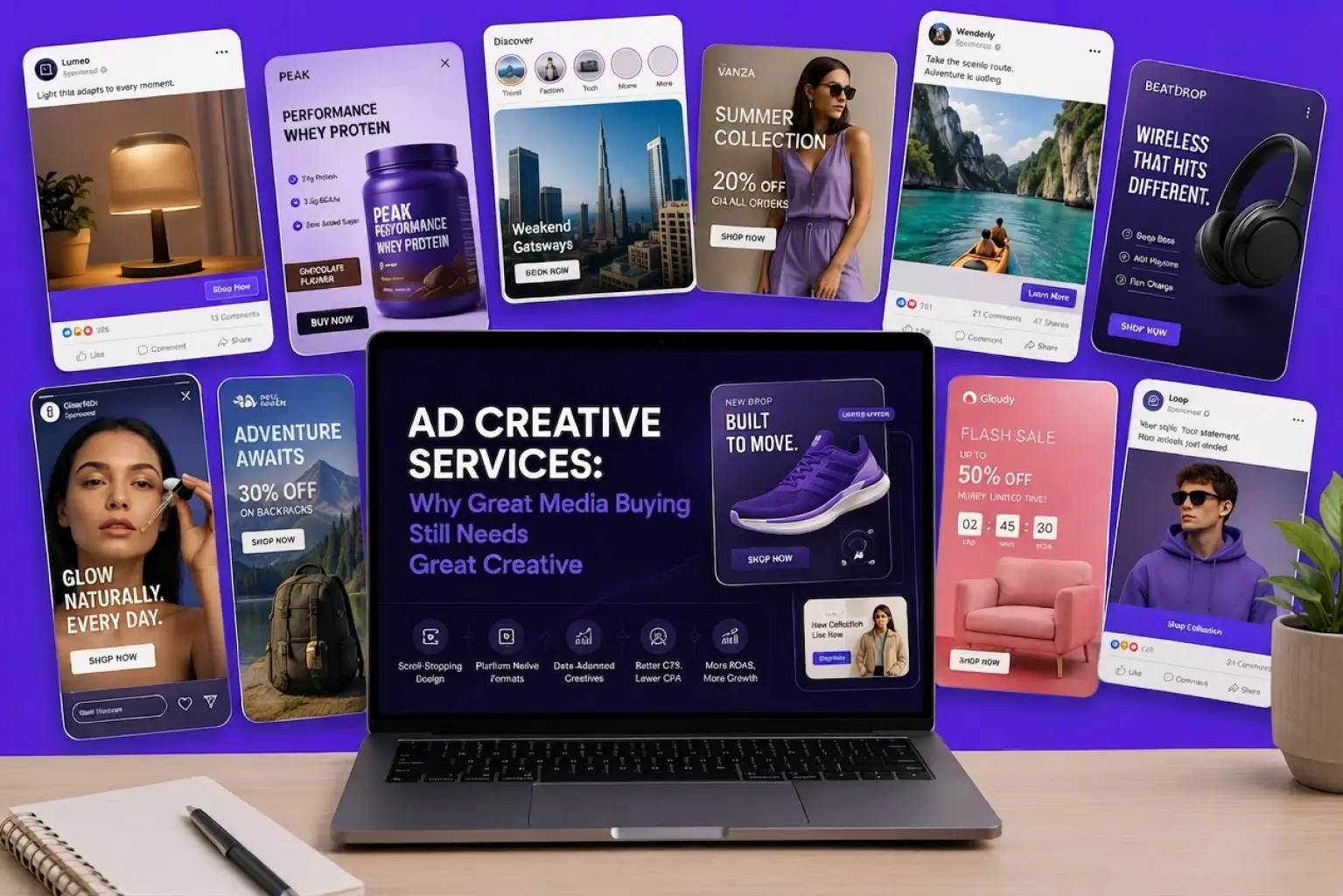
- Media Buying and Creative Solve Different Problems
- The Real Problem Is the Gap Between Performance and Creative
- Great Creative Is Not the Same as Attractive Creative
- Ad Creative Management Should Manage Decisions, Not Just Assets
- Creatives for Facebook Ads Need a Clear Hypothesis
- Creatives for Google Ads Need Different Inputs
- Why Traditional Ad Creative Services Often Stop Too Early
- AI Powered Ad Creative Should Start With the Right Problem
- Gavin and Monica Solve Different Parts of the Workflow
- Brand Memory and Loops Make the Learning Reusable
- Better Media Buying Needs Better Creative Decisions
- Frequently Asked Questions
Performance marketers can optimize bids, restructure campaigns, refine audiences, redistribute budgets, and improve tracking. Yet a campaign can still struggle for a simpler reason: the ad is not giving people a strong enough reason to act.
That matters more as Meta and Google automate larger parts of media buying. Platforms can increasingly help decide where budget goes, who sees an ad, and which combinations are likely to perform. But they still depend on the quality of the inputs brands provide.
This changes how ecommerce teams should think about Ad Creative Services. Creative is not the final design step after media strategy is complete. It is one of the inputs that determines whether media buying has anything persuasive to distribute.
The bigger challenge is knowing what the campaign is telling you and turning that into the right next move. That is where Gavin, ShopOS’s AI Performance Marketer, becomes relevant. Gavin monitors paid-media performance and helps teams determine what should change next, including when the issue points back to creative.
Turn better creative into better performance
See how ShopOS helps campaigns scale with stronger ad creatives.
Media Buying and Creative Solve Different Problems
Media buying answers who should see the campaign, how much to spend, where the campaign should appear, and which objective the system should optimize toward.
Creative answers different questions: Why should someone stop? Which product benefit matters? What should the customer understand first? Which objection needs to be removed? Why should someone act now?
A campaign can be technically well structured and still underperform if the message, offer, visual, or product angle is weak. Media can improve delivery, but it cannot turn an unclear value proposition into a compelling one.
That is why effective Ad Creative Services should help connect what the campaign is doing with what the creative team should build next.
The Real Problem Is the Gap Between Performance and Creative
In many ecommerce teams, performance and creative still operate as separate workstreams.
The media team sees CTR, CPM, CAC, ROAS, conversion rate, frequency, audience response, and campaign trends.
The creative team sees a brief.
Imagine three ads running for the same product. One earns strong clicks but converts poorly. Another attracts fewer clicks but produces stronger ROAS. A third performed well initially but has started declining.
The weak response is: “We need three fresh ads.”
The better response is to ask what is actually happening.
Is the first ad creating curiosity but attracting the wrong intent? Is the second communicating value more clearly? Has the third lost relevance, or has the audience simply seen it too often?
Those answers should shape the next brief.
This is where Gavin enters the workflow early. Instead of treating every performance drop as a request for more assets, Gavin helps teams identify what is changing across Meta and Google and what deserves investigation next.
That creates a better bridge between media and creative.
We explored this wider disconnect in Why Ecommerce Ads Performance Break Between Creative, Media, and Data.
Great Creative Is Not the Same as Attractive Creative
One of the biggest mistakes in creative for ads is judging work primarily by how polished it looks.
An ad can be visually excellent and commercially weak.
Consider a brand selling running shoes. A strong lifestyle image may fit the brand perfectly, but the campaign still needs a buying argument. Is the shoe lighter, more comfortable, more durable, better for long-distance running, or designed for everyday training?
Without that decision, the ad may attract attention without giving the customer a reason to choose the product.
Good creative needs three things working together:
Product truth: what is genuinely valuable about the product.
Customer context: why that value matters to the intended buyer.
Creative expression: how that value should be communicated in the placement.
Gavin helps teams understand which of those elements may need attention before production begins.
Ad Creative Management Should Manage Decisions, Not Just Assets
Ad creative management is often treated as file naming, version tracking, storage, and approvals.
That is necessary, but strategic management should also preserve the logic behind the asset:
What customer problem is this ad addressing?
Which product truth is it built around?
What audience or objective is it designed for?
What changed from the previous version?
Why is the team creating this variation?
Without those answers, a brand can produce hundreds of assets without building a better advertising system.
Gavin helps make this process more disciplined. If a campaign is losing efficiency, the team can first understand whether the issue sits with the hook, format, offer, visual treatment, audience, or another campaign variable.
That is stronger than automatically asking for “fresh creative.”
Creatives for Facebook Ads Need a Clear Hypothesis
Creatives for Facebook ads and Instagram placements compete for attention inside feeds, Stories, and Reels. That makes the creative hypothesis important.
Should the ad lead with a customer problem, product demonstration, benefit, comparison, offer, creator-style explanation, or lifestyle moment?
Each direction tests something different.
If CTR is falling while conversion quality remains healthy, the campaign may need a stronger attention mechanism rather than a new product proposition. If clicks remain strong but conversion weakens, changing the hook alone may not solve the problem.
Gavin helps the performance team interpret that distinction before production begins.
The value is not creating ten Facebook ads. It is knowing which ten are worth creating.
Creatives for Google Ads Need Different Inputs
Creatives for Google ads require a different approach because Google can combine headlines, descriptions, images, logos, videos, and product information across placements.
Brands are often supplying a system with components rather than designing one fixed advertisement.
Teams therefore need to decide which product messages deserve dedicated assets, which images communicate value clearly, which benefits belong in headlines, and which assets should be refreshed when performance changes.
If an asset group is driving strong conversion value, the next step may be to strengthen that message rather than rebuild the campaign around a new idea. If performance falls, Gavin can help the team determine whether the likely issue is creative, audience, budget, or another factor before production resources are used.
Why Traditional Ad Creative Services Often Stop Too Early
Many traditional Ad Creative Services focus on delivery.
The brief arrives. The creative gets produced. Feedback is incorporated. The files are exported.
Performance marketing does not end there.
Once the campaign starts spending, new information becomes available. Some messages attract the wrong traffic. Some hooks create clicks but weak buying intent. Some concepts maintain profitability longer than others.
Those learnings should influence what gets created next.
A disconnected system looks like:
Brief → Creative → Campaign → Reporting
A stronger system looks like:
Brief → Creative → Campaign → Learning → Next Brief
Gavin sits between reporting and the next brief.
He does not replace the creative team. He helps give the team a stronger reason for what to make next.
AI Powered Ad Creative Should Start With the Right Problem
The most common promise around AI Powered Ad Creative is speed: more images, headlines, variations, and formats.
Useful, yes. But the harder problem is deciding what should change.
If a Meta campaign is declining, does the brand need a new concept, hook, visual, or audience? If a Google campaign is becoming less efficient, is the asset set actually the problem?
Generating more assets before answering those questions can create more noise.
A stronger AI-powered workflow starts with diagnosis.
Gavin helps identify what deserves attention. If new creative is required, that direction becomes a clearer brief instead of an open-ended request for more content.
This connects with How to Build an AI Performance Marketing Strategy for Ecommerce Brands, where live campaign information and decision-making operate in the same performance system.
Gavin and Monica Solve Different Parts of the Workflow
Gavin is the performance intelligence layer.
He helps teams identify underperformers, spot opportunities, understand creative fatigue, and determine the next action.
Monica, ShopOS’s AI Creative Director, handles the creative execution layer.
When Gavin identifies that a campaign needs new creative, that direction can become a specific brief for Monica.
Campaign performance → Gavin diagnosis → Creative direction → Monica execution → Campaign
The creative request begins with a business reason, not a blank prompt.
That distinction is important because it keeps Gavin at the center of the performance decision while Monica handles the production that follows.
Brand Memory and Loops Make the Learning Reusable
The next challenge is preventing useful learnings from disappearing after one campaign.
Brand Memory helps keep brand rules, product context, visual direction, and voice available across the ShopOS system.
Loops helps turn repeated campaign actions into a connected cycle where results inform later iterations.
Together, they support a more useful form of ad creative management:
Insight → Creative hypothesis → Asset → Campaign → Result → Next hypothesis
That is the broader opportunity behind AI Powered Ad Creative. The goal is not simply faster content production. It is a tighter connection between what a campaign reveals and what the team creates next.
This same shift is explored in AI Ads for Ecommerce Brands: How to Create Campaigns Faster.
Better Media Buying Needs Better Creative Decisions
As Meta and Google automate more elements of campaign delivery, the competitive advantage increasingly comes from deciding which message to test, which creative is deteriorating, what should be preserved, and what should change next.
This is where Ad Creative Services and performance marketing begin to overlap.
The strongest creative for ads is not simply attractive or fast to produce. It is built around a specific business and performance hypothesis.
And the strongest AI Powered Ad Creative system does not simply answer:
“Can we generate another ad?”
It helps answer:
Based on what is happening in the campaign, what should we create next?
That is where Gavin becomes the consistent thread between media performance and creative action.
Turn Campaign Performance Into Better Creative Decisions
Gavin helps ecommerce teams move from campaign reporting to clearer next actions, while ShopOS connects performance intelligence with creative execution across the wider workflow.
Book a Demo to see how Gavin can help your team identify what to change, what to scale, and what creative should come next.
Frequently Asked Questions
What are Ad Creative Services?
Ad Creative Services cover the strategy, production, adaptation, and management of assets used in paid campaigns. For ecommerce brands, the strongest services connect creative decisions to product positioning, audience context, campaign objectives, and actual campaign outcomes.
What is AI Powered Ad Creative?
AI Powered Ad Creative uses artificial intelligence to support creative strategy, generation, variation, adaptation, and optimization. Its value increases when creative production is informed by campaign and product context instead of isolated prompts.
How does Gavin support ad creative decisions?
Gavin is ShopOS’s AI Performance Marketer. He monitors paid-media performance, identifies what is changing, and helps teams determine the next action. When new creative is required, that direction can become a clearer brief for Monica.
Are creatives for Facebook ads different from creatives for Google ads?
Yes. Creatives for Facebook ads often need to earn attention inside feed-based environments, while creatives for Google ads may be assembled from multiple text, image, video, and product assets across Google placements.
Can better ad creative fix every performance problem?
No. Weak performance can also come from targeting, budgets, landing pages, pricing, tracking, offer quality, or other campaign factors. Teams should understand the root problem before assuming more creative is the answer.