
Introduction: The Misconception Around AI Agents
AI agents are often described as if they are ready to replace full teams.
That is not the most useful way to understand them.
The real value of AI agents for business is more practical. They help companies reduce repeated workflow steps and give teams more time for strategy, creativity, judgment, and customer relationships.
For ecommerce and DTC brands, this matters even more. Teams create product pages, campaign copy, emails, ads, FAQs, metadata, reports, customer replies, and content updates across channels. Much of this work is not difficult, but it is repetitive.
That is where AI agents help.
For this reason, AI agents for business should be understood as workflow systems, not employee replacements. They do not remove human ownership. They reduce the manual loops that slow teams down.
Most businesses do not struggle with AI agents only because the AI is weak. They struggle because their workflows are unclear. AI agents cannot fix a broken process. They work best when the business knows what needs to happen, who approves it, and what good output looks like.
In this guide, you’ll learn what AI agents actually automate, where human judgment still matters, and how ecommerce businesses can use AI agents to build faster, more consistent workflows.
What Is an AI Agent?
Before looking at automation, let’s answer the basic question: what is an AI agent?
An AI agent is a system that understands a goal, uses context, takes action, and moves through a workflow with some autonomy.
A simple AI tool responds to a prompt. An AI agent can work through steps.
| AI Tool | AI Agent |
| Responds to one prompt | Moves through a workflow |
| Creates one output | Completes multiple steps |
| Needs repeated instructions | Uses context and rules |
| Helps with a single task | Helps move work forward |
This is why AI agents for business are different from basic AI chat tools. They help work move from one stage to the next.
Why AI Agents in Business Matter Now
The first wave of AI adoption was built around prompting.
Businesses asked AI to write captions, summarize reports, create product descriptions, suggest campaign ideas, or rewrite emails. That helped, but the workflow stayed manual.
A person still had to collect context, write the prompt, copy the output, check quality, move it into another tool, ask for revisions, and repeat the process later.
This is why AI agents in business are becoming important.
In that sense, AI agents in business are less about novelty and more about operational clarity. The shift is from one-off AI outputs to AI workflow automation.
Instead of asking AI for a single answer, businesses can use agents to move repeated work through a defined process. For ecommerce teams managing content, campaigns, store updates, reporting, and customer communication, that shift is bigger than another writing tool.
For ecommerce teams thinking about this shift, AI Agent Platform for Ecommerce Brands explains how agent-led systems support workflows beyond one-off prompting.
What AI Agents Actually Automate: A Practical Framework
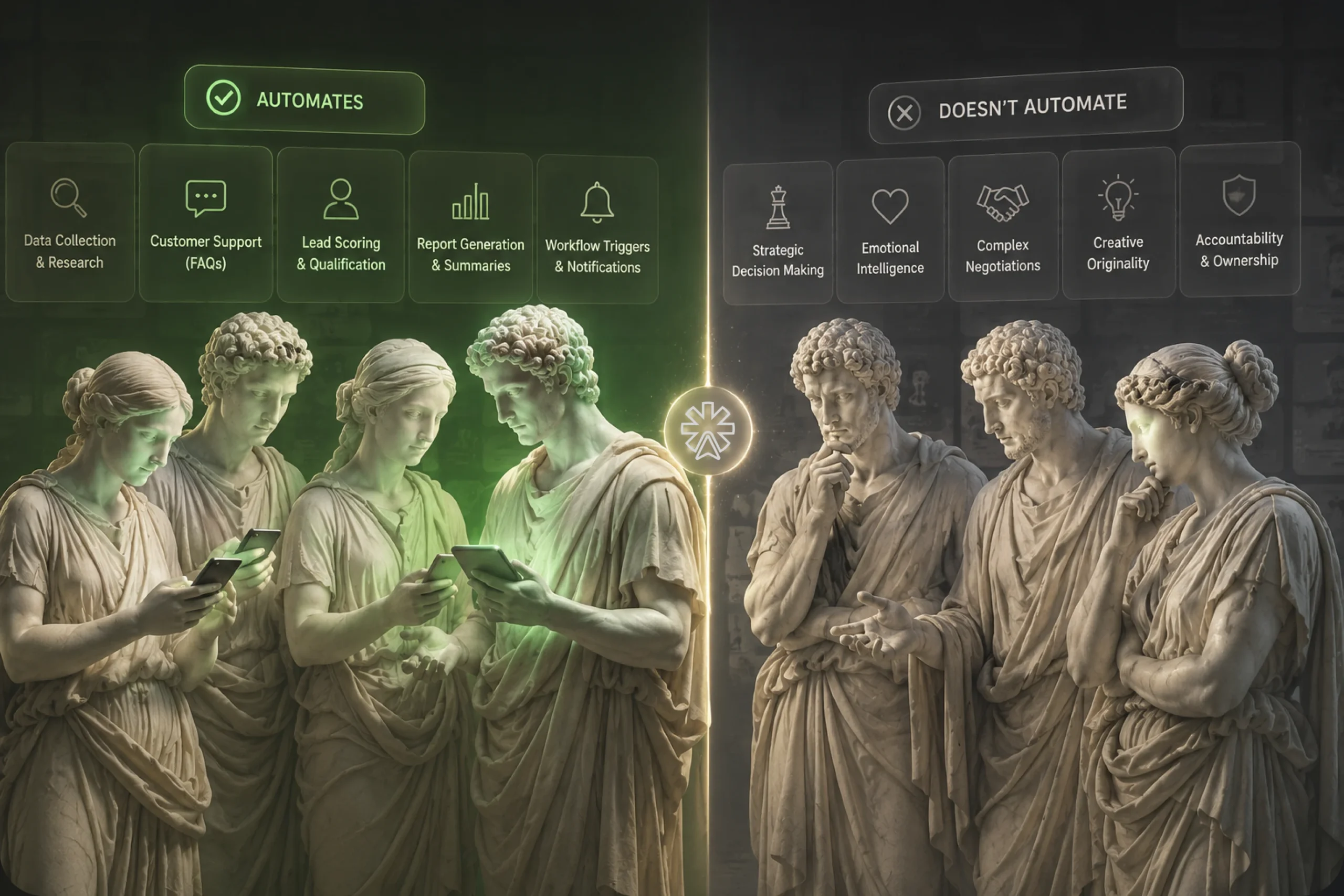
AI agents for business work best when they automate repeatable workflows, not entire roles.
A marketing manager is not replaced. The repeated campaign preparation workflow can be reduced.
An ecommerce manager is not replaced. The manual product content workflow can become faster.
A customer support lead is not replaced. Repeated first-response workflows can be handled more efficiently.
AI agents do not create better businesses on their own. Well-designed workflows do. The agent is useful when it has a clear role.
To make this easier to understand, AI agent automation can be grouped into three categories.
1. Information Work
Information work includes research, summaries, comparisons, customer feedback analysis, competitor observations, and performance notes.
For example, an ecommerce team may want to understand why a product page is not converting. A person may normally check customer reviews, competitor pages, product claims, search visibility, pricing, and past campaign performance.
An AI agent can gather and summarize that information into a structured view. It can highlight common objections, missing product details, competitor messaging patterns, repeated questions, product-page gaps, and performance signals.
The agent does not decide the final strategy. It prepares the information so the team can decide faster.
This is one of the clearest ways to replace manual tasks with AI while keeping human judgment.
2. Content Work
Content work includes product descriptions, SEO metadata, FAQs, email drafts, ad copy, social captions, landing page sections, campaign briefs, and launch copy.
This is where AI agents for ecommerce brands can save a lot of time.
When the workflow is clear, AI agents for ecommerce brands can support content production without creating disconnected outputs.
A product launch rarely needs one piece of content. It needs product page copy, collection copy, metadata, FAQs, email copy, ad variations, social posts, and sometimes AI-search-friendly content blocks.
A basic AI tool can create one output if someone prompts it. An AI agent can read the product information, understand the campaign goal, create the first content set, check for missing details, and prepare it for review.
This is especially useful for ecommerce workflow automation, where teams repeat the same launch process across SKUs.
If AI search visibility is part of the content strategy, the Complete Generative Engine Optimization Guide 2026 explains how ecommerce content can be structured for discovery across AI search engines and answer platforms.
3. Process Work
Process work includes task routing, approval reminders, content checks, missing detail alerts, reporting updates, and workflow handoffs.
This is the hidden layer where a lot of business time disappears.
A campaign may be delayed because one claim is missing. A page may stay incomplete because FAQs were not added. An email may not go live because approval is stuck. A report may take hours because data is scattered.
AI agents can flag what is missing, prepare the next task, remind the right person, and create a review queue. The agent does not own the decision. It reduces the coordination work around the decision.
For many businesses, this is where AI agents for business become more valuable than simple content generation.
Manual Workflow vs AI Agent Workflow: Where Humans Still Fit

AI agents are most useful when they support a human-in-the-loop workflow.
They should not be treated as fully independent decision-makers. The better model is simple: AI prepares, humans review, AI refines, and humans approve.
| Traditional Manual Workflow | AI Agent Workflow |
| Research manually | AI gathers and summarizes information |
| Write first draft from scratch | AI creates the first draft |
| Copy work between tools | AI moves work through the workflow |
| Check every detail manually | AI flags missing details and gaps |
| Send repeated reminders | AI triggers workflow reminders |
| Repeat the same process every time | AI automates repeatable workflow steps |
| Human does everything end to end | Human reviews, improves, and approves |
A healthy AI agent workflow looks like this:
AI creates the first draft.
The human reviews it.
AI refines the work based on feedback.
The human checks accuracy, tone, claims, and context.
The human approves before anything is published.
This gives teams speed without giving up control. For ecommerce brands, every product page, email, ad, or customer reply needs to be fast, accurate, useful, and on-brand.
Ecommerce and DTC Workflow Example
To understand how AI agents work in practice, look at a common ecommerce workflow: launching a new product.
A new product is added to the store. The AI agent reads details such as name, category, price point, materials, use cases, customer segment, and images.
Then the agent creates the first product description, generates SEO metadata, creates FAQs based on likely customer questions, drafts an email campaign, and prepares paid social ad variations.
After that, it checks whether the content has missing details, weak claims, inconsistent tone, or unclear benefits. Then it sends the full content set for human review. The human reviews, edits, approves, and publishes.
This is ecommerce workflow automation in a practical sense. The team is not handing over the brand. They are reducing the repeated execution work around every launch.
This is why AI agents for ecommerce brands are so relevant. Ecommerce teams repeat similar workflows across new products, seasonal campaigns, product refreshes, offers, landing pages, and retention campaigns.
The same logic applies to AI business automation for DTC brands.
For lean teams, AI business automation for DTC brands is most useful when it reduces the repeated steps around launches, content refreshes, and campaign follow-ups.
DTC teams need to move fast, test campaigns quickly, keep messaging consistent, and manage multiple channels with limited resources. AI agents can reduce the production burden while people focus on positioning, offers, creative direction, customer insight, and final approval.
AI agents for D2C brands are especially useful when the team has a clear workflow but not enough time to execute every step manually.
For fast-moving teams, AI agents for D2C brands can support product launches, campaign updates, and content checks without asking the team to rebuild the same process each time.
What AI Agents Don’t Automate
The biggest mistake businesses make is expecting AI agents to automate everything.
They should not.
AI agents can prepare work, organize information, create first drafts, move workflow steps forward, and flag issues. But people still need to own decisions that require judgment, responsibility, and customer understanding.
AI agents should not fully automate:
- Business strategy
- Brand positioning
- Pricing decisions
- Final approvals
- Legal or sensitive claims
- Crisis communication
- Complex customer complaints
- Customer relationships
- Creative judgment
An agent can suggest positioning, draft a sensitive reply, or flag a risky claim. But the business still decides what is accurate, compliant, and right for the customer.
This is why AI agents for D2C brands should be used inside reviewed workflows, especially when the output affects customer trust, product claims, or brand positioning.
This is the difference between automation and ownership. AI agents can reduce work around a decision, but they should not replace accountability for the decision itself.
Multiple Specialized AI Agents Need Shared Brand Context

Businesses are already moving from using one AI assistant to using multiple specialized AI agents for different workflows.
One agent may support marketing. Another may support ecommerce content. Another may support customer support. Another may support reporting. Another may support SEO and GEO visibility. Another may support creative direction.
This is stronger than expecting one generic AI assistant to do everything, but it creates a new problem: how do all these agents stay aligned?
A marketing agent should not describe the product one way while a support agent explains it differently. A product content agent should not use rejected claims. A creative agent should not ignore the brand’s tone. A GEO agent should not create search content that feels separate from the customer journey.
This is where shared brand context becomes essential.
Brand Memory helps AI agents work from the same understanding of the brand. It can include brand voice, approved claims, product positioning, customer segments, phrases to use or avoid, tone rules, past campaign direction, customer promise, and approval patterns.
Without shared memory, AI creates scattered outputs. With shared memory, AI agents can work across different workflows while staying aligned.
For a deeper explanation of this idea, you can read Why AI-Powered Brand Consistency Starts With Brand Memory.
Where ShopOS Fits In
ShopOS is built around this shift from disconnected AI prompting to connected AI agent workflows.
Instead of treating AI as a single tool for one-off outputs, ShopOS works through specialized ecommerce agents and shared brand context.
The ShopOS agents are designed around different ecommerce functions, so each agent owns a clearer part of the workflow.
For creative workflows, Monica supports campaign creative direction and content generation for ecommerce brands. For AI search and GEO visibility, Big Head helps ecommerce brands improve how they appear across AI search engines and answer platforms.
This connects directly to the way modern ecommerce teams work. Product content, creative direction, campaign planning, SEO, GEO, reporting, and store operations should not sit in disconnected tools with no shared context.
ShopOS brings these workflows closer together through agents, Brand Memory, and repeatable ecommerce execution systems. This is also where AI business automation for DTC brands becomes more practical, because the workflow, brand context, and agent output stay connected.
To understand how ShopOS organizes these specialized agents inside one operating model, read AI Platform for Ecommerce Brands: The ShopOS Squad Model.
Let Your Team Focus on the Work That Needs Them
Repetitive ecommerce workflows should not consume the time your team could spend on strategy, creative direction, customer understanding, and growth.
ShopOS uses specialized AI agents and shared Brand Memory to keep execution moving while your team stays in control.
Ready to reduce the manual work behind every campaign?
Conclusion: The Real Role of AI Agents for Business
AI agents for business are not about removing people from the process.
When used well, AI agents for business make repeated execution easier without weakening human control.
They are about replacing repeatable workflows so teams can spend more time on strategy, creativity, judgment, approvals, and customer relationships.
For ecommerce, DTC, and D2C brands, this is the real advantage.
AI agents can help with research, content creation, reporting, workflow movement, reminders, handoffs, content checks, and first drafts. They can help teams replace manual tasks with AI where the work is repetitive, structured, and easy to review.
But humans still matter at the most important points. People decide the strategy, protect the brand, understand the customer, and approve what goes live.
The businesses that get the most value from AI agents will build clear workflows, give agents the right context, keep humans in the loop, and use AI to make teams faster without making the brand weaker.
That is the real role of AI agents for business: replacing repeated workflow steps that keep people away from the work that needs them most.
Stop Spending Human Time on Repeatable Work
Your team should not be rebuilding the same product content, campaign drafts, SEO updates, approvals, and workflow checks every time.
ShopOS uses specialized AI agents and shared Brand Memory to automate repeatable ecommerce workflows while keeping strategy, judgment, and final approval with your team.
Ready to see what that workflow looks like in practice? Book a Demo
FAQs
What are AI agents for business?
AI agents for business are AI systems that understand a goal, use context, take action, and move work through a defined workflow. They help automate repeatable tasks like research, content creation, reporting, and workflow checks while people remain responsible for strategy, judgment, and final approval.
What is an AI agent in simple terms?
An AI agent is an AI system that can complete multiple workflow steps instead of responding to a single prompt. For example, it can create a product description, generate SEO metadata, draft FAQs, and prepare the work for human review before publication.
How do AI agents help ecommerce brands?
AI agents for ecommerce brands automate repetitive work such as product descriptions, SEO metadata, FAQs, campaign drafts, customer support responses, and reporting. This helps ecommerce teams move faster while keeping humans in control of brand voice, accuracy, and final approval.
Can AI agents replace manual tasks with AI completely?
AI agents can replace manual tasks with AI when the work is repetitive, structured, and easy to review. However, businesses should keep humans responsible for strategy, pricing, legal decisions, creative direction, sensitive customer conversations, and final approvals.
What is ecommerce workflow automation?
Ecommerce workflow automation is the process of reducing repetitive manual work across ecommerce operations. AI agents can automate tasks such as product content creation, SEO metadata, approval reminders, reporting, and workflow checks while adapting to changing product and customer information.