
- What Is Lifestyle Product Photography?
- Why Ecommerce Brands Need Product Lifestyle Photos
- Lifestyle Product Photography With Models Builds Buyer Confidence
- The Problem With a Traditional Lifestyle Product Shoot
- Why Brands Need More Lifestyle Photos for Products
- How AI Changes Lifestyle Product Photography
- Where Monica Fits In
- How Monica Helps Create More Creative Variants
- How Lifestyle Product Photography Supports Search Visibility
- Final Thoughts
- FAQs
Most ecommerce brands already have product photos.
They have pack shots, catalogue images, white-background photos, and close-ups. These images show what the product looks like. But they do not always show how the product fits into a customer’s life.
That is where lifestyle product photography becomes important.
A skincare product feels more useful on a bathroom shelf. A snack pack feels more real when someone opens it during a work break. A handbag becomes easier to understand when a model carries it with an outfit.
Lifestyle product photography helps shoppers imagine the product in use. Customers are not only buying the product. They are buying the moment, use case, feeling, style, and outcome attached to it.
The challenge is that ecommerce brands no longer need one lifestyle image. They need many lifestyle photos for products across ads, product pages, social media, email, marketplaces, and launches.
Modern ecommerce teams need more creative variants, faster.
What Is Lifestyle Product Photography?
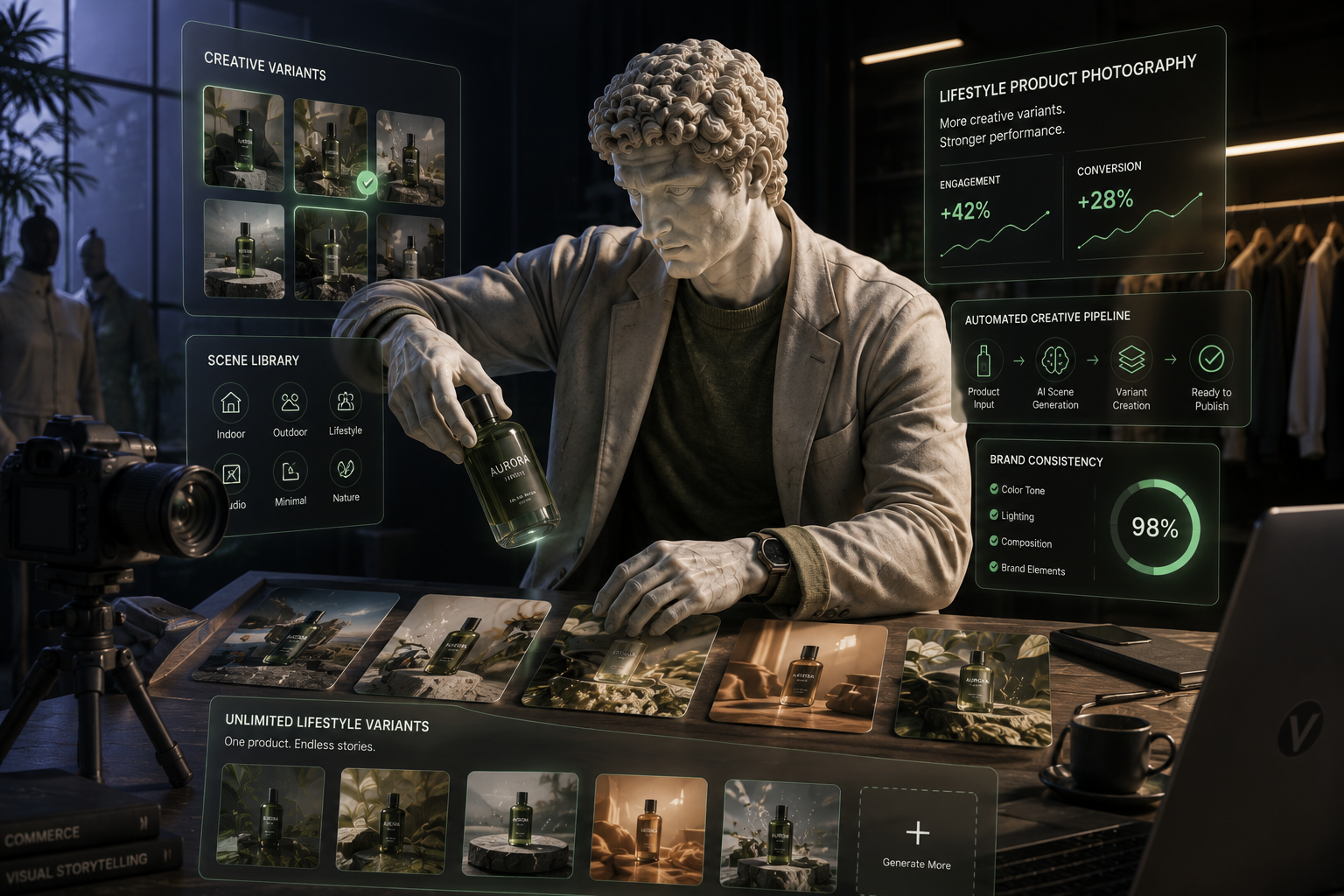
Lifestyle product photography is product photography that shows a product in a real or realistic setting.
Instead of showing the product alone on a plain background, it shows how the product is used, worn, consumed, styled, gifted, stored, or experienced.
A plain product photo may show a coffee mug on a white background. A lifestyle product photo may show the same mug on a morning table with coffee, sunlight, and someone’s hand reaching for it.
Studio product photos help shoppers see the product clearly. Product lifestyle photos help shoppers understand the product emotionally and practically.
A product page may need clean images for clarity. An ad may need a lifestyle image to stop the scroll. A social post may need a scene that feels natural. An email campaign may need a visual that connects the product with a season, routine, or offer.
Good lifestyle product photography makes the product easier to imagine, trust, and buy.
Why Ecommerce Brands Need Product Lifestyle Photos
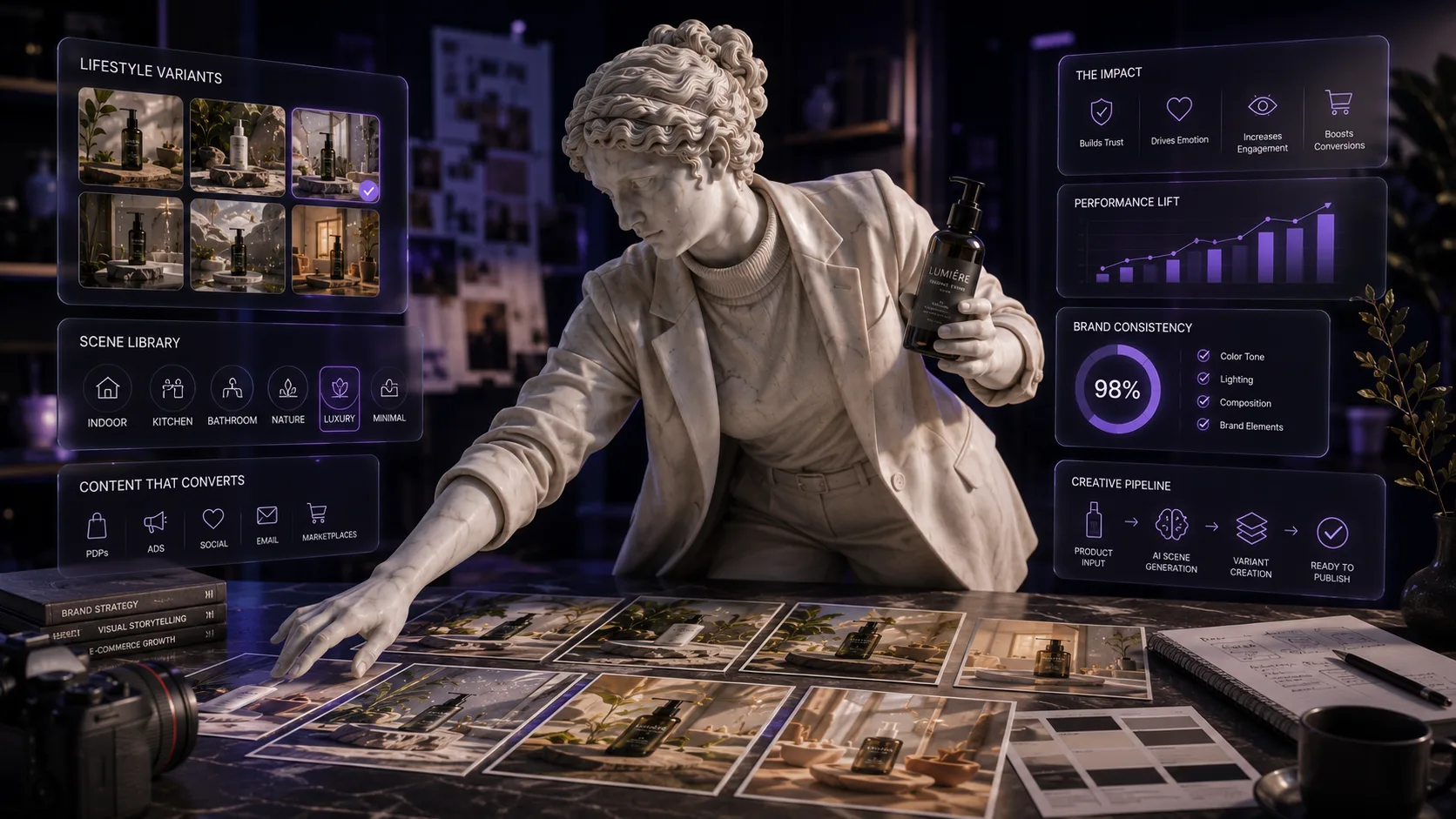
Product lifestyle photos answer questions that plain product images cannot.
How big is the product in real life? Who is it for? How does it look when used? What situation does it belong in? Does it feel premium, practical, playful, natural, modern, festive, or everyday?
These answers matter because ecommerce shoppers cannot touch, test, smell, taste, or try the product before buying.
For fashion brands, lifestyle product photography can show fit, movement, styling, and body context. For beauty brands, it can show routine, texture, shelf appeal, and ingredient-led moments. For food brands, it can show serving ideas, freshness, appetite, and consumption occasions. For home brands, it can show scale, room context, and styling possibilities.
Each angle needs a different visual. That is where ecommerce content teams usually struggle. The product is the same, but the creative need keeps changing.
This is also why many brands are moving toward structured ecommerce content automation, where product data, brand voice, campaign direction, and creative output stay connected instead of being handled as separate tasks.
Lifestyle Product Photography With Models Builds Buyer Confidence
Lifestyle product photography with models is useful when the product needs human context.
Models help shoppers understand scale, fit, usage, movement, and emotion. A dress looks more real when worn. A backpack feels more practical when carried. A lipstick feels more desirable when shown on a face. A wellness product feels more relatable when shown inside a daily routine.
Model-led visuals also help customers see themselves using the product.
This is important for fashion, beauty, accessories, wellness, food, lifestyle, and personal care brands. The model does not always need to be the main focus. Sometimes a hand, face, shoulder, table moment, or natural action is enough to make the product feel alive.
But creating lifestyle product photography with models can be difficult.
Traditional shoots need planning, locations, styling, lighting, photographer time, model coordination, approvals, and reshoots. Brands know model-led lifestyle visuals work, but they cannot always produce enough variants at the speed campaigns demand.
The Problem With a Traditional Lifestyle Product Shoot
A lifestyle product shoot can create beautiful content. It can give the brand polished images, original scenes, and strong campaign assets.
But it also has limits.
A traditional lifestyle product shoot takes time. Teams need to plan concepts, book models, arrange locations, source props, prepare products, manage the shoot, review images, request edits, and resize assets.
It also creates a fixed set of outputs.
Once the shoot is done, the team has what was captured. If the brand later needs a different background, model type, campaign mood, format, or seasonal angle, it may need another shoot or heavy editing.
This becomes a problem because creative demand never stops.
Paid ads need fresh hooks. Product pages need stronger visuals. Social teams need new content every week. Email needs campaign-specific banners. Launches need multiple visual directions.
A single shoot cannot always support all of this. That is why brands are moving from one-off shoots to repeatable creative workflows.
Why Brands Need More Lifestyle Photos for Products
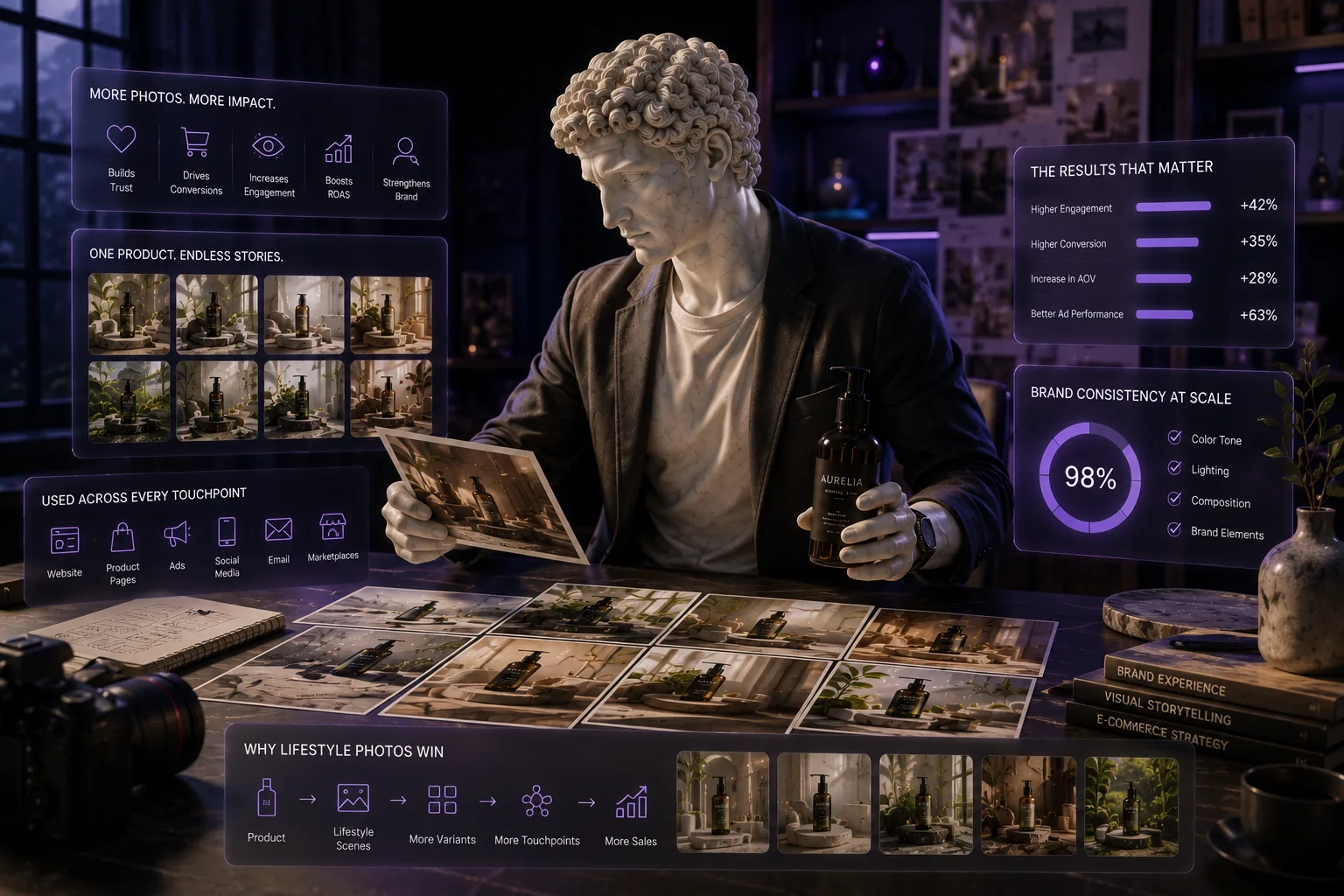
Ecommerce brands need more lifestyle photos for products because shoppers see the same product in different places before buying.
The ad needs attention. The product page needs clarity. The email needs relevance. The social post needs emotion. The launch campaign needs consistency. The retargeting creative needs a fresh reason to come back.
One lifestyle image cannot do all of this.
A strong ecommerce brand may need a model-led image for ads, a routine-based image for product pages, a close lifestyle crop for email, a seasonal version for campaigns, a social-first version for engagement, and a premium version for brand storytelling.
This is where brand lifestyle photography becomes more than a visual style. For ecommerce teams, it is about creating product images that carry the same brand mood, audience context, and campaign message across every channel. The product may appear in different scenes, but the brand should still feel familiar everywhere.
That is also why brand consistency matters. When every channel uses a different visual language, the brand starts to feel scattered. For teams trying to avoid that, AI-powered brand consistency becomes important because every new creative should still feel like it belongs to the same brand.
How AI Changes Lifestyle Product Photography
AI is changing how ecommerce brands create product visuals.
Earlier, brands depended heavily on traditional shoots for every lifestyle image. Now, AI can help create product scenes, model-led visuals, background variants, campaign angles, and channel-specific content faster.
But AI alone is not enough.
A random AI image can look good and still be wrong for the brand. It may not match the product positioning. It may use the wrong setting. It may feel off-brand. It may create a scene that looks attractive but does not support the campaign goal.
This is why ecommerce brands need creative direction before generation.
Before creating lifestyle product photography with AI, teams need to know who the visual is for, where it will be used, what buyer moment it should support, and which product benefit it should highlight.
AI can help with speed. Creative direction helps with relevance.
Where Monica Fits In
Monica by ShopOS fits into this workflow as an AI Creative Director for ecommerce brands.
Monica is not just another AI image generator. That difference matters.
A basic generator may help create one lifestyle product image from a prompt. Monica helps ecommerce teams think through the creative direction behind the image.
For brands working on lifestyle product photography, Monica can help turn one product image into multiple creative variants for different audiences, models, scenes, campaigns, and channels.
Monica helps brands create lifestyle product photography variants connected to real content needs, not random prompt experiments.
- With Brand Memory, Monica can understand the brand’s visual direction, audience, tone, product story, past decisions, and brand lifestyle photography style.
- With Spaces, teams can organize creative work around launches, campaigns, ads, product pages, or social content.
- With Refine, outputs can be improved before they are used in live campaigns.
The brand is not starting from zero every time. Monica brings context into the creative process.
How Monica Helps Create More Creative Variants
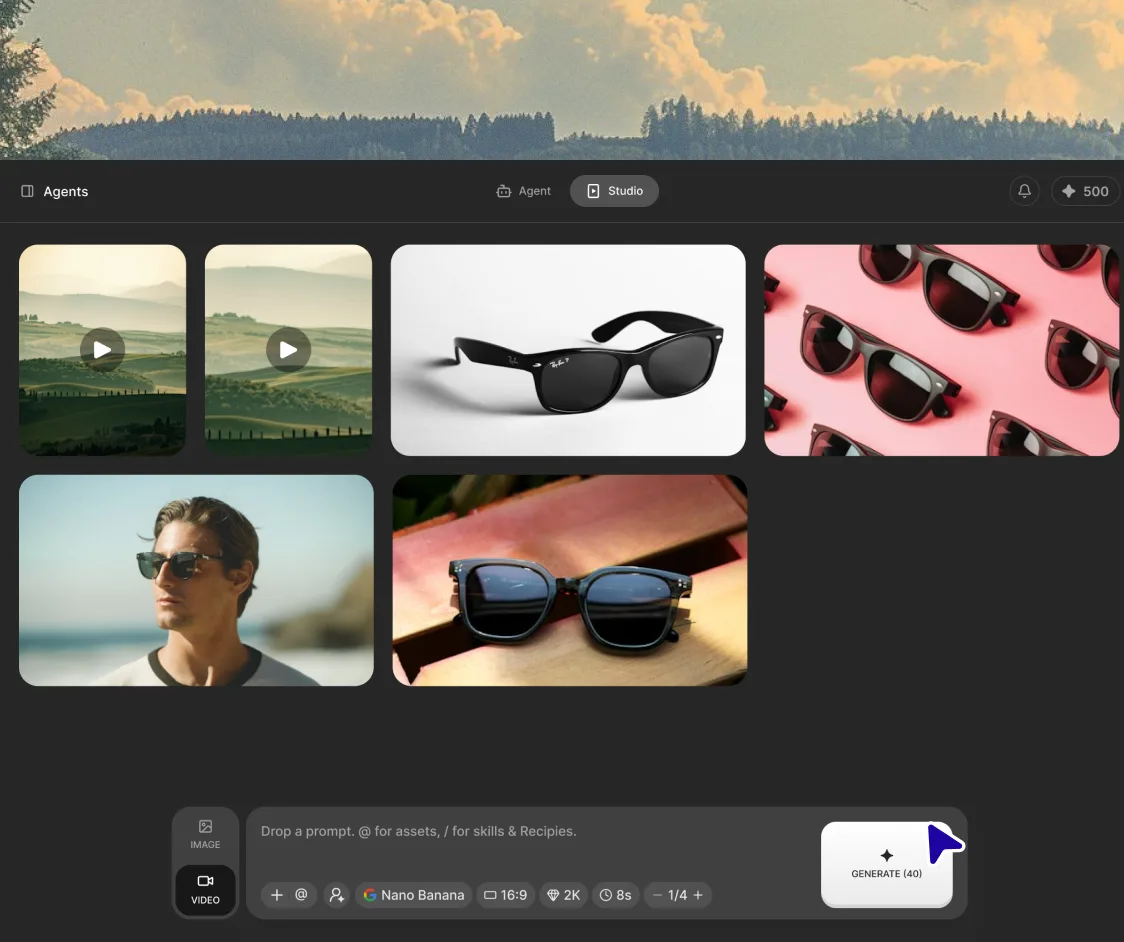
The biggest value of Monica is not only speed. It is structured creative output.
Campaign variants help teams test different angles for the same product, such as daily essential, premium gifts, travel companion, festive offer, or problem-solution product.
Model variants help brands create lifestyle product photography with models for different customer profiles, use cases, and styling directions.
Scene variants help brands place the product in settings such as kitchens, bathrooms, bedrooms, work desks, gym bags, shelves, outdoor moments, or travel setups.
Channel variants help teams adapt product lifestyle photos for ads, PDPs, social media, email, banners, and launch assets.
Seasonal variants help brands create campaign-ready visuals for festivals, sales, summer, winter, gifting, back-to-work, or new collection drops.
This is where ShopOS works better as a connected system than a single creative tool. The ShopOS Squad Model connects agents, features, memory, and human review so ecommerce teams can move from idea to execution without rebuilding the workflow every time.
Turn One Product Image Into a Full Creative Campaign
Monica helps ecommerce teams create lifestyle visuals, model variants, campaign scenes, and channel-specific creatives without starting from scratch every time.
Bring your product, brand context, and campaign idea. Monica helps turn them into creative direction your team can actually use.
Book a Demo to See Monica in Action
How Lifestyle Product Photography Supports Search Visibility
Lifestyle product photography works best when it is connected to clear product content.
Strong product visuals can support better product pages, useful image alt text, richer product storytelling, and clearer buyer answers.
When product images, descriptions, FAQs, and campaign messages stay consistent, search engines and AI answer engines can understand the product use case more clearly.
This is where Monica supports the creative layer, while Big Head supports SEO and GEO visibility for ecommerce brands.
Final Thoughts
Lifestyle product photography is no longer just a nice-to-have for ecommerce brands.
It helps shoppers understand how a product fits into real life. It builds trust. It adds emotion. It supports product pages, ads, social media, email, and campaigns.
But the old way of depending on one lifestyle product shoot for every creative need is becoming too slow for modern ecommerce teams.
Brands now need more variants, more angles, more channel-specific visuals, and more ways to show the same product in different buyer moments.
That is where Monica by ShopOS fits naturally.
Monica helps ecommerce brands move from one product image to multiple lifestyle product photography variants with stronger creative direction. It helps teams plan the angle, create the visual, refine the output, and organize content around real ecommerce goals.
For brands that need lifestyle product photography at campaign speed, Monica turns product visuals into a repeatable creative workflow.
Explore Monica by ShopOS to see how an AI Creative Director can help your ecommerce team create better product creatives, faster.
FAQs
What is lifestyle product photography?
Lifestyle product photography shows a product in a realistic setting, use case, or customer moment. It helps shoppers understand how the product looks, feels, and fits into everyday life.
Why is lifestyle product photography important for ecommerce brands?
Lifestyle product photography helps ecommerce brands build trust, explain product use, show scale, create emotion, and improve campaign storytelling.
What is lifestyle product photography with models?
Lifestyle product photography with models shows products being worn, used, held, applied, carried, or experienced by people.
How many product lifestyle photos does a brand need?
There is no fixed number. Ecommerce brands usually need different product lifestyle photos for product pages, ads, social media, email, launches, seasonal campaigns, and retargeting.
How does Monica help with lifestyle product photography?
Monica helps ecommerce brands create lifestyle product photography variants from product images. It supports creative direction, model-led visuals, campaign angles, channel-specific variants, and brand-consistent product content.